Table of Contents
Summary
- Dominating the Local Map Pack through an optimized Google Business Profile is the fastest way to gain trust and visibility.
- Educational content, like coverage guides and location-specific pages, builds long-term equity by answering client fears and shortening the sales cycle.
- Success lies in targeting long-tail, high-intent keywords (e.g., “General Liability for Florida Contractors”) that attract users ready to purchase.
- A fast, mobile-friendly site powered by local backlinks provides the technical foundation needed to outrank competitors.
Why Insurance Brokers Can’t Ignore SEO Anymore?
People don’t flip through Yellow Pages. They don’t ask their neighbors like they used to. They open Google. They type “insurance broker near me.” If your name isn’t there, you are invisible. It is that simple. SEO for insurance brokers is about inserting yourself into that digital conversation before your competitor does. The insurance buyer is cautious. They are skeptical. They need to trust you. Showing up on page one is the first step of that trust.
Most brokers think advertising is the answer. You throw money at a billboard or a radio spot. It works until you are paying. Then it vanishes once you stop. SEO for insurance brokers is different. It is an asset. It builds equity. With a right and efficient SEO strategy, you can rank for “best insurance brokers” or “insurance agent near me” terms and will stay above your competitors. The work compounds. That is the long game you need to play.
Local SEO: Owning Your Geographic Territory

Local SEO helps businesses dominate nearby searches, attract targeted customers, and build strong community visibility through optimized listings, location-based keywords, and consistent online presence.
Google Business Profile: Your Digital Storefront
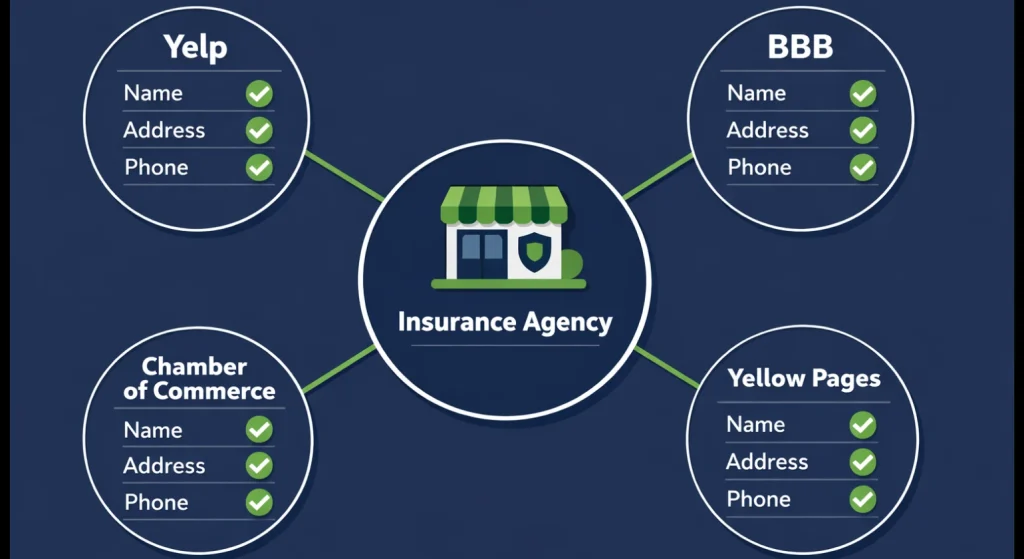
You must claim it. You have to verify it. But that is just the beginning. You need to put real photos, not stock images. Show your team. Show your office. Show you at a local charity event. Use the exact NAP (Name, Address, Phone) everywhere. If it is wrong on one site, you confuse Google. You lose the map pack.
Most agents set up their profile once and forget it. Then they wonder why they disappeared. Google loves freshness. Post updates. Offer a tip about winter driving. Wish the community a happy holiday. These small signals tell Google you are alive. You are relevant.
Local Citations and Consistency
You need to be listed everywhere. Yelp, BBB, Chamber of Commerce, Yellow Pages. Every single listing must match. Same address. Same phone number. This consistency builds a web of trust. It confirms to the algorithm that you are a real, established business. Since maintaining these listings is tedious, many brokers use a virtual assistant to manage the data entry and ensure total accuracy across the web.
The Power of Local Reviews
Do not buy fake reviews. Google will catch you. It will punish you. Instead, ask every happy client. Send them a link. Make it easy. Reply to every review, good or bad. When you reply to a bad review professionally, it shows you care. It shows you are human. AI models are scanning these reviews now. They summarize sentiment. A flood of positive sentiment makes you look like the go-to expert.
Content Marketing for Trust and Traffic

You know insurance. You eat, sleep, and breathe deductibles and liability limits. Your client knows nothing. They are scared. They are confused. Your job is to educate them before they even pick up the phone. That is what content does. It pre-sells you.
Coverage Guides That Answer Real Questions
Do not write “Welcome to our agency” blog posts. Nobody cares. Write “What does general liability actually cover?” Write “Is flood insurance separate from homeowners?” Write the guides that answer the hard questions. When a client reads your guide, they think, “This agent gets it.” They trust you before they meet you. That shortens the sales cycle drastically. When writing these, referencing data from the Insurance Information Institute can also add a layer of authority that helps skeptics trust your advice.
Location-Specific Service Pages
If you serve five towns, you need five pages. Not one page mentioning all five. Separate pages. “Homeowners Insurance in Arlington.” “Auto Insurance in McLean.” Each page needs local flavor. Mention the main streets. Mention the local risks. This is hyper-local targeting. It is how you dominate the “insurance agency marketing strategy” for each specific area.
Agents worry they aren’t writers. They don’t have time. You don’t have to be Shakespeare. You just have to be accurate. Use bullet points. Use simple language. Break down the complicated jargon. You can even record yourself talking and have it transcribed. The value is in your knowledge, not your prose.
Keyword Strategy: Finding the Right Terms
You cannot just guess what people type. You need data. You need to know that “insurance broker seo” gets searched 390 times a month, but “seo for insurance agents” gets 720. That data shapes your strategy. It tells you where to focus.
Avoiding the Short-Tail Trap
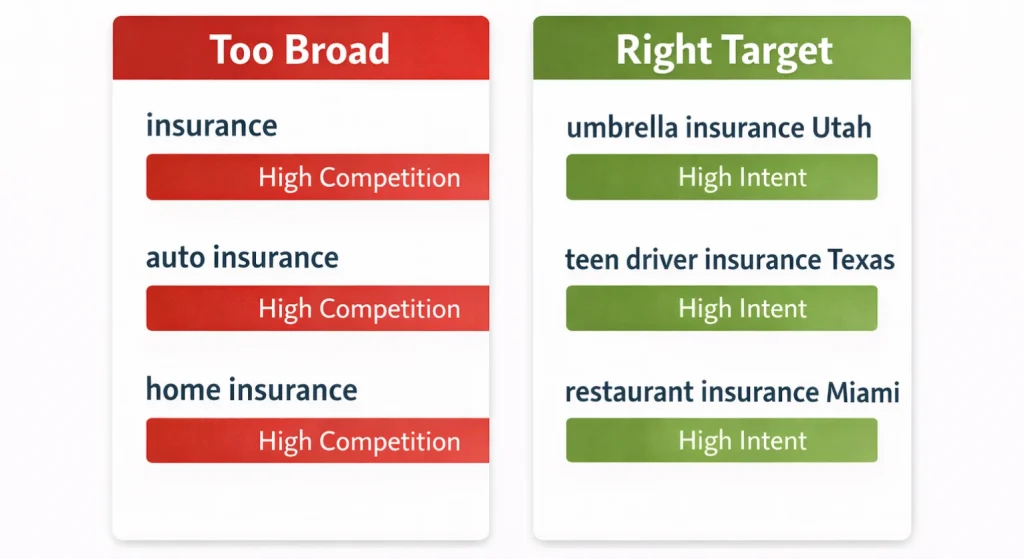
Ranking for “insurance” is impossible. It is too broad. It has too much competition from national giants. You need to be specific. “Umbrella insurance Utah.” “Small business insurance for Miami restaurants.” These are winnable battles. These attract the right people. People who are actually looking for what you sell.
Blogging for the Long Tail
Keywords like “SEO for insurance companies” are broad. You need them. But you also need the long tail. “How much does it cost to insure a teen driver in Texas?” That is specific. That person is closer to buying. They are doing research before the quote. Answer that question. Capture that traffic. It might be lower volume, but it is higher intent.
Matching Intent with Content
Someone searching “what is commercial umbrella insurance” is different from someone searching “get commercial umbrella insurance quote.” The first person needs education. Give them a blog post. The second person needs a transaction. Give them a quote form. Match the keyword intent to the page type. If you send a transactional searcher to a blog, they leave. You lost them. So, it is advised to take the help of a content specialist for the starting phase of SEO content marketing for insurance websites, as this step helps agents to ideate, write, and publish the right content.
Link Building and Authority
Google ranks pages based on votes. Those votes are links. When another website links to you, it says you matter. For insurance brokers, this is tough. Nobody links to agents naturally. You have to earn it.
Community and Sponsorships
Sponsor the little league team. Sponsor the charity 5k. Often, those organizations have a sponsors page. They link to your site. That is a local backlink. It is gold. It shows community involvement and builds your link profile.
Partnerships and Testimonials
Do you work with a real estate agent? Do you refer clients to each other? Ask them for a link on their site. Write a testimonial for a software vendor you use. They usually publish it with a link back to you. These niche, relevant links are powerful. They come from real business relationships. They are hard for competitors to copy.
Technical SEO and User Experience

Your site has to work. It has to load fast. If it takes three seconds to load on a phone, the user leaves. Google notices. It drops your rank. You need mobile optimization. You need secure HTTPS. These are not optional luxuries. They are the entry ticket.
Schema Markup
This is code you put on your site. It helps search engines understand you. You can tell Google your business hours, your services, and reviews. It creates rich snippets in the search results. Those snippets stand out. They get more clicks. For local insurance brokers, local business schema is a must. It tells Google exactly where you operate. By using the standards set by Schema.org, you can easily create “rich snippets” in search results that stand out and get more clicks than just normal text links.
Site Structure
Make it easy to navigate. Auto insurance should be in one place. Home insurance in another. The contact page is obvious. If users get lost, they leave. If search engine crawlers get lost, they don’t index your pages. Simple menus. Clear headings. That is all it takes.
Conclusion
SEO for insurance brokers isn’t about “gaming the system” or chasing vanity rankings; it’s about building a digital asset that works even when you’re off the clock. In an industry built entirely on trust, appearing at the top of a Google search is the modern-day equivalent of a firm handshake and a referral from a neighbor.
While the “quick wins” come from a polished Google Business Profile, the long-term dominance comes from being the most helpful resource in your specific territory. Whether you are answering a frantic question about flood coverage or optimizing your site speed, every technical and creative effort you put in today builds equity for your agency tomorrow. SEO is a marathon, but for those who stay the course, the prize is a consistent, predictable stream of high-intent leads that your competitors—stuck on the “pay-per-click” treadmill—will never catch.
Stop being the best-kept secret in your city. Start optimizing, start writing, and start claiming the digital territory your agency deserves.
FAQs
1. Why is a Google Business Profile more important than a fancy website for brokers?
Your profile is the “digital storefront” that triggers the Local Map Pack, where 40% of insurance searches land. While a website converts, the profile ensures you’re visible in local “near me” queries, directly driving high-value phone calls and immediate trust.
2. What are "long-tail keywords" and why should I prioritize them?
Long-tail keywords are specific phrases like “contractor liability insurance in Austin” rather than just “insurance.” These terms have lower competition and much higher intent, meaning the searcher is usually ready to buy, which leads to significantly higher conversion rates for your agency.
3. How does consistent NAP information impact a broker’s local search ranking?
NAP stands for Name, Address, and Phone number. If this data varies across directories like Yelp or the BBB, Google’s algorithm becomes skeptical of your legitimacy. Consistent listings build a “web of trust,” proving to search engines that you are an established business.
4. Can content marketing really replace traditional insurance advertising?
Advertising stops working the moment you stop paying, but SEO content is a compounding asset. By answering client questions through detailed guides, you build long-term authority and trust, which generates leads organically and builds business equity without a recurring ad spend.
5. Why do phone calls from search results generate more revenue than web forms?
Search-driven phone calls convert 30% faster because they represent immediate, high-intent interest. These callers are typically further along in the decision-making process, often resulting in 10-15x more revenue compared to passive web leads that require extensive follow-up to close.