Table of Contents
Summary
Direct booking websites help hosts avoid high OTA commissions while maintaining full control over guest relationships and branding.
Specialist platforms like Lodgify and Hostaway provide seamless calendar sync and integrated booking engines for efficient property management.
Owning a website with improved SEO serves as a central hub for social media, email, and paid advertising campaigns.
Start with simple templates to validate demand before investing in a custom website for advanced branding and portfolio scalability.
Why does your vacation rental need a website?
Relying only on Airbnb or Booking.com feels safe until commission, cancellations, and policy changes start eating the profit. Those platforms also own the guest relationship, email, and data, not you.
According to hospitality industry reports, the shift toward direct-to-consumer models is accelerating as hosts look to protect their margins from rising platform fees. A direct booking website gives control over branding, policies, pricing rules, and upsells while avoiding 15 to 20% OTA (Online Travel Agencies) commissions on every stay. Over a year, that difference can fund your entire marketing and tech stack.
For example, platforms like OwnerRez and Guesty sync direct reservations with OTA calendars, so one booking blocks dates everywhere and prevents double bookings. This way, you get the same operational safety net as OTAs, without their fees on direct stays.
From a vacation rental marketing point of view, your own site lets you run email, retargeting ads, and social campaigns that always send people to a page you control. That is almost impossible if your only “website” is your Airbnb listing.
Here is the first conflict. Many hosts invest in social and short-term rental marketing yet send all traffic back to OTAs. Clicks go up, saves go up, but direct bookings stay flat, and lifetime value barely moves. Though for engagements to conversions, you can always make use of professional social media management services, but you need to have a website as a priority that can ensure followers are directed to your booking engine rather than a third-party app.
The point is to channel every campaign into a proper site, whether built with a vacation rental website builder or by preferred developers, and then track bookings, not likes. That is how SEO, email, and paid traffic actually become profit rather than free traffic for OTAs.
Vacation rental SEO should also be done on your own site, as those OTAs have been running for a number of years and have the best SEO in place. To bail out of such a situation, there are tools like Smoobu and Guesty that explicitly provide SEO features and content tools because search traffic converts into direct bookings when you own the website, not just a listing.
Top 8 Best-in-Class Website Builders
1. Lodgify
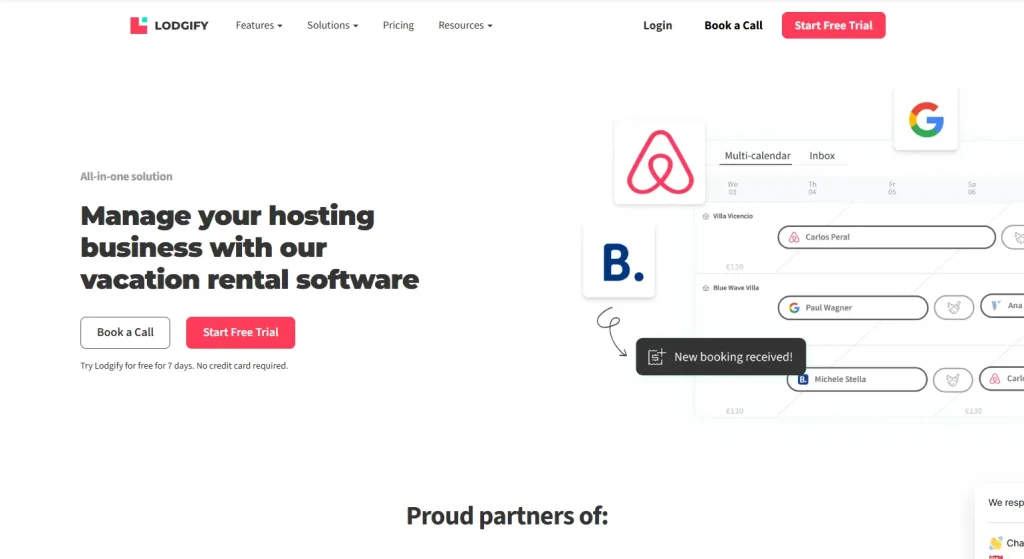
Lodgify gives you niche vacation rental templates with a built in booking engine and CMS, so you can launch without coding. Templates are fully customizable and pull in property descriptions, amenities, and photos from your rental settings automatically.
You can add custom content sections, HTML blocks, and extra pages for things like local activities or owner stories, which helps both conversion and vacation rental SEO. Channel manager connections keep calendars unified across Airbnb, Vrbo, and your own site.
2. OwnerRez Hosted Websites

OwnerRez offers hosted websites as a premium add on inside its PMS, so your site runs on the same platform as reservations and rates. Property information, photos, pricing, and rules flow straight into the website with no manual copying.
There is no commission on direct bookings, just transparent software fees, which is unusual compared with many vacation rental platforms. A separate Direct Booking Tools integration can show guests a real time price comparison versus OTAs directly on each property page.
3. Smoobu Website Builder

Smoobu’s website builder is part of a stack built specifically for short term rentals, not generic small business sites. It connects tightly with the channel manager, guest communication tools, and a dedicated guest area.
Their own SEO for vacation rentals guide literally makes “Use Smoobu’s web page builder” the fifth step in the strategy, tying content, calendar widgets, and payments into one site. You can embed the booking system, availability calendars, and online payments without extra plugins.
4. Hostaway Direct Booking Website Builder

Hostaway’s Direct Booking Website Builder lets you create a mobile friendly, SEO optimized website in minutes, with templates tuned for vacation rentals. The builder lives in the Hostaway dashboard, which means reservations from the site are instantly reflected in your central calendar.
The website builder itself is free for users, and you only pay a processing fee per direct reservation, plus a guest side markup. Features include multi language support, custom branding, promo codes, upsells, analytics, and even Google Vacation Rentals integration.
5. Guesty Websites

Guesty’s vacation rental website builder comes with an embedded booking engine that syncs availability, rates, and rules with your Guesty account in real time. It supports multiple currencies, around 30 languages, and imports OTA reviews to build trust.
They also layer AI tools on top of your listings to optimize content, SEO, and accessibility, which is rare in this niche. You can connect an existing site to the booking engine or have Guesty’s team build everything end to end.
6. Uplisting Direct Booking Website
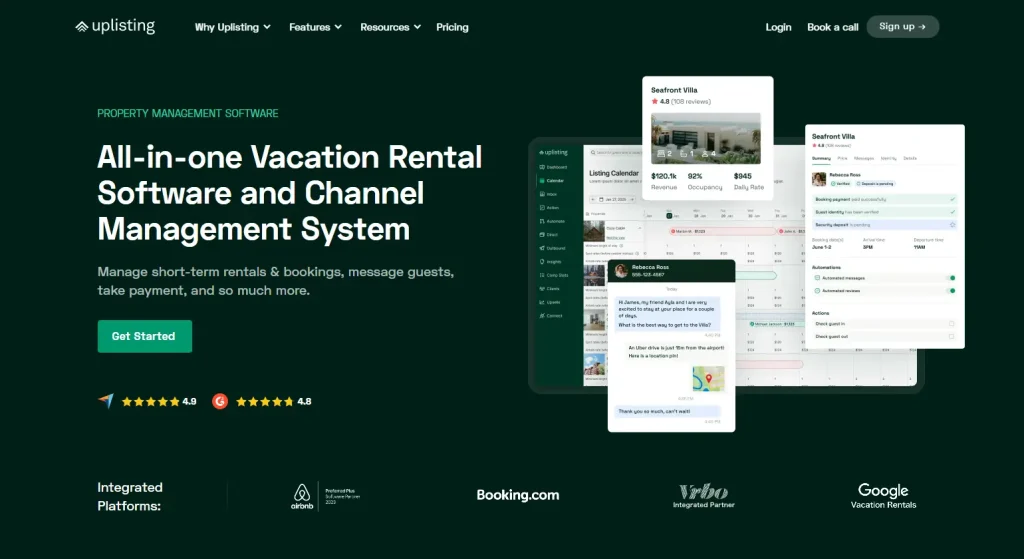
Uplisting’s direct booking website automatically imports your Airbnb listings, photos, descriptions, and prices once you connect your account. It keeps everything in sync across platforms and generates landing pages for each property on desktop and mobile.
Stripe integration supports secure payments plus payment plans, like 10% at booking and the rest before check in, which can lift conversion for higher priced stays. Their own documentation is honest that the builder is weaker for SEO, which matters if organic traffic is your main channel.
7. Wix with a PMS integration

Wix itself is a general website builder, but vacation rental oriented tools and platforms frequently connect to it with booking widgets. Hostaway, for example, supports embedding search, calendar, and payment widgets on Wix and Squarespace sites, then syncing bookings back into its PMS.
This path is useful if you want more visual control or already have a Wix brand site, but still need a vacation rental booking engine, calendar sync, and direct payments. It turns a generic website into a functional direct booking channel.
8. WordPress site powered by your PMS
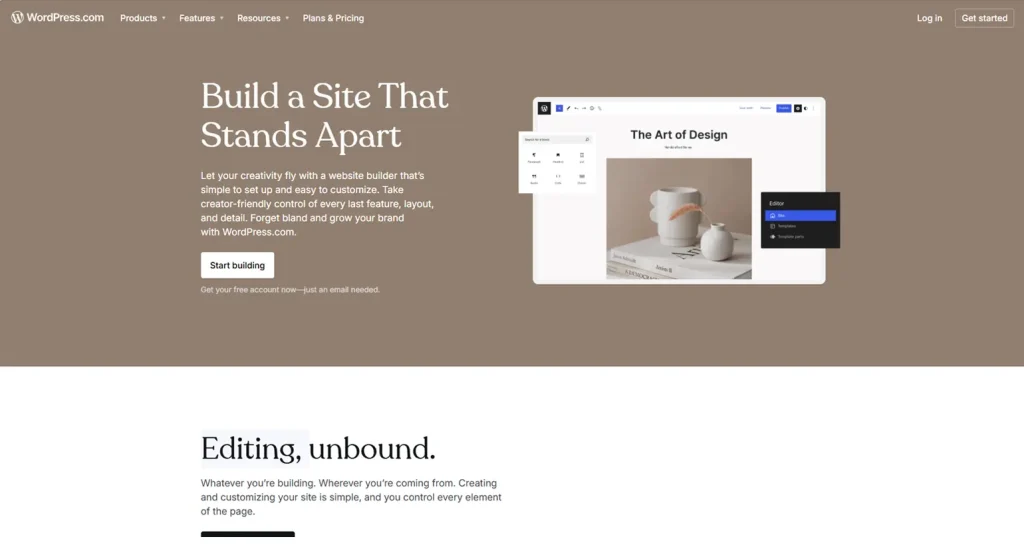
Some property managers prefer a WordPress site that they fully own, then plug in PMS features through integrations. Hostaway can connect to WordPress with widgets, while Uplisting recommends designers like Boostly to build a WordPress site that syncs content, images, amenities, prices, and availability automatically.
This blend gives maximum control over vacation rental website design, content structure, and blog SEO while still pulling live data from your PMS. It sits between pure template based website builders and fully custom development.
Here is another conflict. Many owners choose the “prettiest” template, then realize six months later that the booking flow, speed, and SEO structure are holding them back. The site looks great, yet conversion, rankings, and direct revenue lag badly.
The solution is to judge any vacation rental website builder on the boring parts first: booking engine, calendar sync, payment options, SEO tools, and mobile performance; only then play with fonts, colors, and imagery.
Custom Vacation Rental Web Design With a Developer
A custom site becomes useful once you know your brand story, guest avatar, and booking funnel, and your templates start to feel limiting. At that point, a web development company can design layouts tailored to your photos, reviews, and local positioning.
The crucial detail is integration. The custom front end should still embed a booking engine from platforms like Guesty, Hostaway, OwnerRez, or Uplisting so rates, rules, and availability stay synced. Pure brochure sites without true booking logic quietly bleed money.
Some agencies, such as Boostly in the Uplisting ecosystem, specialize in WordPress builds that are powered entirely by the PMS via API or widgets. That means your team still manages everything in the PMS, while the front end is designed for brand and conversion.
From a vacation rental SEO angle, a custom build lets you create deep location pages, content hubs, and schema markup that many SaaS builders do not expose. This is where serious vacation rental marketing campaigns, including content and link building, often end up.
The tradeoff is cost and time. You add development budget, maintenance responsibility, and communication overhead, so it only makes sense once the property or portfolio is already generating reliable direct booking revenue.
Conclusion
If you are just starting, pick a specialist vacation rental website builder from this list, wire in payments, and get a clean booking flow live. That alone will change how your short term rental marketing performs.
As bookings ramp up, invest in specialized SEO services to ensure your site stays at the top of search results for your local area. When you start running into limits around design and content structure, move gradually toward a WordPress or fully custom build integrated with your PMS.
Having said that, there are a lot of issues for a travel or rental company to focus upon, and in that regard, we have listed a few blogs that would be helpful in understanding the nuances and strategies for running an excellent company.
In case you are interested to Read More? Check Out >>> Best Travel SEO Services to Grow Your Travel Brand
You can also Read >>> The Advantages of Creating a Custom Travel Booking System for Your Business
FAQs
1. Can I build a vacation rental website myself?
Absolutely! You do not need to be a developer. User-friendly tools like Lodgify, Smoobu, Hostaway, Guesty, OwnerRez, and Uplisting are specifically designed to help non-technical hosts launch professional, direct-booking websites quickly and effortlessly.
2. Which builder is best for a single property?
For a single property, platforms like Guesty Lite, Smoobu, and Uplisting are excellent choices. They offer simple setups, intuitive dashboards, and low overhead costs, making them perfectly tailored for hosts managing just one to three listings.
3. How does a website help vacation rental SEO?
A dedicated website lets you target specific local keywords, publish neighborhood guides, and structure pages for search engines. Using builders that allow you to customize titles, metadata, and content areas makes ranking on Google much more practical.
4. Is a custom website better than templates?
Custom websites excel for complex branding, heavy content, and advanced SEO, but they are significantly slower and more expensive to launch. Most hosts should validate their demand using a template builder before investing in full custom development.
5. How does this fit into vacation rental marketing overall?
Your custom website becomes the central hub of your entire marketing strategy. All your social media efforts, email newsletters, paid ads, and referral campaigns will directly funnel guests into a seamless, commission-free booking experience that you entirely control.