Table of Contents
Key Takeaways
- Seo Evolution is the shift in SEO strategy from manipulative keyword-based approaches to sophisticated intent-based discovery using machine learning and value-based approaches.
- Historical Context: seo’s history has been the journey towards a meritocracy of authority, starting with the shift from directories and Archie to Google’s PageRank.
- Algorithmic Maturity: Major updates like Panda, Penguin, and BERT redirected focus toward E-E-A-T (Experience, Expertise, Authoritativeness, Trustworthiness) and semantic relevance.
- AI-Powered Future: The rise of generative ai and seo evolution prioritizes zero-click visibility and information gain, requiring brands to provide original, non-generic insights.
- Strategic Adaptation: The evolution of seo and contemporary success require a comprehensive approach, including technical optimization, mobile, and high-quality content marketing strategies to satisfy changing user intent.
The Story Behind How Online Search Keeps Transforming
If you’ve spent any time trying to grow a business online, you’ve likely felt the ground shift beneath your feet more than once. One day, you’re focusing on a specific keyword; the next, Google announces a “Core Update,” and suddenly, the rules of the game have changed. This constant transformation is what we call the seo evolution.
It is a transformation of how we communicate. In the early days, you could trick a search engine. Today, you have to earn its trust. Understanding this seo evolution helps you stop chasing “hacks” and start building a presence that lasts.
Whether you are a startup founder or a marketing manager, knowing the seo history is your competitive advantage. It’s the difference between a site that gets lost in the noise and one that leads the conversation.
This isn’t just a story about code and crawlers. It is a human story about how we share information. Understanding the seo history isn’t just for tech geeks; it’s for every business owner who wants to stay relevant. In this deep dive, we’ll explore how we got from the chaotic “Wild West” of the 90s to the AI-driven conversational search of 2026.
Introduction to SEO Evolution and Why It Matters for Modern Businesses

Why the history of search engine optimization matters for 2026 business owners
Why should a founder in 2026 care about what happened in 1995? Because the history of search engine optimization shows a consistent pattern: search engines always move toward the user. Every time a shortcut or “hack” appeared, the algorithms evolved to prioritize real value. Knowing this helps you stop chasing temporary trends and start building a brand that lasts.
Defining the modern seo story from technical ranking to human connection
The seo story has moved from “tricking a machine” to “helping a human.” In the past, SEO was a back-room technical task. Today, it’s a front-facing marketing pillar. It’s about being the most helpful, most authoritative answer to a customer’s problem.
A Brief History of SEO and the Early Days of Search Engines
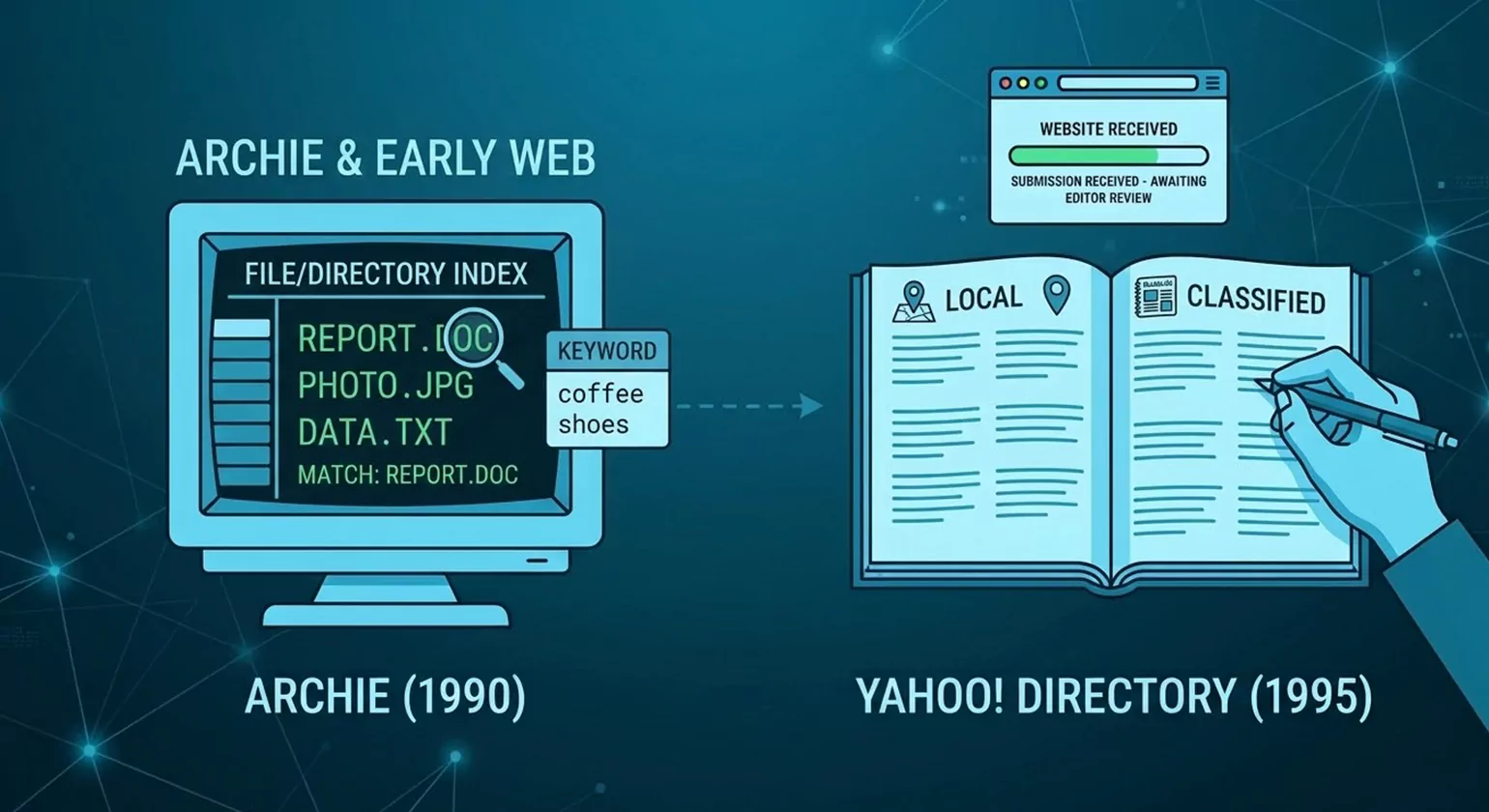
Exploring the brief history of seo through Archie and early web directories
The brief history of seo actually predates the web as we know it. In 1990, a tool called Archie was created to search FTP files. There were no websites, just filenames. When the web finally arrived, engines like Excite and Lycos appeared. They were basic; they looked for exact word matches. If you wanted to find “coffee,” the engine just looked for that specific string of letters.
How the emergence of the seo platform started with manual site submissions
In the mid-90s, the emergence of the seo platform wasn’t about complex dashboards. It was about manual labor. You had to “submit” your URL to a directory like Yahoo! and wait for a human editor to review it. If you weren’t in the directory, you weren’t on the map. It was the first time businesses realized that “being online” wasn’t enough—you had to be findable.
Understanding the History of Search Engine Optimization
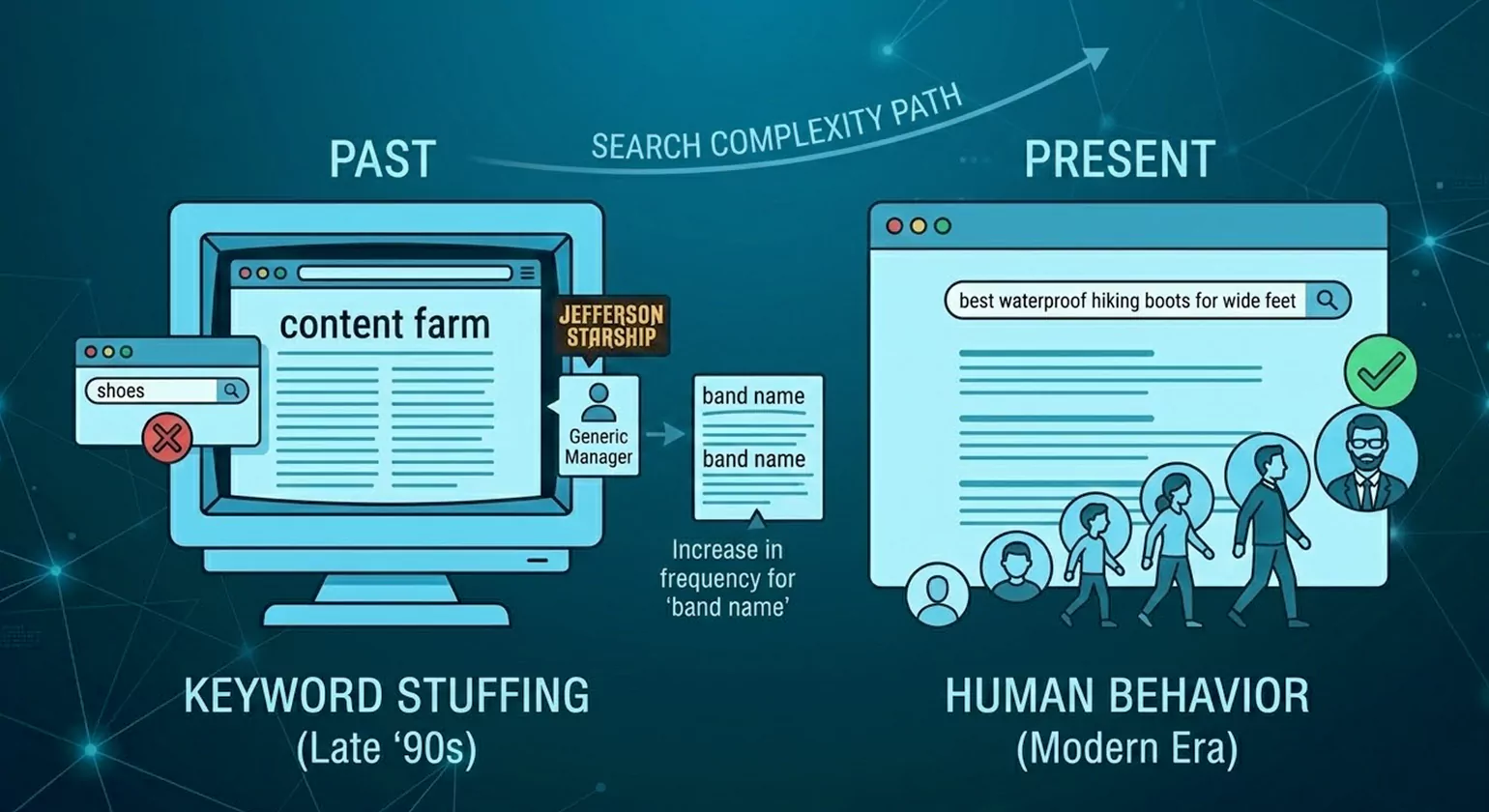
What the history of search engine optimization tells us about digital marketing
The history of search engine optimization is essentially a mirror of human behavior. As we became more comfortable with the internet, our searches became more complex. We stopped typing “shoes” and started typing “best waterproof hiking boots for wide feet.” The seo evolution tracks our growth from basic internet users to sophisticated digital consumers.
Early SEO practices including keyword density and metadata strategies
In the late 90s, the goal was simple: repeat your keyword until the engine couldn’t ignore you. This led to “keyword stuffing,” where pages were unreadable to humans but “perfect” for bots. We also relied heavily on Meta Keywords a hidden tag where you’d list every word you wanted to rank for. It was a technical era, but it lacked soul.
The seo story behind the first optimization techniques
The legendary seo story involves the manager of the band Jefferson Starship. He was frustrated that the band’s official site was buried on page 4 of a search engine. By realizing that increasing the frequency of the band’s name on the page helped the ranking, the foundation for modern optimization was laid. It was the moment we realized we could influence the machines.
Major Milestones in the SEO History
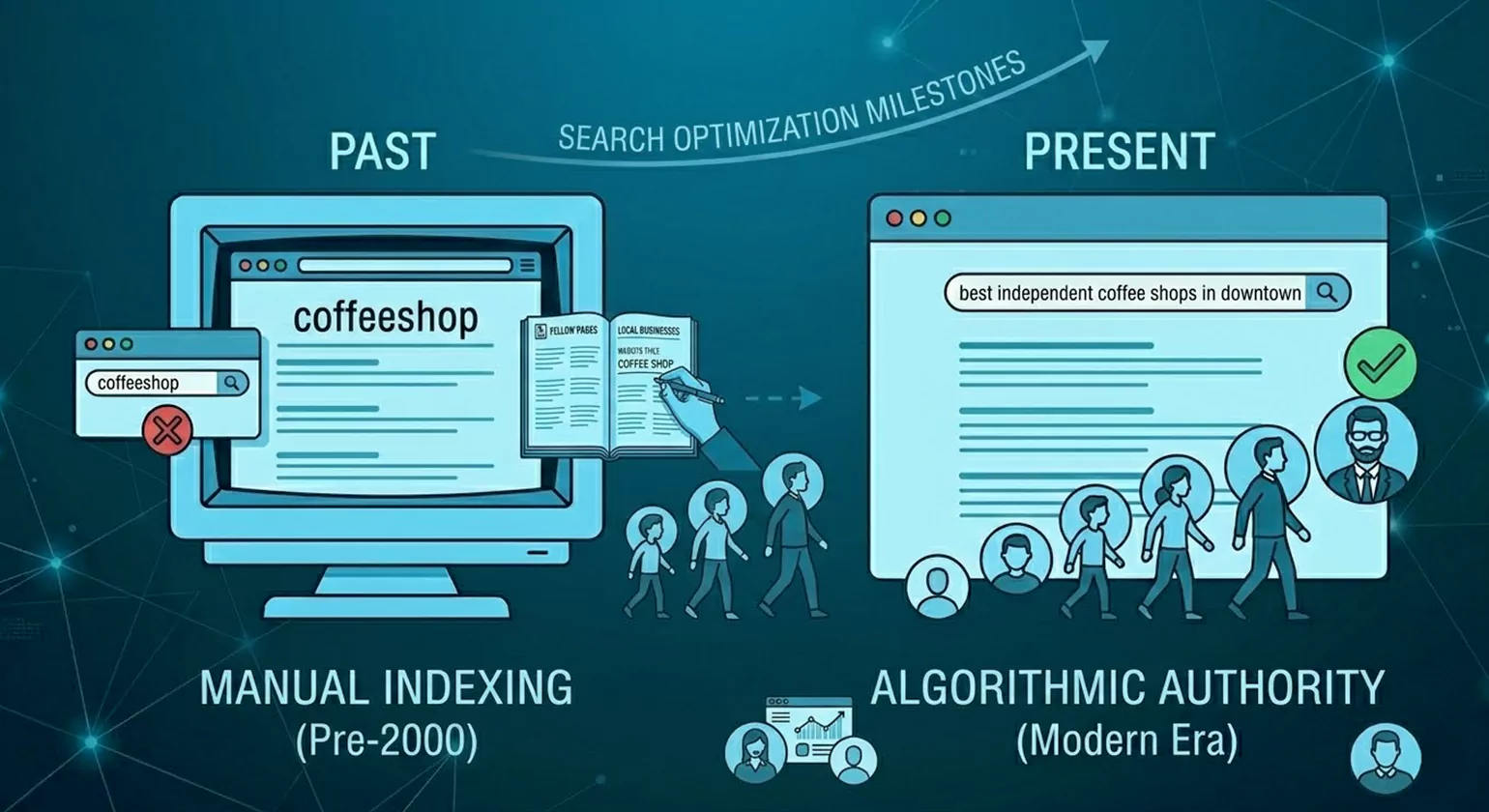
The rise of search engines and the transformation of seo history
As the 90s closed, the seo history became a race for index size. Engines bragged about how many billions of pages they had “crawled.” But having a big library is useless if the librarian is bad. This competition forced engines to look for better ways to sort information, leading to the birth of algorithmic authority.
From manual indexing to algorithm based ranking systems
The seo evolution took a massive leap when engines started using mathematical formulas (algorithms) instead of human editors. This allowed the web to scale. It also meant that if you understood the math, you could win the game. This professionalized the industry and gave birth to the first SEO consultants.
How website optimization became essential for online visibility
By 2004, the internet was crowded. Optimization was no longer a “bonus”—it was a survival tactic. This era saw the rise of the digital marketing virtual assistant services model, as businesses realized they couldn’t keep up with the technical demands of search engines while running a company.
Era | Primary Strategy | Key Search Engines |
1990-1995 | Manual Submissions | Archie, Gopher |
1995-1998 | Keyword Stuffing | AltaVista, Lycos, Excite |
1998-2003 | Backlink Quantity | Early Google, Yahoo! |
The Evolution of SEO and Google as a Modern Answer Engine
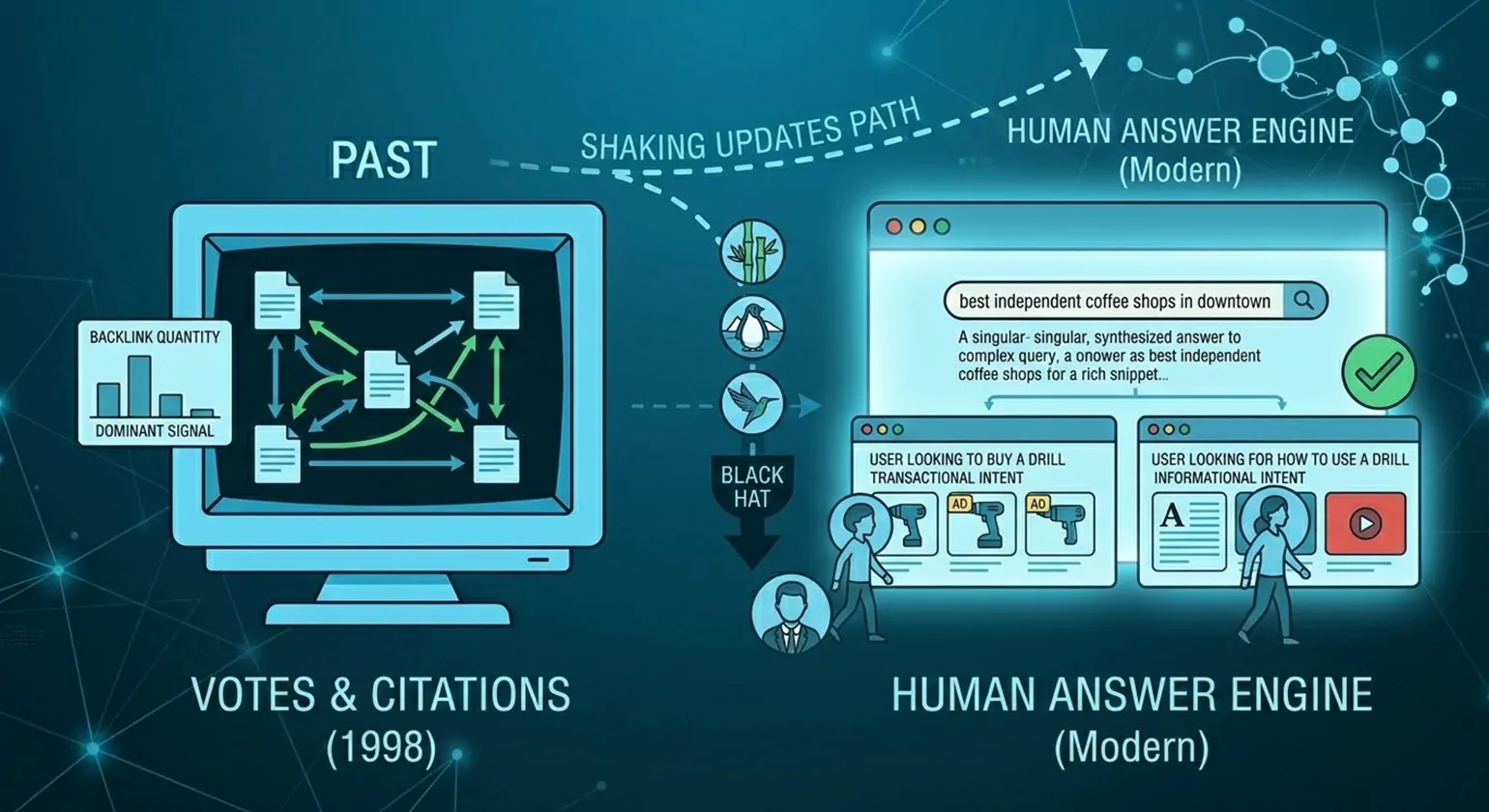
The evolution of seo and google search algorithms
Google’s entry in 1998 changed everything. Their PageRank algorithm looked at links as “votes.” This evolution of seo and google moved the focus from what you said about yourself to what others said about you. It turned the web into a meritocracy of citations.
Major updates that reshaped SEO strategies
As the evolution of seo progressed, Google began launching “updates” to punish people who were gaming the system. These weren’t just tweaks; they were industry-shaking events. They forced marketers to move away from “black hat” tricks and toward “white hat” value.
How search engines improved content quality and relevance signals
Today, Google is an “Answer Engine.” It doesn’t just give you a list of links; it tries to solve your problem on the spot. This is the peak of the seo evolution—where the engine understands the difference between a user looking to buy a drill and a user looking for how to use a drill.
Major Google Updates That Shook the SEO Industry

Ending the spam era with Florida Panda and Penguin
- Florida (2003): The first massive “shake-up.” It wiped out sites that used hidden text and keyword stuffing. It was the first sign that Google was watching.
- Panda (2011): This update targeted “content farms”—sites with thousands of low-quality, thin articles. It rewarded depth and originality.
- Penguin (2012): This was the death knell for spammy link building. If you bought 5,000 cheap links from a “link farm,” Penguin buried your site.
Decoding user intent through Hummingbird and RankBrain
- Hummingbird (2013): A total engine replacement. It allowed Google to understand the meaning of a sentence rather than just individual words.
- RankBrain (2015): The introduction of Machine Learning. Rank Brain enabled Google to respond to queries it had never been asked before, using patterns of human intent.
Prioritizing human experience with Mobilegeddon BERT and Helpful Content
- Mobilegeddon (2015): If your website wasn’t usable on a phone, you got penalized. This is because it reflected how humans actually interact with the web.
- BERT (2019): A breakthrough in Natural Language Processing. This enabled Google to understand prepositions, as well as the nuances of conversational search.
- Helpful Content Update (2022-2024): This update further reinforced the need for content to be written for humans, rather than search engines. This, in essence, penalized AI fluff, as it added no value whatsoever.
The Evolution of Content Marketing and SEO to Prioritize Quality

Why high quality content became central to search rankings
We’ve moved into the era of evolution of content marketing and seo. It’s no longer enough to have a technically perfect site; you need to be an authority. Google wants to see that you aren’t just repeating what everyone else said—you’re adding something new to the conversation.
The shift from keyword stuffing to user focused content
If you write a blog post today and it feels like a conversation, that’s because the seo evolution has made “natural language” a requirement. We don’t write for bots anymore. We write to answer questions, solve pain points, and build trust.
How businesses adapted their SEO strategies through content marketing
Smart brands now integrate their content creation services directly into their SEO strategy. They create “Topic Clusters”—a pillar page that covers a broad subject, supported by dozens of smaller articles that dive into the details. This proves to Google that you are a true expert.
Mastering E-E-A-T to Build Modern Brand Authority
E-E-A-T stands for Experience, Expertise, Authoritativeness, and Trustworthiness. This is a critical part of the seo evolution. Google now looks for “signals” of trust—like an author bio that proves you actually have the credentials to give advice on health, finance, or business.
Shifting Focus from Keyword Density to Semantic Search Intent
Instead of asking “How many times did I say ‘SEO history’?”, modern marketers ask “Did I answer the user’s intent?” This is the hallmark of the evolution of seo. Semantic search looks at the relationships between entities—if you talk about “batteries,” “torque,” and “chuck,” Google knows you’re talking about a power drill.
The Emergence of the SEO Platform and the Professionalization of Growth
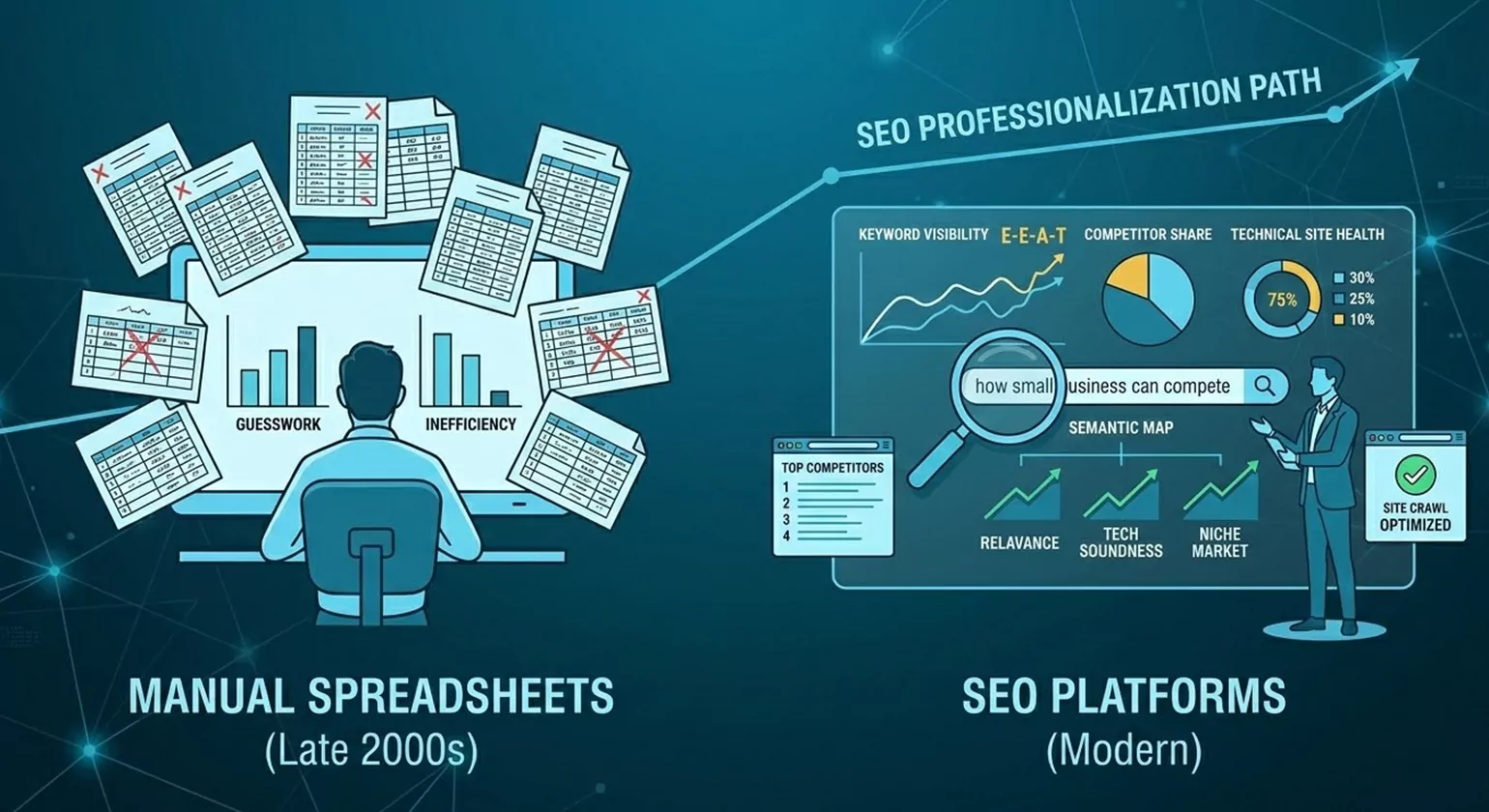
As search became a multi-billion dollar industry, we needed better tools. The emergence of the seo platform allowed us to move away from spreadsheets and toward data-driven insights. Platforms like Ahrefs or Semrush give us a window into what the competition is doing and where our own sites are failing.
This professionalization is a key milestone in the seo evolution. It allows a small business in a niche market to compete with a global giant simply by being more relevant and more technically sound.
SEO Milestone | Key Change | Business Impact |
PageRank (1998) | Links = Authority | Networking and PR became SEO tasks. |
Hummingbird (2013) | Intent > Keywords | Content had to become conversational. |
Core Web Vitals (2020) | Speed & UX = Rankings | Site performance became a marketing priority. |
AI Overviews (2024) | Summaries at the Top | Focus shifted to being a citable source. |
Generative AI and SEO Evolution in a Conversational Search Landscape
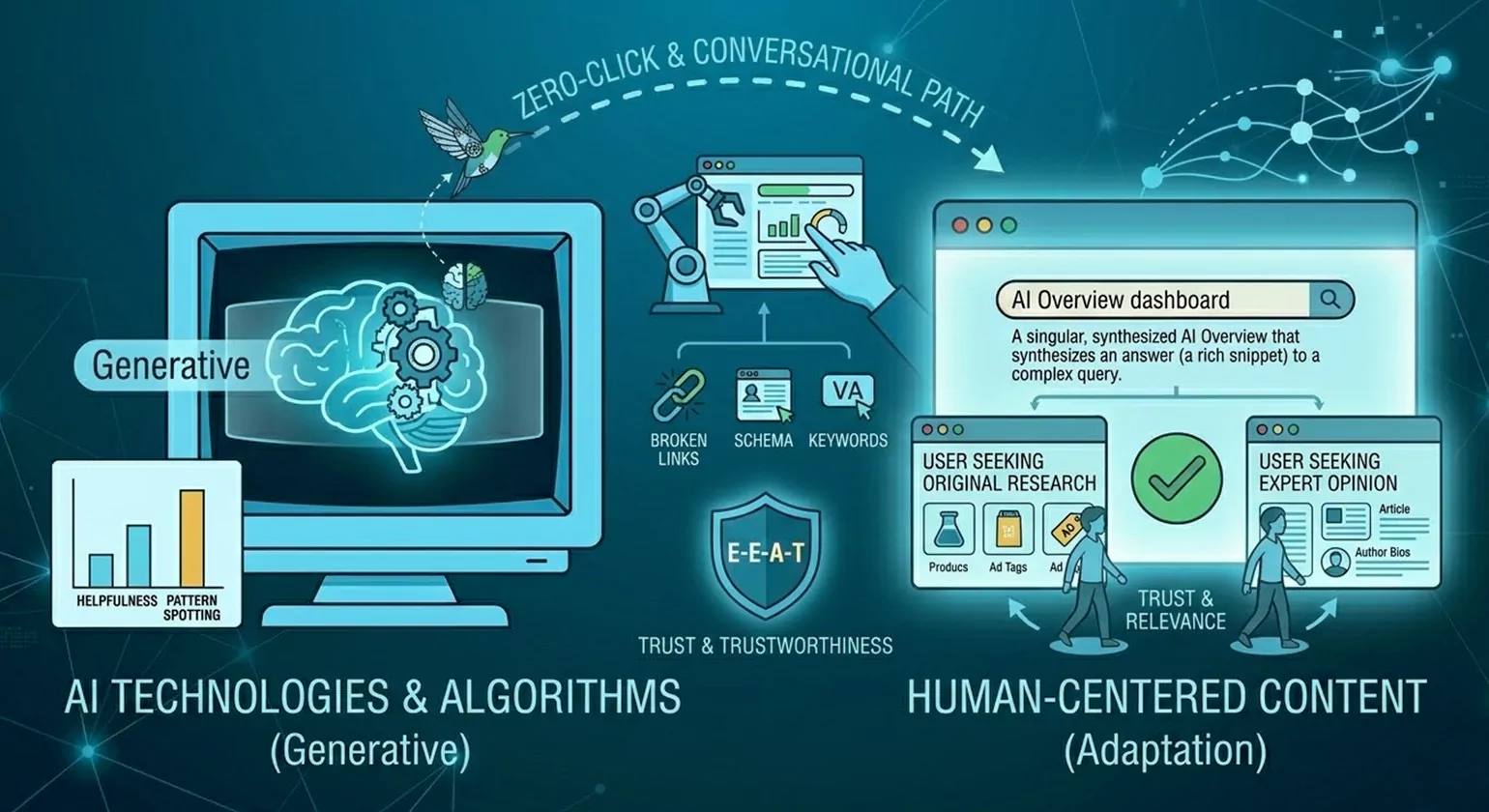
How AI technologies influence search algorithms
We are currently living through the generative ai and seo evolution. Search engines are moving from “finding” to “creating.” When you ask Google a question today, it might generate a summary of three different articles to give you an answer without you ever needing to click a link.
The role of automation and machine learning in SEO practices
Machine learning allows Google to spot patterns in “helpfulness” that a human could never see. For us, automation helps with the heavy lifting—finding broken links, generating schema markup, or analyzing thousands of keywords in seconds. This allows us to focus on the human side of the seo evolution.
How businesses are adapting content strategies in AI powered search environments
In 2026, the biggest risk is being “boring.” AI can write a generic “How-To” guide in 10 seconds. To survive this stage of the seo evolution, your content must have “information gain”—original research, personal stories, or expert opinions that an AI cannot simulate.
Adapting to AI Overviews and the Rise of Zero Click Searches
“Zero Click Search” is the new reality. Google answers the query on the SERP, and the user never visits your site. This is a major pivot in the history of seo. The goal now is to be the authoritative source that the AI references in its summary, keeping your brand in front of the user even if they don’t click.
Using Generative AI to Scale Content Without Sacrificing Trust
AI is a great co-pilot, but a terrible driver. You can use it to brainstorm or structure your thoughts, but the final content must be humanized. The seo evolution has taught us that Google eventually gets very good at identifying—and devaluing—automated content that lacks a human soul.
How the Evolution of SEO Changed Digital Marketing Strategies
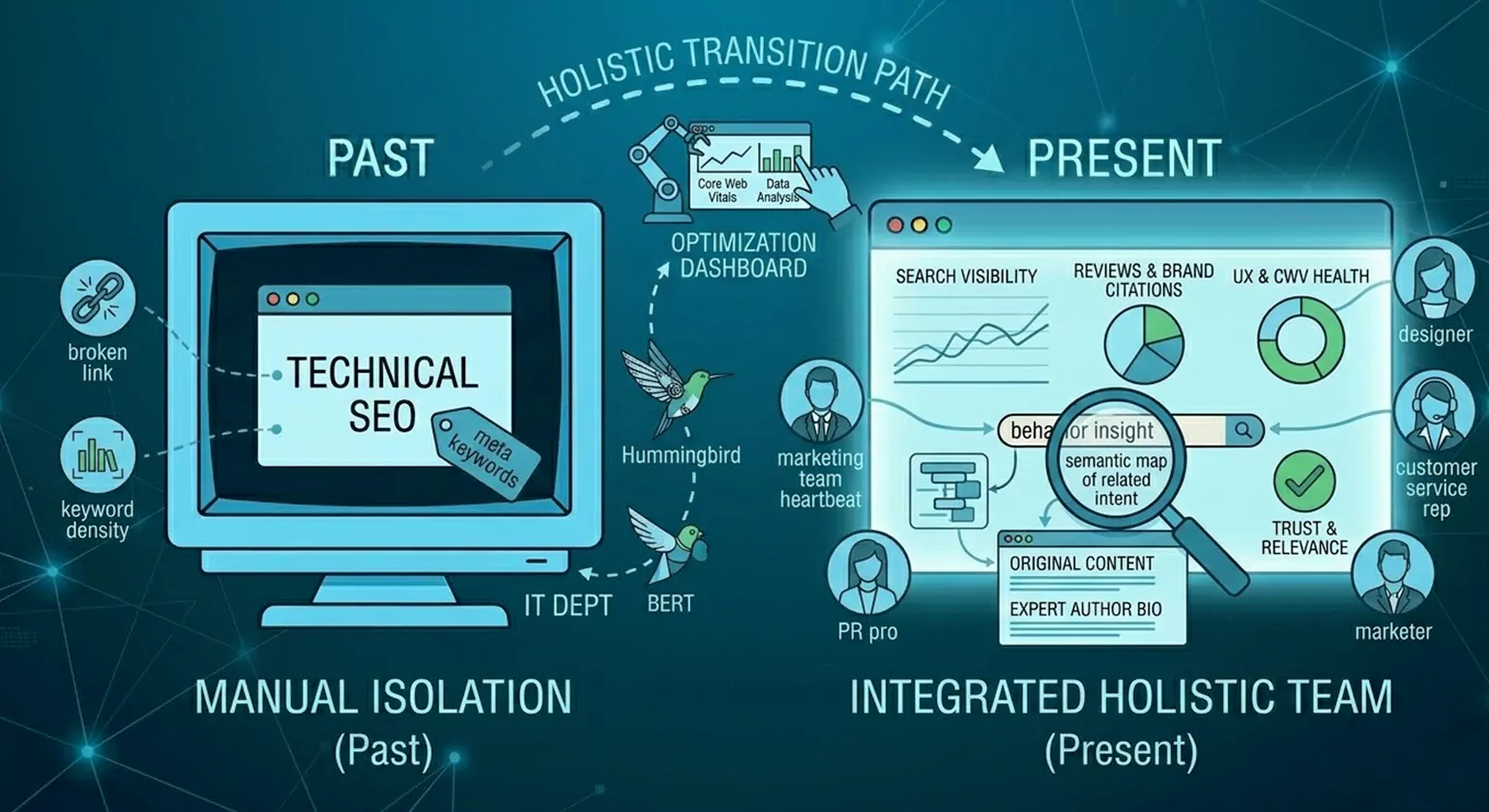
The transition from technical SEO to holistic SEO strategies
SEO used to be isolated in the IT department. Now, it’s the heartbeat of the marketing team. The evolution of seo has made it a team sport involving designers, PR pros, and customer service reps. Every positive review and every shared image is an SEO signal.
Growing importance of user experience and website structure
If your site takes 5 seconds to load, you’ve already lost the SEO battle. Google’s Core Web Vitals are now a ranking factor. This is part of the SEO evolution, ensuring that the web remains fast and accessible for all.
The role of data analysis and search behavior insights
We do not have to speculate what people want; we can simply look at search data to see exactly what people are asking. This is part of the history of SEO, and it’s one of the pillars, which is data-driven, allowing us to create something that people actually want to find.
Key Lessons Businesses Can Learn from the Evolution of SEO

Why SEO strategies must continuously adapt
The internet of 2026 is not the internet of 2020. If your strategy hasn’t changed, you’re invisible. The seo evolution is a reminder that standing still is the same as moving backward.
Important takeaways for marketers and business owners
Don’t build for Google; build for your customer. The history of search engine optimization proves that when you prioritize the user, the rankings eventually take care of themselves. Google’s algorithm is simply trying to mimic a human’s preference for quality.
Practical ways businesses can maintain effective SEO execution
Staying on top of these changes is a full-time job. This is why many businesses use virtual assistants to handle the tactical side—technical audits, keyword tracking, and link outreach. It allows the business owner to focus on the high-level seo story while the “heavy lifting” happens in the background.
Conclusion
The seo evolution is a story of progress. We’ve moved from a world of simple keyword matching to a world where AI can understand the nuance of a human question. It’s a more challenging landscape, but also a more rewarding one.
If you focus on authority, trust, and real human value, you aren’t just “optimizing for search” you’re building a brand that people actually want to find. The history of seo isn’t over; we are just beginning the most exciting chapter yet.
The seo story is still being written. From the chaotic days of Archie to the sophisticated world of Generative AI, the seo evolution has always been about one thing: connecting people with the information they need.
The evolution of seo isn’t something to fear it’s an opportunity. By embracing quality, building authority through E-E-A-T, and staying curious, you can ensure your brand remains visible no matter how the algorithms change.
Remember, the history of seo isn’t just about the past. It’s a roadmap for your future. If you stay focused on providing genuine value, you’ll find that the “search engine” isn’t an obstacle it’s your most powerful partner.
Actionable Summary Table for Modern SEO
Priority | Strategy | Why it Matters |
User Intent | Answer specific questions | AI Overviews prioritize direct, helpful answers. |
E-E-A-T | Show your credentials | Builds trust with both Google and your readers. |
Mobile UX | Fast, responsive design | Most searches happen on phones; speed is a ranking factor. |
Technical Health | Clean code and sitemaps | Helps bots crawl your site efficiently. |
Get more insights >>> Benefits of a HR Virtual Assistant for Rapid Growth
>>>> 10 Leading CRM Consulting Services Companies in 2026
FAQs
1. When SEO started?
SEO was initiated in the mid-1990s, when the first search engines, like Archie AltaVista, and Yahoo Directory, started crawling the web and listing the websites. At this time, website owners understood that they could get higher results by optimizing their website with the right keywords, which could help the search engines crawl the website in a better way.
2. Who invented SEO?
No one person has invented SEO, and it was initiated in the mid-1990s, when website owners were trying to get higher results in search engines like AltaVista and Yahoo. In the year 1997, the term ‘search engine optimization’ was coined by the professionals in the field, and they started providing services in the field of SEO.
3. What is semantic SEO and its evolution?
Semantic SEO is a term used to optimize the website based on the context in which the user is searching and the relationship between the topics. It was initiated with the updates in Google, like Hummingbird and RankBrain, which helped the search engines crawl the web in a better way and provide the most accurate results.
4. How did mobile SEO change the evolution?
Mobile SEO has impacted the evolution of SEO in the sense that it has given priority to user experience and the user-friendly nature of a website. Google has started to rank the websites based on their mobile version, and this is why it has become a critical factor in the evolution of SEO.
5. What role did machine learning play in SEO evolution?
Machine Learning has impacted the evolution of SEO in the sense that it has helped Google and other search engines analyze the large amount of data and provide the most accurate results based on the queries made by the user. Google’s RankBrain is a part of this, and it has helped in providing the most accurate results based on the queries made by the user.
6. What are the major milestones in SEO history?
Some of the major milestones in the history of SEO are the development of early search engines in the 1990s, the development of Google’s PageRank algorithm in 1998, and the major algorithm updates such as Panda, Penguin, and Hummingbird.
7. How has Google changed SEO?
Google has changed SEO in many ways, such as by regularly updating its algorithm to emphasize the importance of relevance, quality, and user experience, as seen with updates such as Panda, Penguin, Hummingbird, RankBrain, and Helpful Content.
8. What is the future of SEO?
The future of SEO is based on the concept of search intent, semantic search, and AI-based search experiences. In the near future, the major factors that will influence the success of an SEO strategy are high-quality content, topical authority, user experience, and the use of structured data to help AI systems understand the content correctly.