Table of Contents
Introduction
In the complex world of modern marketing, understanding how different marketing channels contribute to customer acquisition and conversion is critical. Marketing attribution software plays a key role in this process by assigning credit to various touchpoints along a customer’s journey to identify which ones are most influential in driving sales or other desired outcomes. With an increasing number of channels and platforms available for marketing campaigns, businesses need effective attribution strategies to optimize their efforts and maximize return on investment (ROI). By utilizing marketing attribution tools, businesses can track customer interactions across multiple channels, enabling them to make data-driven decisions and improve the efficiency of their marketing strategies. These tools allow companies to understand the true impact of each touchpoint, whether it’s social media ads, email campaigns, paid search, or organic content, ensuring that marketing budgets are allocated to the most effective channels. Investing in marketing attribution software helps businesses refine their strategies and achieve better results.
What Is Marketing Attribution?

Marketing attribution is the practice of assigning credit to various marketing touchpoints that influence a customer’s purchasing decision. As customers engage with brands across multiple channels—such as email campaigns, social media ads, paid search, and influencer partnerships—marketers need to understand which touchpoints are most effective in driving conversions. By leveraging marketing attribution software, businesses can accurately assess the performance of each marketing channel and determine where to invest more resources. This data-driven approach ensures that marketers can identify which channels lead to the most successful outcomes and optimize their strategies accordingly.
By attribution tracking and analyzing how customers move through the sales funnel and interact with different marketing efforts, businesses gain insights that improve campaign effectiveness. With the use of marketing attribution solutions, companies can measure the impact of each touchpoint and make informed decisions on budget allocation. These tools offer valuable data that helps businesses refine their strategies, enhance customer targeting, and ultimately improve return on investment (ROI). By leveraging multi touch attribution tools, companies can implement the right attribution model to ensure their marketing efforts work in harmony and deliver optimal results.
Why Is Marketing Attribution So Important?

marketing attribution tools is a crucial component of effective marketing strategies in the digital age. It provides businesses with a clear, data-driven understanding of how different marketing channels are performing, offering invaluable insights that drive better decision-making and more efficient resource allocation. Here are several reasons why marketing attribution is so important:
Better ROI and Budget Allocation
marketing attribution tool helps businesses identify which channels and touchpoints deliver the best results, enabling them to allocate their marketing budgets more effectively. By focusing on high-performing channels, such as paid search, social media, or email campaigns, businesses can optimize their spend and avoid wasting resources on underperforming efforts. This ensures that every dollar spent on marketing generates the highest return on investment (ROI), improving overall profitability. Attribution enables more precise adjustments to campaigns, helping businesses make smarter financial decisions and prioritize strategies that lead to measurable success.
Data-Driven Decision Making
Accurate attribution helps businesses understand what’s working and where they should allocate resources for the most impact. By combining attribution tracking with rigorous quantitative market research, marketers can validate their data-driven insights against broader market trends and consumer statistics, ensuring that their pivots are backed by both internal performance and external reality.
Optimizing the Customer Journey
Attribution offers a deeper understanding of the customer journey, revealing how various touchpoints influence decisions. To get the most granular view of these interactions, businesses must utilize advanced website tracking tools that capture heatmaps and click-stream data. This technical foundation ensures that when an attribution model credits a website visit, you understand exactly which page elements contributed to that success.
Cross-Channel Performance Insights
Customers today interact with multiple channels before making a purchase, whether through social media, search engines, or email. Multi touch attribution tools help marketers understand how these channels complement one another and contribute to the customer’s final decision. With marketing attribution tools, businesses can assess the combined impact of their efforts and create a more integrated marketing strategy that maximizes the effectiveness of each channel. This holistic view of cross-channel performance provides a comprehensive understanding of how various touchpoints work together to drive sales.
In conclusion, marketing attribution tool is key to improving campaign effectiveness, enhancing customer experience, and maximizing ROI. By leveraging attribution tools, businesses gain the insights needed to refine their strategies, optimize budget allocation, and stay ahead in an increasingly competitive marketplace.
10 Best Marketing Attribution Tools For Digital Marketing
1. Usermaven
Overview
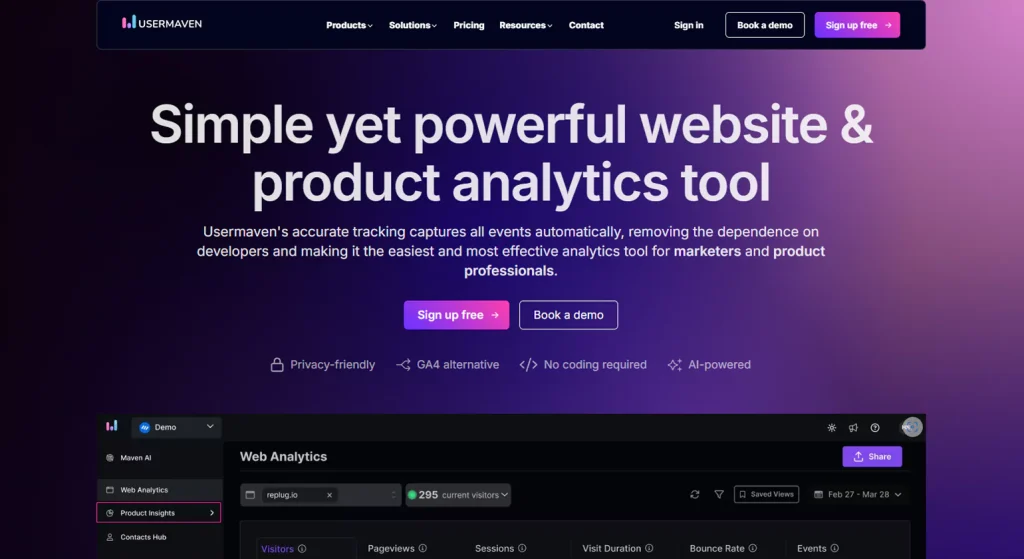
Usermaven is a robust AI-powered marketing attribution tool designed to track and analyze customer behavior across multiple touchpoints. It empowers businesses with real-time insights into user journeys, helping them optimize marketing performance, reduce acquisition costs, and improve ROI. With a clean, intuitive interface, Usermaven simplifies complex attribution modeling for marketers of all levels.
Key Features
Multi-Touch Attribution Models: Accurately identify which channels drive conversions using first-touch, last-touch, and linear attribution.
Customer Journey Mapping: Visualize the full user path across all marketing and sales channels.
Real-Time Analytics: Get actionable insights with live tracking and performance dashboards.
Event-Based Tracking: Monitor specific user actions like clicks, form submissions, and product views.
Funnel and Cohort Analysis: Understand user behavior trends and optimize conversion funnels.
Seamless Integrations: Easily connect with popular platforms like Google Ads, Facebook, HubSpot, and more.
Why Choose Usermaven
User-Friendly Interface: Designed for marketers, not developers—start tracking without writing code.
AI-Driven Insights: Leverage machine learning to identify top-performing campaigns and hidden conversion paths.
Highly Accurate Attribution: Eliminate guesswork with precise channel performance data.
Privacy Compliant: Built with GDPR and CCPA compliance in mind to ensure data protection.
Scalable for All Business Sizes: From startups to enterprises, Usermaven adapts to your needs.
2. Hyros

Overview
Hyros is a leading AI-powered marketing attribution tools designed for eCommerce brands and direct response marketers. It offers precise tracking of customer journeys by integrating multi-channel data, helping businesses uncover true ROI across complex funnels. Whether you’re running high-ticket offers or multi-step sales sequences, Hyros delivers unmatched clarity and performance insight.
Key Features
Advanced Multi-Channel Attribution: Tracks user behavior across ads, email, SMS, and web interactions.
High-Ticket Sales Tracking: Accurately attributes revenue to the correct source, even in long or high-value sales cycles.
Funnel Visualization: Provides in-depth views of every touchpoint in your sales process.
AI-Driven Optimization: Uses machine learning to help you scale what works and cut what doesn’t.
CRM & Ad Platform Integrations: Seamlessly connects with platforms like Facebook Ads, Google Ads, Shopify, and more.
Call Tracking: Monitors sales calls and links them to the exact marketing source.
Why Choose Hyros?
Hyros stands out for its unmatched attribution accuracy and ability to handle complex sales environments. It’s trusted by top digital marketers and eCommerce brands to boost ad efficiency, lower customer acquisition costs, and make smarter data-driven decisions. If you’re serious about scaling with confidence, Hyros is your go-to solution for complete marketing clarity.
3. SegMetrics

Overview
SegMetrics is a powerful AI-powered marketing attribution Tools and analytics platform that empowers businesses to track and understand the full customer journey across multiple channels. Designed for data-driven marketers, it provides actionable insights into user behavior, conversion paths, and campaign ROI. With seamless integration into your existing marketing stack, SegMetrics makes it easier to measure what truly drives revenue and growth.
Key Features
Multi-Touch Attribution: Track and credit every customer interaction across email, ads, web, and more.
Real-Time Analytics: Access instant performance reports to monitor marketing effectiveness.
Revenue Attribution: Connect ad spend to actual revenue across all stages of the funnel.
CRM & Tool Integration: Easily integrates with major platforms like HubSpot, ActiveCampaign, and more.
Custom Dashboards & Reporting: Visualize data with tailored reports that match your KPIs.
Behavioral Insights: Understand exactly how leads convert by analyzing user behavior at each touchpoint.
Why Choose SegMetrics?
Built for Marketers: Unlike generic analytics tools, SegMetrics is designed with marketing teams in mind.
Eliminates Guesswork: Get clear visibility into which campaigns and channels actually drive sales.
Scalable & Flexible: Whether you’re a startup or enterprise, the platform adapts to your data needs.
Boosts ROI: Optimize ad spend and lead quality by focusing on what works best.
Trusted Accuracy: No sampling, no approximations—just clean, reliable attribution data.
4. Triple Whale
Overview
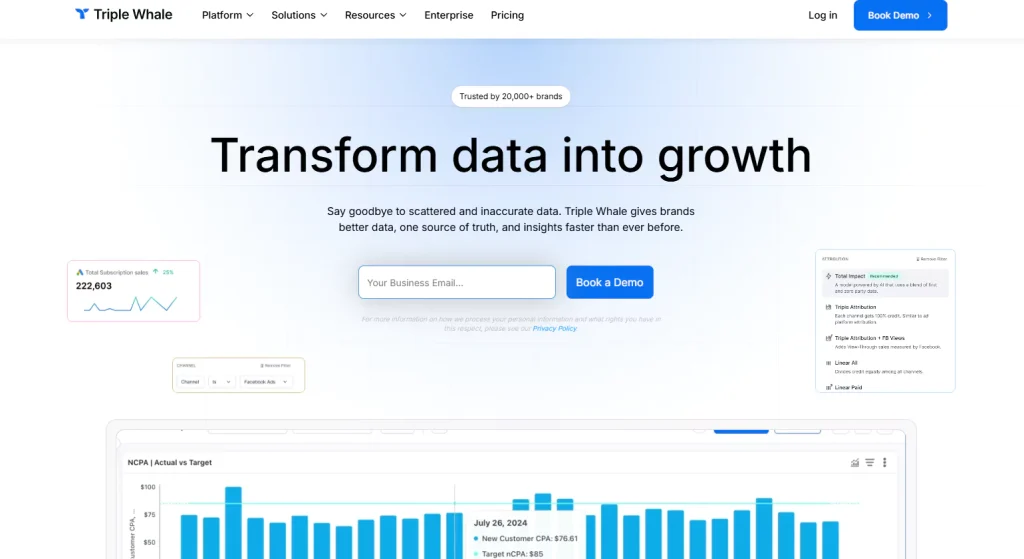
Triple Whale is a leading AI-powered marketing attribution platform designed specifically for eCommerce businesses. Tailored for Shopify and DTC (Direct-to-Consumer) brands, Triple Whale offers a seamless, user-friendly interface and real-time reporting to help marketers uncover deep insights into customer behavior and campaign performance. Its centralized dashboard empowers businesses to make smarter, data-driven decisions with clarity and precision.
Key Features
Multi-Touch Attribution Modeling – Track and analyze the complete customer journey across multiple touchpoints.
Real-Time Dashboard – Get instant access to sales, ROAS, and ad performance in one intuitive interface.
Shopify Integration – Deep, native integration with Shopify for accurate and automated data syncing.
Creative Performance Tracking – Identify which creatives and campaigns drive conversions.
Customer Journey Mapping – Visualize the full path to purchase for every customer.
Profitability Insights – Understand revenue vs. cost data to optimize profitability at every level.
Why Choose Triple Whale
Triple Whale is trusted by hundreds of fast-growing DTC brands for one simple reason: it delivers results. With powerful attribution tools and eCommerce-specific features, we make it easier to cut ad waste, scale successful campaigns, and understand the real ROI of every marketing dollar. If you’re a Shopify brand looking to turn complex data into clear, actionable strategies—Triple Whale is your ideal partner.
5. Funnel
Overview
Funnel is a powerful AI-driven marketing attribution tools designed to centralize and harmonize data from multiple marketing channels. It provides a unified dashboard that enables marketers to track, analyze, and optimize campaign performance with ease. By offering real-time insights, Funnel empowers businesses to make data-driven decisions and maximize their marketing ROI.
Key Features
Unified Data Collection: Automatically gathers data from hundreds of ad platforms, CRMs, analytics tools, and more.
Cross-Channel Attribution: Understand how each channel contributes to conversions across the buyer journey.
Custom Dashboards: Build tailored reports for various stakeholders with drag-and-drop simplicity.
Real-Time Analytics: Gain instant performance insights to adjust campaigns on the fly.
Seamless Integrations: Easily integrates with Google Data Studio, Looker, Tableau, and other BI tools.
Automation & Scheduling: Automate data refreshes and report delivery to streamline workflows.
Why Choose Funnel
Funnel stands out for its ability to simplify complex marketing data and deliver clear, actionable insights. With AI-powered automation and deep attribution modeling, it helps marketing teams eliminate data silos, reduce manual reporting, and focus on strategy. Whether you’re a small business or a global enterprise, Funnel scales with your needs—making marketing analytics more intelligent and efficient.
6. HockeyStack
Overview
HockeyStack is a powerful AI-powered marketing attribution tools built for modern marketing teams. It offers comprehensive, end-to-end tracking across all channels to help businesses understand the full customer journey. By unifying data and visualizing multi-touch attribution, HockeyStack enables smarter decisions, optimized campaigns, and higher ROI.
Key Features
End-to-End Attribution Tracking
Track every interaction across the funnel—from first touch to conversion—without relying solely on cookies.Multi-Channel Integration
Seamlessly connects with your entire tech stack including paid ads, organic, email, and CRM platforms.Customizable Reporting Dashboards
Create flexible, real-time reports tailored to your marketing KPIs and revenue goals.Behavioral Data Insights
Analyze user behavior at every touchpoint to discover what truly drives conversions.No-Code Implementation
Get up and running fast without needing developer support or complex setups.
Why Choose HockeyStack?
HockeyStack stands out for its ability to deliver accurate, real-time insights that fuel data-driven marketing decisions. Unlike traditional tools, it offers full visibility into the customer journey and eliminates blind spots in your attribution model. Ideal for B2B and SaaS teams, it helps you connect marketing spend directly to revenue outcomes. If you’re looking to optimize ROI, simplify attribution, and scale faster—HockeyStack is the tool you need.
7. LeadsRx
Overview
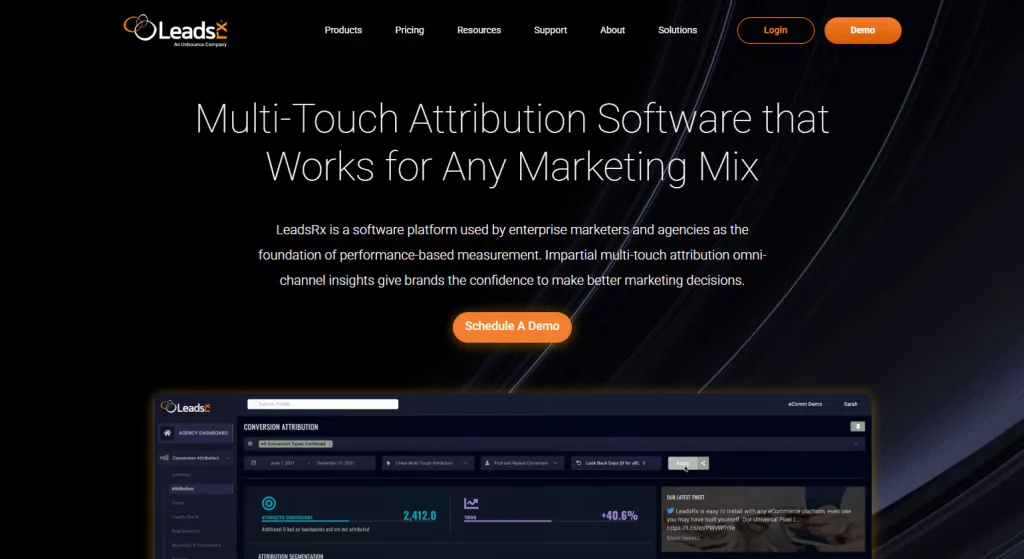
LeadsRx is a powerful AI-powered multi-touch attribution platform that helps businesses accurately track and measure customer journeys across all marketing channels. With its real-time analytics and advanced attribution models, LeadsRx enables marketers to gain clear insights into what’s working, optimize campaign performance, and maximize ROI. It seamlessly integrates with various ad platforms, CRMs, and marketing tools, delivering a unified view of marketing effectiveness.
Key Features
Multi-Touch Attribution Models
Track customer interactions across all touchpoints—digital and offline—to understand true conversion paths.Cross-Channel Integration
Connects with major ad networks, CRM systems, email platforms, and more for complete marketing visibility.Real-Time Analytics
Provides up-to-the-minute performance insights to quickly identify high-impact channels and campaigns.Customer Journey Mapping
Visualize the full path to purchase, from first touch to final conversion.Data-Driven Optimization
Actionable insights help refine budgets, messaging, and targeting based on true attribution.Privacy-Compliant Tracking
Adheres to global standards like GDPR and CCPA, ensuring ethical data usage.
Why Choose LeadsRx
Comprehensive Attribution
Unlike basic last-click models, LeadsRx gives a holistic view of your marketing efforts across all channels.Seamless Integration
Easily connects with your existing marketing stack, including Google Ads, Facebook, HubSpot, Salesforce, and more.Proven ROI Insights
Helps identify which marketing channels deliver real value, allowing smarter budget allocation.Built for All Business Sizes
Scalable for SMBs and enterprise-level teams alike, with tailored attribution solutions to fit your needs.Trusted by Leading Brands
Hundreds of businesses worldwide trust LeadsRx to make smarter, data-backed marketing decisions.
8. Google Analytics

Overview
Google Analytics remains a top choice for marketing attribution tools in 2025, offering deep insights into user behavior and campaign performance. Though not a dedicated attribution tool, its integration with AI and multi-channel tracking capabilities make it invaluable for mapping customer journeys and optimizing strategies across platforms.
Key Features
Multi-Channel Funnel Reports: Analyze the full customer journey across organic, paid, direct, referral, and social channels.
Attribution Modeling: Compare different attribution models (last click, linear, data-driven) to evaluate campaign performance.
Advanced Segmentation: Segment users by behavior, traffic source, geography, and more for granular insights.
AI-Powered Insights: Leverage Google’s machine learning to detect trends, anomalies, and performance predictions.
Real-Time Analytics: Monitor live user activity and assess immediate campaign impact.
Seamless Integrations: Connects easily with Google Ads, Search Console, BigQuery, and other marketing tools.
Why Choose Google Analytics
Trusted and Scalable: Used by millions of businesses globally, suitable for startups to enterprises.
Free and Feature-Rich: Google Analytics offers powerful tools even in its free version, with GA4 adding predictive capabilities.
Data-Driven Decision Making: Helps marketers and business owners make smarter decisions with actionable insights.
Supports Attribution Strategy: While not solely an attribution tool, it supports comprehensive analysis of user touchpoints to refine your marketing ROI.
Compliant and Secure: Aligns with GDPR and other data protection standards, ensuring responsible data handling.
9. Wicked Reports
Overview
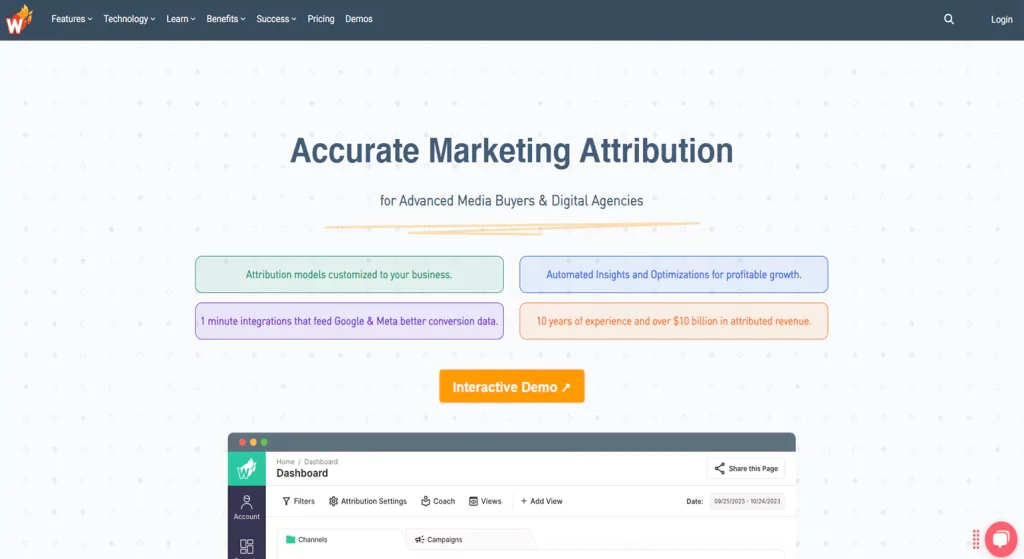
Wicked Reports is a powerful AI-driven marketing attribution platform tailored for eCommerce businesses. It provides deep insights into the customer journey by accurately linking marketing efforts to actual revenue. By uncovering which campaigns truly drive sales and long-term customer value, Wicked Reports empowers brands to make smarter, data-backed decisions for growth.
Key Features
Advanced Multi-Touch Attribution: Tracks every customer interaction across channels to provide precise, multi-touch attribution insights.
Customer Lifetime Value (LTV) Tracking: Measures and predicts the long-term value of each customer from their first click.
Real Revenue Data Integration: Connects with your sales and CRM platforms to attribute real revenue—not just clicks or leads.
Funnel Stage Analysis: Understand which campaigns are influencing early, middle, and late-stage conversions.
Seamless eCommerce Integration: Works smoothly with Shopify, WooCommerce, Magento, and other major platforms.
Email & Ad Attribution: Accurately attributes ROI across email marketing, Facebook Ads, Google Ads, and more.
Why Choose Wicked Reports
Wicked Reports is a powerful AI-driven marketing attribution platform tailored for eCommerce businesses. It provides deep insights into the customer journey by accurately linking marketing efforts to actual revenue. By uncovering which campaigns truly drive sales and long-term customer value, Wicked Reports empowers brands to make smarter, data-backed decisions for growth.
10. Looker
Overview
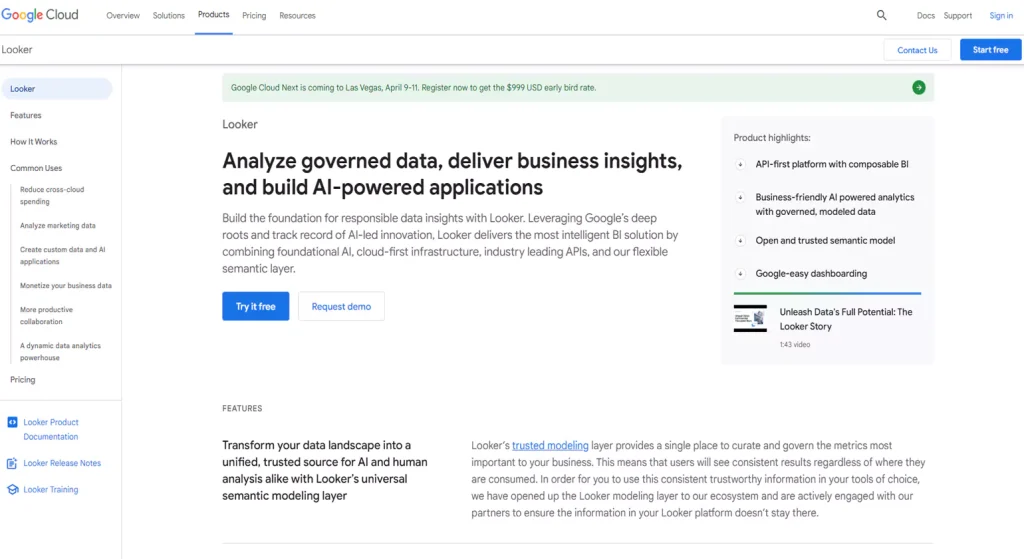
Looker is a robust business intelligence (BI) and analytics platform that empowers organizations to gain deeper insights into customer behavior and marketing attribution tools performance. With its powerful data modeling capabilities, Looker helps businesses unify data from various sources, enabling accurate and flexible marketing attribution Tool. Whether you’re managing multi-touch campaigns or need advanced segmentation, Looker offers the customization and scalability required to drive data-informed marketing decisions.
Key Features
Advanced Marketing Attribution Models: Build custom attribution models tailored to your sales cycle and channels.
Seamless Data Integration: Connect data from CRMs, ad platforms, web analytics tools, and more in one centralized platform.
Dynamic Data Visualization: Create interactive dashboards and reports that offer real-time marketing insights.
Customizable Metrics: Define and track KPIs that matter most to your campaigns and business goals.
Scalable Architecture: Handle large datasets efficiently with Looker’s high-performance analytics engine.
Team Collaboration: Share insights across departments with controlled access and real-time data sharing features.
Why Choose Looker for Marketing Attribution?
Looker stands out as a top choice for companies with complex marketing ecosystems due to its deep customization and powerful analytics capabilities. Its ability to blend data from multiple touchpoints makes it ideal for accurate and actionable attribution analysis. Looker is also part of the Google Cloud Platform, ensuring enterprise-grade reliability, security, and scalability. Whether you’re a data analyst or a marketer, Looker’s user-friendly interface and powerful backend make it a valuable tool for driving ROI through smarter marketing decisions.
10 Benefits of Using Marketing Attribution Tools

Marketing attribution tools offer businesses invaluable insights into the performance of their marketing campaigns. These tools are designed to track, measure, and analyze how customers engage with various touchpoints along their buying journey, providing data that helps businesses make informed, strategic decisions. By leveraging marketing attribution solutions, companies can gain a clearer understanding of which channels drive the most conversions, enabling them to optimize their marketing strategies and maximize ROI. Implementing marketing attribution software allows businesses to streamline data collection and enhance decision-making for more effective campaign management. Below are some key benefits of using these tools:
1. Clearer Visibility into Customer Behavior
One of the most significant advantages of marketing attribution tool is the clearer visibility they provide into customer behavior. These tools allow businesses to track customer interactions across multiple channels, from social media ads to email campaigns and website visits. By understanding how customers engage with these touchpoints, marketers can identify key patterns, preferences, and pain points. This insight is essential for refining marketing strategies to align with customers’ needs and expectations, ultimately leading to better customer experiences and higher conversion rates.
2. Enhanced Campaign Optimization
Marketing attribution tools empower businesses to optimize their campaigns in real-time. With actionable data on how each marketing touchpoint performs, marketers can quickly adjust various aspects of a campaign, such as messaging, timing, or targeting. This agility ensures that campaigns remain relevant and effective, delivering the best possible results. Attribution tools allow marketers to continuously fine-tune their strategies based on the actual impact of each touchpoint, ensuring that marketing efforts are always in line with customer behavior and market trends.
3. Improved Collaboration Across Teams
Attribution tools provide a unified view of data, which promotes collaboration between marketing, sales, and other departments. With access to the same insights, teams can better understand the customer journey from start to finish, ensuring that every touchpoint and interaction is accounted for. This shared understanding leads to more cohesive strategies, stronger alignment across teams, and a more seamless customer experience.
4. Advanced Reporting and Analytics
Marketing attribution tools offer powerful reporting and analytics capabilities, enabling businesses to assess the effectiveness of individual channels, campaigns, and customer segments. Detailed reports allow marketers to dive deeper into their performance metrics, identify trends, and track the success of different marketing initiatives. This level of analysis helps businesses make data-backed decisions, optimize strategies, and allocate resources to the most effective channels.
5. Customer-Centric Insights
Attribution tools provide insights into individual customer journeys, allowing businesses to track how customers interact with various channels over time. This granular view helps marketers create personalized and targeted marketing strategies that are more likely to result in conversions. Understanding customer behavior across touchpoints also enables businesses to deliver relevant content and offers at the right time, enhancing customer engagement and satisfaction.
6. Predictive Analysis
Advanced multi touch attribution tools incorporate machine learning and predictive analytics to forecast future customer behavior and marketing trends. These tools help businesses stay ahead of the competition by allowing them to optimize campaigns before they even launch. Predictive analysis helps businesses anticipate customer needs, make proactive decisions, and fine-tune their strategies to maximize future marketing performance.
7. Optimized Campaign Performance
Marketing attribution tools provide real-time insights into which campaigns are driving engagement, leads, and conversions. By analyzing performance at each touchpoint, marketers can fine-tune messaging, targeting, and timing to boost results. This continuous optimization leads to higher ROI and more efficient use of marketing budgets.
8. Cross-Channel Analysis
Modern customers interact with brands across multiple channels—social media, email, search, paid ads, and more. Attribution tools unify these data points, allowing marketers to assess the impact of each channel within the broader journey. This comprehensive view ensures a more strategic, data-driven marketing mix.
9. Personalized Marketing
Attribution tools help segment audiences based on behavior, enabling tailored campaigns that resonate deeply. While these tools focus on the ‘conversion’ end of the funnel, integrating them with specialized brand awareness tools allows brands to measure the top-of-funnel impact—tracking how initial impressions and brand sentiment eventually feed into the multi-touch journeys identified by your attribution software.
10. Enhanced Customer Journey Insights
Attribution tools map the entire customer journey from first touch to final conversion. This helps marketers identify key moments, drop-off points, and influential interactions. With these insights, brands can refine their funnels, improve user experiences, and guide prospects more effectively toward purchase.
Types of Marketing Attribution Tools

Marketing attribution tools are essential for businesses looking to optimize their marketing strategies by understanding how various touchpoints influence customer conversions. Different types of marketing attribution software offer unique insights based on their approach to attribution tracking and assigning value to marketing interactions. Here’s an overview of the most common types of marketing attribution tools:
Multi-Touch Attribution (MTA) Tools
Multi-Touch Attribution (MTA) tools track and assign credit to multiple touchpoints along the customer journey, providing a comprehensive view of how various interactions contribute to conversions. These tools assign weighted value to each touchpoint based on its role in the final conversion. By considering the entire customer journey, MTA tools offer a more accurate picture of marketing effectiveness across channels. They allow businesses to understand the full impact of their campaigns, from initial awareness through to the final purchase.
Example Tools: Google Analytics, HubSpot, and Adobe Analytics.
Single-Touch Attribution Tools
Single-Touch Attribution tools focus on just one interaction in the customer journey—either the first or last touchpoint—and attribute all the credit for the conversion to that point. While this model is simpler than MTA tools, it may not provide a complete understanding of the customer’s decision-making process. Single-touch attribution is often used by businesses with shorter sales cycles or those that prioritize immediate actions like conversions or purchases.
Example Tools: Marketo and Salesforce.
Predictive Attribution Tools
Predictive Attribution tools use machine learning and artificial intelligence to predict future behaviors based on historical data. These tools can forecast the potential performance of future campaigns, helping businesses proactively optimize their strategies. Predictive attribution offers insights into which marketing activities are likely to drive conversions in the future, enabling marketers to make data-driven decisions before a campaign even starts.
Example Tools: Attribution and Bizible.
Linear Attribution Tools
Linear Attribution tools distribute credit equally across all touchpoints in the customer journey. This model assumes that every touchpoint plays an equal role in the conversion process. While it provides a holistic view of customer interactions, it may lack the granularity needed to identify which touchpoints are truly driving conversions. Linear attribution is useful for businesses that want a broad understanding of their marketing efforts but may not be suitable for those seeking more detailed insights.
Example Tools: Google Analytics and Kissmetrics.
Time-Decay Attribution Tools
Time-Decay Attribution tools assign more credit to touchpoints that occur closer to the final conversion. This model reflects the idea that recent interactions have a greater influence on the customer’s decision. Time-decay attribution is valuable for businesses that want to focus on the impact of touchpoints nearer to the conversion, helping them optimize final-stage interactions and maximize conversion rates.
Example Tools: HubSpot and Google Analytics.
In conclusion, the right marketing attribution tool depends on your business needs, sales cycle, and the level of detail required for your campaigns. Using marketing attribution tools helps businesses make smarter, data-driven decisions that lead to more effective marketing strategies and improved ROI.
Exploring Different Models of Marketing Attribution

Marketing attribution models provide businesses with frameworks to understand how each touchpoint in the customer journey contributes to conversions. Different models focus on varying aspects of the journey, giving businesses insight into the effectiveness of their marketing channels. Here are the most common attribution models used in 2025:
First-Touch Attribution
The First-Touch Attribution model assigns 100% of the credit for a conversion to the first touchpoint a customer interacts with. This model is useful for understanding which channels initially capture the attention of potential customers. However, it can provide limited insight into how the customer moves through the rest of the journey, making it less effective for long-term or complex buying cycles. It’s ideal for businesses focused on awareness and lead generation.
Last-Touch Attribution
The Last-Touch Attribution model gives all the credit for the conversion to the final touchpoint before a customer makes a purchase or completes an action. This model is popular when the final interaction—whether it’s a purchase confirmation, email click, or ad click—is seen as the most influential in driving the decision. While it simplifies tracking and decision-making, it overlooks the role that earlier touchpoints may have played in nurturing the customer towards conversion.
Linear Attribution
Linear Attribution distributes equal credit across all touchpoints that the customer encounters. Every interaction, from the first touch to the final conversion, is seen as equally important in driving the decision. This model is useful for businesses that want to understand the overall contribution of each marketing activity but may not provide a nuanced view of which touchpoints truly drive conversions. It’s a good middle ground for those who want to take a holistic view of the customer journey.
Time-Decay Attribution
The Time-Decay Attribution model assigns more credit to touchpoints that occur closer to the final conversion, reflecting the idea that recent interactions are more influential in the decision-making process. This model is ideal for businesses with shorter sales cycles or those focusing on last-minute decision-making. By emphasizing later-stage interactions, businesses can optimize the final steps in the customer journey.
U-Shaped & W-Shaped Attribution
The U-Shaped Attribution model gives more credit to the first and last touchpoints, while the W-Shaped Attribution model adds emphasis to key milestones in the middle of the journey, such as adding an item to the cart or initiating a trial. Both models are useful for businesses with longer or more complex customer journeys where multiple touchpoints play significant roles in converting a lead into a customer.
In 2025, marketing attribution tools enable businesses to track and analyze these models in real time, helping them optimize campaigns and improve ROI. Understanding the right attribution model for your business will allow you to make smarter, data-driven decisions, ensuring more efficient marketing spend and better customer engagement.
Choosing the Right Marketing Attribution Tool

Selecting the right marketing attribution tool is a critical decision for businesses looking to optimize their marketing efforts. The ideal tool will vary depending on the size of the business, the complexity of its customer journey, and the specific marketing objectives. Here are some essential factors to consider when choosing the right marketing attribution tool for your needs:
Understand Your Needs
The first step in selecting an attribution tool is understanding what you need it to accomplish. Do you want to track the performance of individual marketing channels, or do you need to measure the impact of your entire marketing mix? Identifying the key questions you want to answer will help guide your decision. For example, if you are more concerned with understanding the role of each touchpoint in the conversion process, multi-touch attribution tools would be a better fit. On the other hand, if you’re focused on tracking the final conversion action, a single-touch model might suffice.
Assess Integration Capabilities
A crucial feature of any attribution tool is its ability to integrate with your existing systems. Ensure that the tool can seamlessly connect with your customer relationship management (CRM) system, analytics platforms, and marketing tools. This integration is essential for accurate data tracking and reporting. Without seamless integration, you risk fragmented data, which can undermine your ability to make informed decisions.
Consider the Learning Curve
Some attribution tools are designed with user-friendliness in mind, while others offer more complex features that require significant technical expertise. When selecting a tool, consider your team’s technical capabilities. If your marketing team has a solid technical background, advanced tools with complex configurations may be appropriate. However, if your team lacks experience with sophisticated software, a simpler tool with an intuitive interface will ensure greater adoption and effectiveness.
Evaluate Customization and Reporting Features
Customization is key for attribution tools that need to align with your specific marketing goals. Look for tools that allow you to tailor attribution models, so they reflect your unique customer journey. Additionally, robust reporting and analytics features are essential. These tools should offer actionable insights, such as conversion paths, campaign performance data, and customer behaviors, to guide optimization efforts.
Scalability for Growth
Finally, consider the scalability of the tool. Your marketing efforts will likely grow over time, and your attribution needs will evolve as well. Choose a tool that can scale with your business, allowing you to track larger volumes of data, adapt to new marketing channels, and generate deeper insights as your business expands.
In 2025, marketing attribution tools are indispensable for businesses looking to optimize their marketing strategy, enhance ROI, and make data-driven decisions. By selecting the right tool, businesses can gain clarity into their marketing performance and refine their strategies for greater success.
Conclusion
In 2026, marketing attribution tools are indispensable for businesses looking to optimize their marketing strategy. For organizations that lack the internal bandwidth to manage these complex systems, partnering with experienced marketing analytics companies can provide the necessary expertise to set up custom models, integrate fragmented data sets, and translate raw attribution reports into actionable growth strategies.
Read more>>>>> Mastering Customer Journey Consulting – A Comprehensive Guide
Step-by-Step Guide to B2B Marketing Funnel
FAQs
What is marketing attribution?
Marketing attribution identifies which touchpoints influence customer decisions, assigning value to each interaction. It helps brands optimize strategies, improve ROI, and make data-driven decisions by revealing which channels and campaigns drive the most conversions throughout the customer journey.
Why is marketing attribution important?
Marketing attribution tracks customer interactions to identify the most effective channels. It helps maximize ROI, optimize strategies, and allocate resources efficiently, enabling data-driven decisions that enhance campaign performance and support more targeted, impactful marketing efforts.
What are the benefits of using marketing attribution tools?
Marketing attribution tools analyze customer interactions across channels to link efforts with ROI. They help optimize campaigns, allocate resources efficiently, refine strategies, and strengthen customer relationships—driving better results, improved planning, and increased overall marketing performance.
What is the purpose of marketing attribution?
Marketing attribution tracks and analyzes customer interactions across channels to reveal which touchpoints drive conversions. It helps businesses optimize resource allocation, refine strategies, and improve ROI by understanding the impact of each marketing effort on consumer decisions.
How does marketing attribution improve marketing strategies?
Marketing attribution provides insights into customer behavior and channel performance, allowing marketers to refine targeting, messaging, and budget allocation for better results.
What Types of Marketing Attribution Models Are Available?
Common attribution models include First-Touch, which credits the initial interaction, and Last-Touch, which credits the final one. Multi-Touch Attribution distributes credit across all touchpoints, while Linear Attribution assigns equal value to each, offering a balanced perspective.
What Features Should I Look for in a Marketing Attribution Tool?
Advanced analytics tools offer multi-channel tracking, real-time insights, and automated reporting to enhance decision-making and efficiency. They seamlessly integrate with CRMs and marketing systems, ensuring streamlined operations, data consistency, and reduced manual effort across various platforms.