Table of Contents
Blog Summary
- Prioritize Endurance Over Labor: Outsourcing is about buying a resilient “buffer” that handles rejection, not just finding the cheapest hourly rate.
- Filter for Specificity: Avoid generalists; look for vendors with deep niche experience and local cultural nuances (like regional slang and area codes).
- Demand Transparency: Always speak to the actual agents assigned to your account and insist on a 30- to 60-day pilot before committing long-term.
- Track Revenue, Not Dials: Success should be measured by qualified meeting rates and customer acquisition costs rather than vanity metrics like “calls made.”
What is Telemarketing Outsourcing?
Telemarketing outsourcing means hiring an external company to handle cold calling, lead qualification, and appointment setting. You provide the target list and product details. They provide the voices, the dialers, and the resilience to hear “no” 40 times before lunch. It is important to remember that these services must operate within the legal frameworks established by the Federal Trade Commission’s Telemarketing Sales Rule to ensure compliance and consumer protection.
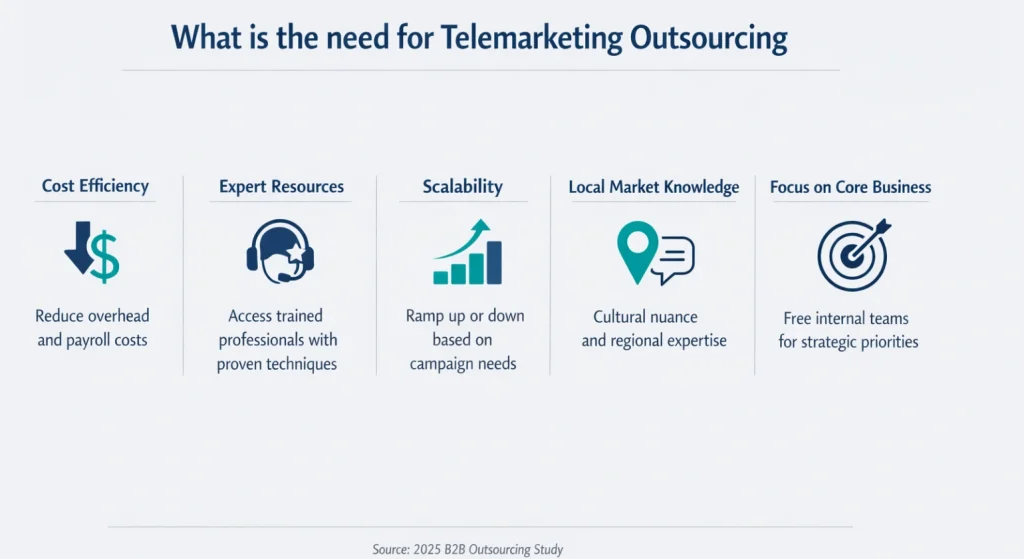
But that simple definition causes most of the trouble. Buyers think they are just moving headcount off payroll. They compare hourly rates in Boise versus Manila and call it a strategy.
As a buyer, you are not looking for cheaper labor but a specific kind of endurance. A good telemarketing service provider also knows about the area zoning trap. For example, if you work with a US-specific telemarketing company, besides the standard know-how of the US market, they even have peculiar knowledge, like that in Pittsburgh you say “pop,” not “soda,” and that in Phoenix the 101 freeway is just “the 101.” This makes them even more relatable for the user. And, therefore, modern BPO solutions leverage this local expertise to build immediate rapport.
Outsourced telemarketing companies typically handle several functions:
- Cold outreach to prospects who have never engaged with your brand
- Lead nurturing for contacts who showed interest but didn’t convert
- Appointment scheduling with decision-makers in target accounts
- Survey distribution for market research or customer feedback
- Event promotion for webinars or trade shows
- Customer reactivation targeting past clients who stopped buying
The model works well for B2B software firms, consulting agencies, and equipment manufacturers. A 2025 study found that 37% of small businesses now outsource at least one sales or marketing function. Companies like Martal Group reported a 6.7% call‑to‑meeting conversion rate when campaigns aligned with ideal customer profiles. Random calling without targeting produces under 1%. Considering that, let’s look at the steps to follow when handing out your telemarketing to a reputed provider.
How to Outsource Your Telemarketing?
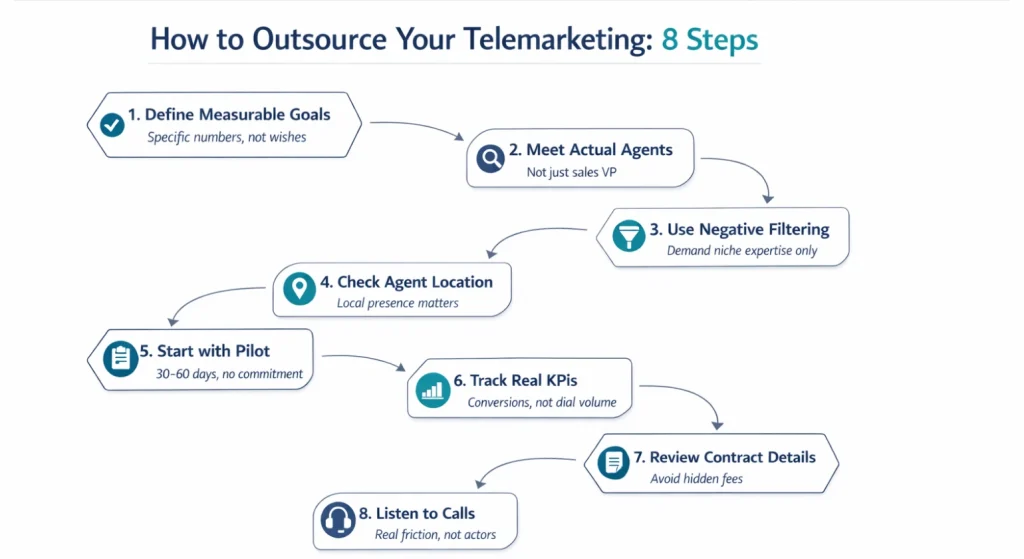
Step 1: Define success in writing, not wishes
Write down exactly why you are outsourcing. Not “generate more leads.” That is too vague. Specify how many qualified appointments per month, from which industries, with what job titles, at what average deal size. Goals without numbers are just wishes. If you cannot measure it, you cannot manage it.
Step 2: Reverse the demo
Every telemarketing outsourcing services firm sends their best people to the sales pitch. You meet the charismatic VP who sold cloud software to Fortune 500 companies. That person will never touch your account. Research from the MIT Sloan Management Review suggests that the most successful outsourcing partnerships are built on transparency and the actual capabilities of the operational team, not just the sales pitch.
Ask to speak with the agent assigned to your shift on Tuesday at 3 P.M. If the vendor says “We are still finalizing the team” or “We will introduce you after onboarding,” they plan to bait‑and‑switch. You bought the closer. You will get the trainee. So, the point is to talk to a real representative who is going to handle your telemarketing needs.
Step 3: Use negative filtering
You also need to tactically use negative filtering. For example, when you say, “We need healthcare experience”, it will invite every vendor to claim they have it. Say instead: “We need someone who sold prior authorization software to revenue cycle managers in hospitals under 400 beds.”
This way you will find a vendor who has specifically mastered your pain point, and doing this filtering will prevent you from outsourcing telesales to generalists to get generalist results. Many firms find that specialized sales support delivers much higher ROI than general outreach.
Step 4: Apply the commute test
Ask how the agents get to work. If they say “most drive about twenty minutes,” that means they have a physical hub and can use local presence dialing. If they say “fully remote, we hire nationwide,” ask how they handle area code mismatches. Without local presence software, your Boise prospect sees a New Jersey number. They do not answer. In short, know how your outsourced team’s mindspace will affect the calls.
Step 5: Set up menu and product pages
Never sign a long‑term contract upfront. Insist on a 30- or 60‑day trial covering 50–100 appointments. This tests agent quality, lead accuracy, and vendor communication without massive risk.
During the pilot run, watch for these red flags:
- Agents who cannot answer basic questions about your product
- Appointments booked with prospects who do not match your ICP at all
- Difficulty getting the account manager on the phone
- Metrics reported only as “calls made” without conversion data
- High turnover: different agents handling your campaign each week
One or two of these might be fixable. Three or more means find a different vendor. Also, do not just psych over the cheapest option instead, look for the quality. Good outsourced telemarketing companies will charge you extra to help you increase the conversions. Pay it. One real decision maker is worth fifty fancy titles.
Step 6: Track KPIs that matter, not vanity metrics
The second conflict: Buyers track the wrong metrics and declare victory while revenue stays flat. Dials and talk time are vanity metrics. They make you feel productive without moving the needle.
Track these instead:
- Qualified appointment rate:percentage of conversations that meet your criteria and actually show up
- Meeting‑to‑opportunity conversion: how many first calls advance to the next stage
- Customer acquisition cost from outsourced leads compared to other channels
- Average deal size from telemarketing versus inbound
Success in these metrics often depends on how well your vendor manages appointment setting services to ensure that only high-intent leads reach your closers. Review these weekly during the first month. If qualified appointment rates stay below 5%, something is broken. Either targeting is off, scripts need work, or agents require more training.
Step 7: Watch for hidden costs and contract traps
Many telemarketing outsourcing services bury fees in fine print. Setup charges, per‑lead data costs, CRM integration fees, and early termination penalties can add thousands.
Vague contracts signal bigger problems. If the service level agreement does not specify response times, quality standards, and escalation processes, you have zero recourse when performance slips.
Demand monthly contracts or include 30‑day termination clauses after the pilot. You need flexibility to walk away if results do not materialize. Vendors who refuse probably know their retention rates are terrible.
Step 8: Listen for ringers
Record your monthly business reviews at random. Listen for objections. If every call in the review goes perfectly and the prospect never pushes back, you are watching actors. Real telesales outsourcing has friction. Skilled outbound sales representatives should be able to navigate these objections naturally rather than following a too-perfect script. If there is no friction, there is no reality.
Conclusion
You are not buying a dialer. You are buying a buffer. The telemarketing outsourcing team takes the first fifty rejections so your internal closers do not have to. That mood preservation is the actual product. In addition, stop optimizing for cost per hour. Optimize for cost per conversation that actually turns into revenue. A vendor at $45 per hour who generates three qualified discussions is cheaper than a vendor at $28 per hour who generates zero.
Outsource telesales only after you have closed at least 20 deals using your own calling or other channels. You need to understand your sales process, qualification criteria, and objection handling before teaching someone else. Moreover, choose vendors who ask hard questions about your ICP, pricing, and competition during the sales process. If they promise results without understanding your business, they will underdeliver.
In case you are interested to read more? Check Out >>> B2B Telemarketing Lead Generation Tips for More Sales
You can also Read >>> Why Businesses Outsource Digital Advertising for Faster Growth?
FAQs
1. Is telemarketing outsourcing dead in 2026?
No. But buying raw lists is dead. The real opportunity is re‑engaging old leads that went dark six months ago. Ask your vendor how they plan to resurrect dormant prospects. If they only want fresh data, they are taking the easy route.
2. How can I tell if my outsourced telemarketing company is lying about dials?
Request average talk time per rep. If it is consistently under 45 seconds, they are speed dialing, hunting for the one‑in‑a‑million buyer. You need hunters who can hold a conversation, not fishermen dragging a net.
3. Can I outsource telemarketing for a highly technical product?
Yes, but only if the vendor employs a “tech translator.” Someone who used to be an engineer and now sells. If the agent cannot pronounce API without stumbling, your credibility evaporates.
4. What is the biggest hidden cost in telemarketing outsourcing services?
Training amortization. Some vendors spread the training cost over twelve months and include an early‑termination penalty equal to the remaining amortized amount. Demand flat‑rate training fees paid upfront.
5. Should I provide my own CRM?
No. Let them use their native system for the first sixty days. Integrate later. If you force them into Salesforce on day one, they spend more time logging activities than talking. Bridge tools like Ringy or Kixie work better during the ramp period.
6. Do outsourced telemarketing companies work for local service businesses?
Yes, but avoid national firms. Find a vendor in your time zone. A telemarketing service in Chicago calling for a Boise plumber sounds local. A vendor in Mumbai calling for that same plumber sounds like a scam. Perception is reality.
7. How do I exit the contract if performance tanks?
Look for a diagnostic clause. If the vendor refuses a thirty‑day performance review with an unconditional exit option, walk away. Good telemarketing outsourcing partners are confident in their ramp. Bad ones lock you in for six months of misery.
8. What is a “ringer” in telesales?
In telesales, a ringer is a fake prospect or staged call used to make agents look better. It is usually an internal person or actor pretending to be a real lead during monitored or demo calls.