Table of Contents
Do you have your next success story right under your nose? When it comes to successful dropshipping using Google Trends, it’s risky to guess—but this is the key to predicting future trends. This is the ultimate way to verify your demand, avoid fading trends, and discover your new product lines before anyone else does.
What Is Google Trends Dropshipping?

Google Trends dropshipping is one of the techniques employed in discovering successful products through the analysis of search trends on Google. This approach enables sellers to identify the trending products in the market.
How Does Google Trends Work
- Search Interest (0-100): The scale is about the popularity of the subject and not the search volume. 100 is the highest value possible and 50 means that interest is down by half.
- Region & Time Filters: You can target specific countries or cities. Look into the “Past 5 Years” window to check whether your product will stay relevant.
- Trend vs. Seasonal Search Demand: This will enable you to differentiate between a temporary viral trend and a season search trend (like the Christmas gift period).
How to Use Google Trends for Dropshipping Product Research
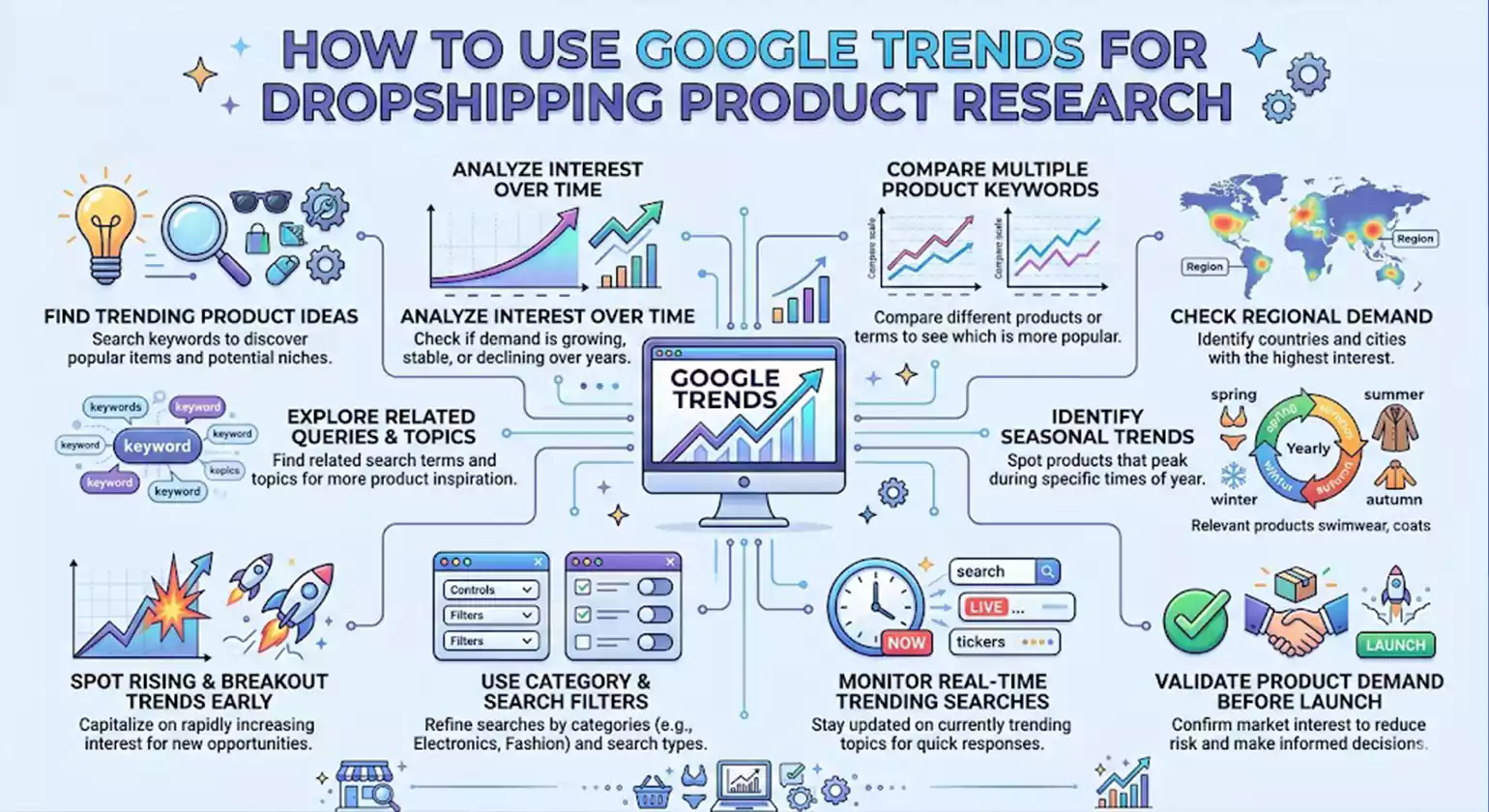
Google Trends is a top tool for online sellers in 2026. It helps you see if a product is worth your time before you pay for ads. Mastering google trends dropshipping methods helps you find long-term winners instead of short-term fads.
1. Find Trending Product Ideas
- Take Action: Change your search filter from “Web Search” to “Google Shopping.” This shows you what people actually want to buy.
- Pro Tip: Discover the “Exploding” trends. These are items that grew by 5,000% in a very short time.
2. Analyze Interest Over Time
A popular product today might be gone tomorrow. Use the “Interest Over Time” graph to see if a product is stable.
- Good Growth: Look for a steady upward line over one or two years.
- Fad Warning: Avoid huge spikes that drop fast, like fidget spinners.
The winning google trends dropshipping strategy seeks products that show stable growth over 90 days, not overnight sensations.
3. Compare Multiple Product Keywords
Utilize the “Compare” function in order to identify which niche is better and thus which product you should focus on.
- Example: Compare “Mushroom Coffee” to “Matcha Powder.”
- The Goal: Pick the item with higher interest or a more stable chart.
4. Check Regional Demand
The “Interest by Subregion” map shows you where to show your ads. This saves you money by targeting the right people.
- Strategy: If a camera is popular in California but not Texas, only show ads in California. This helps you get more sales for less money.
5. Explore Related Queries and Topics
The “Related Queries” section helps you find new keywords. It also shows you other items you could sell.
- Search Tip: Search for “Breakout” Keywords. “Breakouts” refer to rapidly increasing searches.
- Example: The search “Dog Harness” may reveal the increasing search for “Tactical Dog Harness.”
6. Identify Seasonal Trends
Do not launch a summer product when winter is starting. Use the 5-year view to see when items sell the most each year.
The Plan: Start your store two months before the peak season. This gives you time to show up in search results.
7. Spot Rising and Breakout Trends Early
The “Rising” filter helps you find products before they get too crowded on sites like Amazon. This helps you sell items before every other store has them. This fast approach is the heart of a good google trends dropshipping plan.
- Be First: Use this filter to see what is starting to get popular right now.
- Beat Others: Selling early means you can pay less for ads and get more customers.
8. Use Category and Search Filters
Always change your search filter to the “Shopping” category. This is important because it hides people who are just looking for facts. It shows you people who really want to buy something.
- Filter Choice: Select “Shopping” to see commercial demand.
- Better Data: This helps you focus on high-intent buyers instead of students or researchers.
Search filtering is the act of narrowing down google trends dropshipping data to show only the people who are ready to make a purchase.
9. Check Live Trending Searches
Live data allows you to discover “Flash Trends” which occur within a 24-hour span. feature is especially useful for quick ecomerce marketing campaigns on TikTok or Instagram Reels. You will know what is trending at the moment and take swift action.
- Insights: Utilize the “Trending Now” tab to check what has been rising over the past 24 hours.
- Viral Ads: Create viral ads based on current trends.
10. Validate Product Demand Before Launch
Always check if a product is growing before you spend money on ads. Validation stops you from selling items that no one wants anymore. This is the most effective method of reducing risks.
- The Final Test: Use the 12-month filter to make sure the trend is still healthy.
- Avoid Failure: If the graph is going down, do not launch that product.
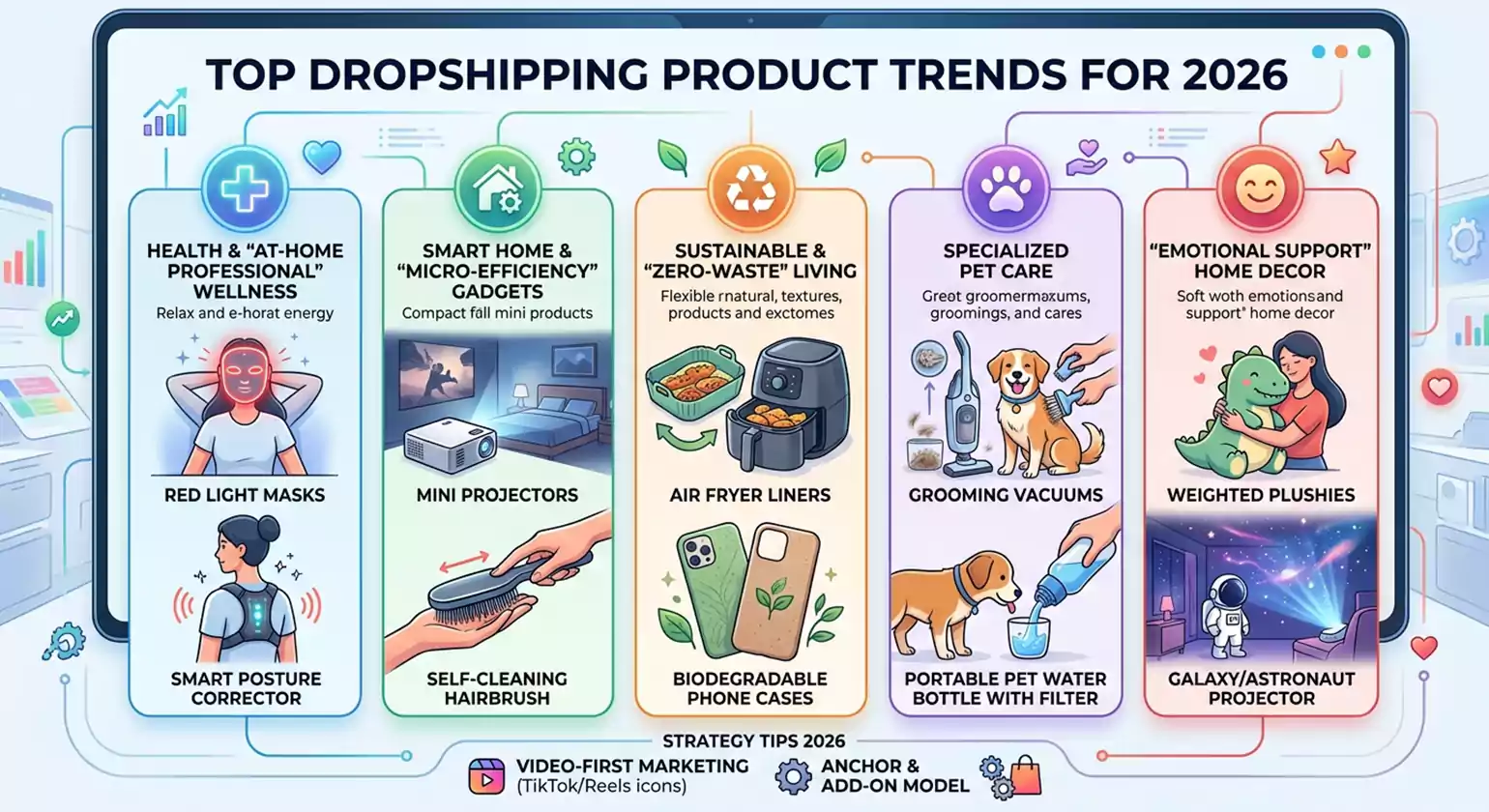
Top Google Trends for Dropshipping Products in 2026
Product | Key Drivers | Est. Margin | Target Audience | Top Channels |
Mouth Tape (Sleep Strips) | Sleep health, wellness | 40-60% | Biohackers, 25-45yo | TikTok, Instagram |
Flat Back Earrings | Comfort fashion | 50-70% | Fashion lovers, Gen Z | Pinterest, IG Reels |
Glass Straws | Eco-sustainability | 30-50% | Green consumers, 20-40yo | Facebook, YouTube |
Sauna Blankets | At-home detox | 35-55% | Fitness enthusiasts | TikTok, Email |
Sleep Bonnets (Silk) | Hair/beauty protection | 45-65% | Women, curly hair care | IG Stories, TikTok |
Blue Light Therapy Devices | Skincare tech, acne treatment | 40-60% | Teens/adults, skincare | YouTube, TikTok |
Case Study: Scaling Dropshipping with Trends + VA Support

1. Case Study: Sarah’s Lifestyle Store
The Problem: Sarah’s dropshipping store was taking over her life. She spent 6–7 hours every day on boring manual tasks like fixing order errors and answering emails. She was exhausted and had zero time to grow her business or spot Google Trends Dropshipping.
The Strategy: Sarah decided to work smarter by using Google Trends to see which products were actually popular. To handle the workload, she hired two virtual assistants (VAs):
Product VA: Watched Google Trends, found winning products, and contacted suppliers.
Ops VA: Managed the Shopify store, processed orders, and talked to customers.
In her new approach, the VAs did the heavy lifting, leaving Sarah to only focus on picking the best products and running ads.
The Result: In two months, Sarah’s workweek dropped from 35 hours to just 10. Mistakes fell by 80% because her team used clear checklists. With her extra time, Sarah scaled her winners, and her revenue grew 4x in six months without the burnout.
2. Case Study: Douglas’s Tech & Apparel
The Problem: Douglas managed a dual-niche store but was paralyzed by inventory bloat and stagnant growth. He spent his weeks manually cross-referencing tech specs and fashion sizes, leaving him too exhausted to identify which products were actually profitable. His “gut-feeling” scaling led to high ad spend on products with declining interest.
The Strategy: Douglas moved to a data-driven plan using Google Trends to track seasonal shifts. He hired a Technical VA and a Logistics VA to help:
Tech VA: Checked Google Trends Dropshipping for long-term growth and “breakout” topics to ensure products were worth the investment.
Logistics VA: Automated inventory updates and handled technical customer support using simple scripts.
The Result: In three months, Douglas cut his workload by 75%. By using trending search terms in his ads, his return on ad spend (ROAS) jumped 60%. He launched two private-label products, doubled his profit, and reclaimed 25 hours a week.
3. Case Study: Elena’s Beauty Brand
The Problem: Elena’s brand was growing, but she was trapped in “admin hell.” She spent 40+ hours a week tracking skincare trends and fixing shipping delays. This left her zero time to create new products, causing her business to stall.
The Strategy: Elena used Google Trends Dropshipping to find rising interest in specific ingredients (like “rice water”). To scale, she hired a VA duo:
Trend VA: Monitored search data daily and found suppliers for trending ingredients.
Logistics VA: Managed VA Shopify orders, influencer samples, and customer support.
The system was simple: Google Trends showed a spike → the VA sourced the product → Elena approved it → the VA launched the listing.
The Result: Within 60 days, Elena’s workload dropped to just 12 hours a week. With the VAs managing the backend, she launched three “trend-first” products that sold out immediately. Her revenue grew 5x in eight months, allowing her to focus entirely on being a creative director.
Advanced Google Trends Strategies for Dropshipping

Google Trends Dropshipping is a free tool that shows what people are buying. It helps you find winning products by tracking real search data. Instead of guessing what might sell, you can use these facts to pick items that people actually want right now.
Using category filters to refine data
- Pick Your Industry: If you search for “Pink,” use the “Beauty” category so you don’t see results for the singer or the color.
- Find Local Buyers: Use the “Interest by subregion” map to see which states have the most customers. This helps you save money by showing ads only to those people.
- Clean Up Results: Filtering by category removes “search noise” and shows you only the shoppers in your specific niche.
YouTube and Shopping search trends?
Most people only look at “Web Search,” but specific filters show you exactly when a trend is about to explode.
- Spot Early Trends: Switch to “YouTube Search.” Products often go viral in videos a few days before they become popular on the rest of the web.
- Find Ready Buyers: Change your search to “Google Shopping.” This shows you people who are ready to spend money rather than people just looking for info.
Finding Micro-Niche Products
A micro-niche is a small, specific market. These are great because they have less competition and higher profits.
Look for “Breakout” Keywords
Go to the Related Queries box and click “Rising.” If you see the word “Breakout,” it means that search has grown by more than 5000%.
Check for Long-Term Growth
Don’t get tricked by a “fad.” Look at the “Past 5 years” of data. You want to see a line that goes up slowly and stays steady.
Conclusion
Google Trends Dropshipping is the best tool to use in finding profitable drop shipping products in the year 2026. You will make informed decisions with data and ensure low risks when doing so. Get an edge on your competitors using these tips. Wish to boost your company? It’s time to conduct research about your next hit product using Google Trends!
FAQs
How reliable is Google Trends when choosing winning products?
It’s excellent for analyzing search interest, but it cannot measure any real sales. Consider it like taking your vitals—it indicates demand without indicating purchases.
How can beginners begin using Google Trends for drop shipping?
The first thing to do would be typing in one broad niche into the Google Trends search engine. Filter your results by “Past 5 years.”
Can Google Trends really help find profitable products?
Definitely. It helps you spot “rising stars” before they get saturated. You will be able to outdo your competitors as well as significantly reduced your marketing costs.
What niches work best with Google Trends for dropshipping?
Hobbies, seasonal items, and home solutions perform best. It’s perfect for seeing when people starting search for “summer gear” or “winter essentials” so you can prep your store early.
Can I use Google Trends for international dropshipping?
Yes! You can filter by specific countries or cities. This is a goldmine for finding untapped markets where a product is exploding but nobody is running ads yet.