Table of Contents
Key Takeaways
- Clear 90 day SEO roadmap that helps plastic surgeons beat nearby competitors and turn searchers into booked consultations.
- Practical work on Google Business Profile, site structure, and content that fits how real patients actually search in your city.
- Procedure-focused pages, supporting blogs, and reviews that together lift local rankings, not just raw traffic numbers.
- Simple tracking habits so organic visits get linked to real surgeries, not just vanity metrics inside analytics dashboards.
Introduction
In the medical field, a patient’s journey almost always begins with a search engine. While general digital marketing for doctors focuses on broad patient education and brand building, plastic surgery requires a more nuanced approach that balances clinical expertise with aesthetic aspiration to convert high-intent leads into consultations.
This 90 day roadmap for seo for plastic surgeons breaks that pattern with a steady, realistic plan comprising 3 phases: foundation, content building, and authority & reviews, which will definitely help you to stand neck-and-neck against your nearby plastic surgeons in the search results.
By the end of 90 days you should see more impressions, more directions requests, and more phone calls from Google surfaces. A few key procedures usually start climbing into the top three.
How is SEO for Plastic Surgeons Different?
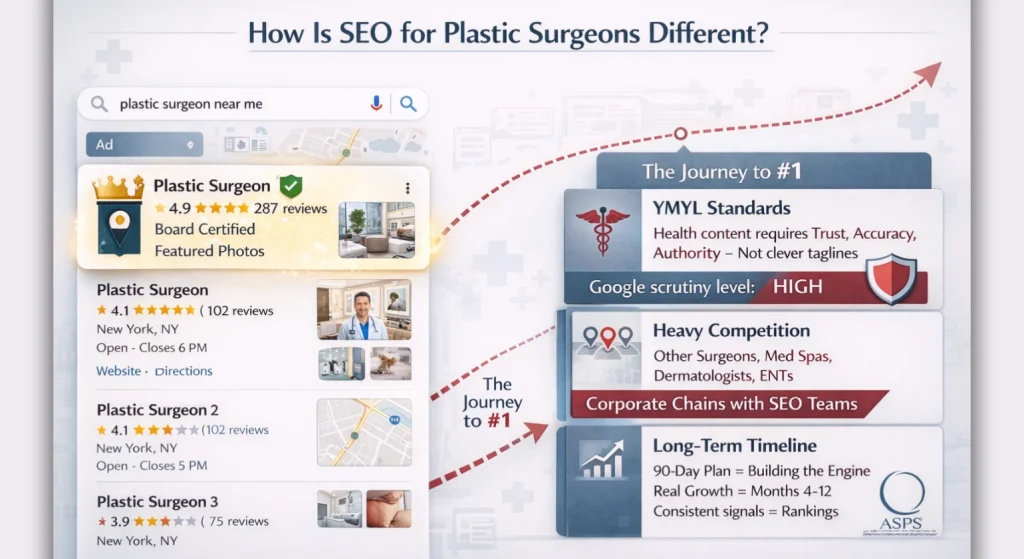
Google treats medical sites as sensitive content, as they fall under YMYL (your-money-your-life) categories, which are, in short, the topics related to finance, health, nutrition, etc. For SEO for cosmetic surgeons and SEO for aesthetic surgeons, trust, accuracy, and consistent business details matter more than clever taglines or trendy design.
In addition to the topic complexity, competition is heavy too, especially in metro areas. You are not only against other surgeons but also med spas, dermatologists, ENTs, and chains that hire a plastic surgeon SEO company early.
Considering the sensitivity of the field, your SEO practices must align with the ethical standards set by organizations like the American Society of Plastic Surgeons, ensuring that claims about results and recovery remain grounded in reality. This complexity is why the real “SEO engine” starts humming between months four and twelve, once Google recognizes your consistent signals of expertise.
Think of this 90 day plan as building the engine. Following this will help you get the real growth, which is likely to arrive between months four and twelve, and once Google sees consistent signals and patients keep engaging with your content.
Days 1-30: Foundation Phase
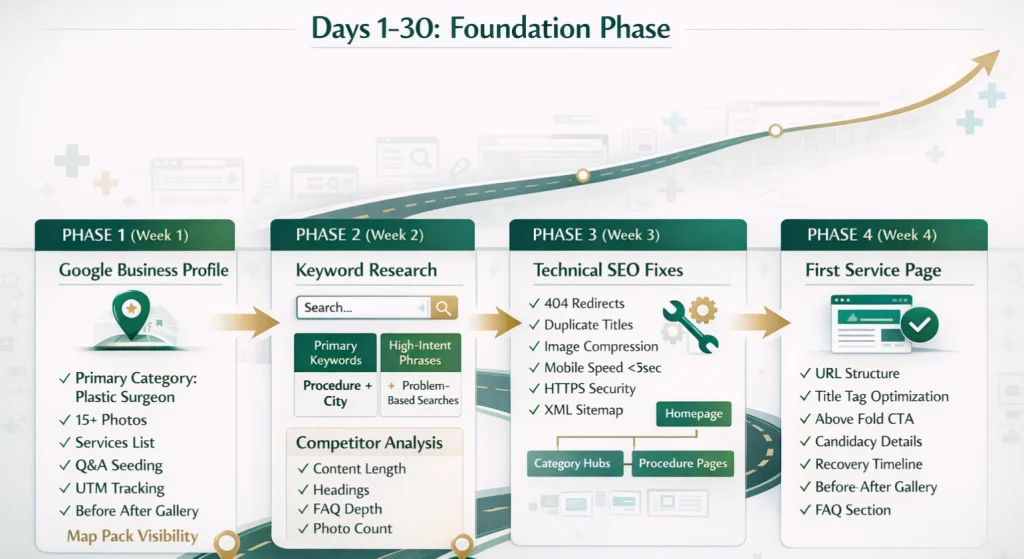
Week 1: Claiming and optimizing your Google Business Profile
Your Google Business Profile decides if you show up in that golden map pack where patients hunting rhinoplasty or facelifts click directions instantly. Calls from there convert way faster than anyone stumbling from a blog post, since they’re already sold on location and ready to book. First go to: GBP site, add your clinic name, and claim it, then lock in Plastic Surgeon as your primary category. Add secondary categories only for what you actually offer, like med spa or skin care.
Next layer in the specifics that make Google trust you over competitors.
List concrete procedures under Services: rhinoplasty, facelift, gynecomastia surgery, mommy makeover, and breast lift, each with plain descriptions patients actually read. Point the appointment URL straight to a booking page, not your homepage, and use UTM tags so analytics catches every GBP-sparked consult. Pile in at least fifteen photos right away, grabbing exterior shots, the entrance, waiting room, staff, your portrait, treatment rooms, and consented before-and-after sets that scream real results.
Filenames like “rhinoplasty-city-before-after-01.webp” sneak in long-tail SEO juice without trying hard, paired with alt text that nods to the procedure and location naturally. Most profiles let the Q&A section gather dust for months, but you seed it first with honest pre-consult questions patients always ask. Then nudge real ones to chime in via follow-up emails or handy printed cards, turning idle curiosity into active conversations that boost your local edge.
Week 2: Conducting keyword research for your specific procedures
High value search terms for seo for cosmetic surgeons tend to be simple phrases. Think “procedure plus city” and “procedure plus near me,” including nearby suburbs and commuter towns. Also, look inside Search Console if your site already has data. Then expand with tools like Semrush, Ahrefs, or even the free Keyword Planner, filtered to your region and language.
Each major surgery needs one primary keyword and a handful of supporting ones. For rhinoplasty, that might be
- rhinoplasty city
- nose job city
- ethnic rhinoplasty city
- revision rhinoplasty city
Patients often describe their problem instead of the procedure name. They search for:
- droopy eyelids surgery city
- loose skin after pregnancy
- wide nostrils correction
- excess fat under chin
These terms usually have lower keyword difficulty but show very strong intent. Someone typing “wide nostrils correction” is further along than someone searching “nose surgery.”
In addition, check the top 3 competitors‘ rankings for each term you want. Look at their pages in detail:
- how long is the content
- what headings they use
- how many internal links point to the page
- do they have a deep FAQ section
- how many before‑and‑after photos are shown
Do not copy them. Understand why Google ranks them and build something better.
Week 3: Fixing critical technical issues on your website
Technical problems quietly hold back plastic surgery SEO even when the copy looks great. If Google cannot crawl or render your main pages quickly, rankings tend to stall. Ensuring your site’s backend is optimized often requires more than just a one-time fix; integrating reliable healthcare managed services can provide the 24/7 monitoring and technical infrastructure support needed to keep your site fast, secure, and compliant.
Running a crawl with Screaming Frog or Sitebulb reveals what is broken under the hood. Export these lists:
- 404 errors that should be redirected
- redirect chains longer than two hops
- duplicate title tags confuse Google.
- missing meta descriptions
- thin doorway pages that repeat the same text across different URLs
Mobile page load should stay under roughly three seconds on a mid‑range device using 4G. Heavy galleries with uncompressed images are almost always the reason pages feel slow.
Convert images to WebP or another efficient format. Enable lazy loading for photos low on the page. Keep hero images under about 200 kilobytes without ruining quality. If your site structure feels cluttered or slow, it may be time to consult with experts in website design and development to ensure your “hubs” (Face, Breast, Body) are logically organized and your HTTPS protocols are watertight.
Site structure works best when it is shallow. A good flow looks like this:
- Homepage
- Category hubs: Face, Breast, Body, Non‑surgical
- Individual procedure pages under each hub
Week 4: Creating your first optimized service page
For your first page, pick one procedure that brings strong revenue and has search volume in your city. Breast augmentation, rhinoplasty, and mommy makeover often top that list in many regions. The URL can look like “/rhinoplasty-city”. The title tag uses the main keyword and an outcome, for example, “city rhinoplasty surgeon” for natural nose surgery results.
Above the fold, give a quick, clear overview of whom the procedure suits and what outcome they can expect. Don’t forget to add a simple call to schedule a consultation without pushing hard-selling language. Many high-growth practices utilize healthcare virtual assistants to manage these incoming inquiries immediately, ensuring that the traffic generated by your SEO efforts results in booked appointments rather than missed opportunities.
- Include specific timelines, like when bruising usually fades or when patients return to office work.
- Embed a procedure-specific before-and-after gallery on that page.
- Sort images by angle and lighting so nose or breast changes are easy to compare, which quietly improves engagement signals.
- Finish with a short FAQ section that handles very practical concerns. Pain levels, time off work, driving restrictions, combining procedures, and when final results appear are common topics.
Days 31-60: Content Building Phase
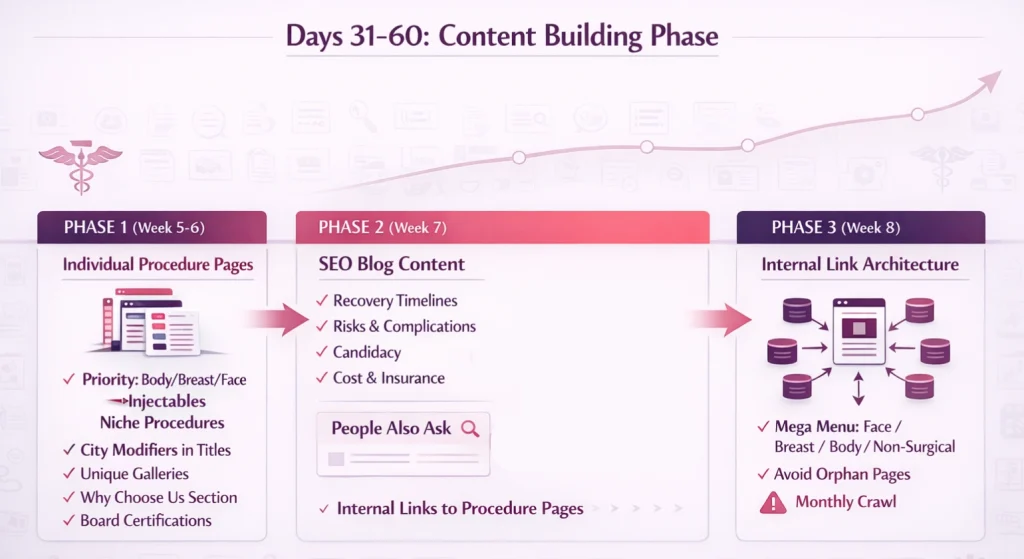
Week 5-6: Building individual pages for each procedure you offer
Many clinics keep every treatment in a single Services page with short blurbs. Google has no clear page to rank for eyelid surgery city or tummy tuck city. Med spas and solo practitioners with dedicated URLs win those queries.
Individual procedure pages give each keyword a proper home. Every page carries focused content, a unique gallery, local cues, and internal links. Together they push relevance higher over time.
Priority usually follows profit and search demand:
- Core body, breast, and face surgeries come first
- Injectables and fillers next
- Niche operations like labiaplasty or otoplasty when time allows
City modifiers belong in titles, meta descriptions, and a few lines of copy. The text reads better when some sentences mention landmarks or neighborhoods instead of repeating the city name robotically.
Include a short “why choose this practice” area on each page. Bullets work well here:
- Board certification
- Number of years in practice
- Annual case volume for that procedure
- Subspecialty training or fellowships
These details help both conversion and perceived expertise.
Week 7: Writing your SEO-optimized blog posts
Blog posts support your procedure pages and push them up. They are smaller pages that feed authority into your main surgery URLs.
The best topics are the questions you answer every week in consults:
- How long swelling lasts after a facelift
- Combining tummy tuck with hernia repair
- Choosing implant size after pregnancy
- Can you fly after liposuction
- When can I exercise after breast augmentation
People Also Ask boxes in Google are an ongoing idea source. Search your main plastic surgery SEO terms, then gather related questions and group them into clusters:
- Recovery timelines
- Risks and complications
- Candidacy requirements
- Cost and insurance
Articles about recovery, cost factors, timing, and myths bring in early‑stage researchers. Retargeting ads and email follow‑ups can slowly turn those readers into booked appointments.
Internal links from blogs should point back to the most relevant procedure pages using natural language anchors:
- Read more about facelift surgery in city.
- Explore breast lift options in city.
- See before and after photos of rhinoplasty.
Week 8: Setting up proper internal linking between your pages
Internal links show Google which pages matter most. They also help patients move from vague interest into specific treatments without hunting through menus. Beyond linking procedure pages, your broader strategy should align with industry-standard healthcare SEO services, which prioritize a ‘hub-and-spoke’ structure to build overall domain authority and trust.
Navigation should highlight major procedures instead of hiding everything under one “Services” item.
- Group face, breast, body, and non‑surgical sections in a mega menu
- Avoid dropdowns that bury content three clicks deep
- Use descriptive labels, not industry jargon
Each procedure page can link to a few related surgeries or alternatives when clinically sensible:
- A rhinoplasty page might reference chin augmentation or non‑surgical contouring
- A tummy tuck page can link to liposuction or mommy makeover
- A facelift page can mention neck lift or eyelid surgery
Blog clusters work using a hub‑and‑spoke structure. The main facelift page becomes the hub. Posts about mini lifts, neck lifts, and detailed recovery timelines link back to that hub. Investing in long-term SEO efforts helps your practice move away from a total reliance on expensive paid ads. By improving your organic search visibility, you ensure that your website appears prominently in the ‘earned’ results for competitive terms like ‘rhinoplasty near me’ or ‘best breast augmentation surgeon,’ establishing immediate authority and trust with potential patients.
Days 61-90: Authority Building Phase
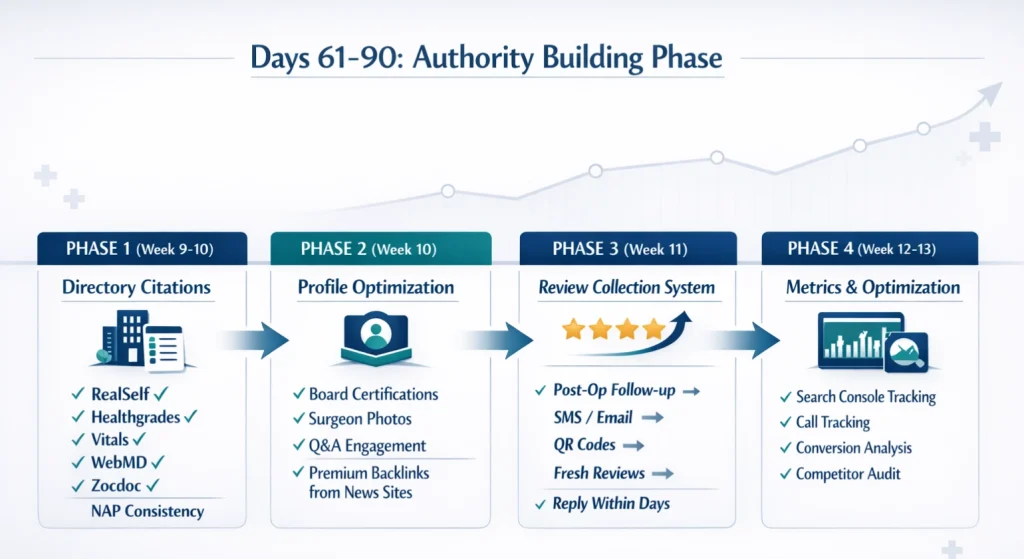
Week 9-10: Getting listed in medical directories correctly
Local authority for plastic surgery SEO still depends heavily on citations. Medical and procedure‑focused directories usually carry more weight than random general business listings.
Start with these platforms:
- RealSelf
- Healthgrades
- Vitals
- WebMD
- Zocdoc
- Local hospital physician directories
- National association profiles (ASPS, ASAPS, etc.)
Consistency is everything. Every listing must use exactly the same:
- Practice name
- Street address (no “Suite” vs “Ste” mismatches)
- Phone number
Complete every profile as fully as possible:
- Surgeon photo
- Board certifications
- Subspecialties
- Languages spoken
- Parking options and nearby transit
- Accepted insurance
Q&A areas inside these platforms are often ignored. Thoughtful, short answers to patient questions there can rank on their own and send surprisingly targeted referral traffic.
Beware of bulk submission services. Some agencies sell mass directory submissions. If the list contains irrelevant business sites, those links add clutter instead of real strength.
A handful of strong backlinks from regional news sites or reputable health publishers often outweigh dozens of weak citations. Typical hooks:
- Interviews about new techniques
- Safety explainers during recovery seasons
- Expert quotes for local news stories
A handful of strong backlinks from regional news sites or reputable health publishers often outweigh dozens of weak citations. Typical hooks include interviews about new techniques, safety explainers during recovery seasons, and expert quotes for local news stories. While these strategies are powerful, navigating the regulatory and technical nuances of the aesthetic industry often requires the expertise of established medical SEO companies. These partners bring the data-driven methodologies needed to build long-term authority while you focus on patient care. To manage this high-level media outreach effectively, many practices utilize specialized link-building specialists to secure premium local placements while the surgeon stays focused in the OR.
Week 11: Implementing a patient review collection system
Review freshness is a massive ranking factor. The easiest way to stay consistent is to build it into your front-desk routine. Having a healthcare virtual assistant follow up with happy post-op patients via email or SMS can ensure a steady stream of five-star feedback without adding to your in-office staff’s workload.
Front desk routines can solve this.
- After a happy post‑op visit, staff briefly mention reviews
- Send a short SMS or email with direct links to Google Business Profile and one or two key directories
- Keep wording simple – “Helping other patients choose a surgeon” feels more natural than “Please give us five stars”
Printed cards or small signs with QR codes near checkout boost response rates. The QR code should lead straight to the review page, not just the main profile.
Reply to every review within a few days where possible.
- Keep responses polite and brief
- Never include private health details
- Mention the procedure in broad terms when appropriate: “Thank you for sharing your facelift experience”
That language sometimes appears in long‑tail review‑based searches.
Week 12-13: Measuring your progress and adjusting your strategy
By weeks 12 and 13, data begins to shape decisions more than guesswork.
Search Console should show:
- Rising impressions for core procedure keywords
- Slow ranking gains for target terms
- Which queries start sending clicks to your main money pages
Analytics needs to separate organic search, local listings, and paid channels. Track goals for:
- Consultation form submissions
- Booking requests
- Tracked phone calls from high‑intent pages
Call tracking numbers help connect real consults back to the right source – “rhinoplasty organic” or “facelift blog.” Dynamic number insertion on the site keeps external listings consistent.
If a valuable term sits around positions 11–15 for weeks, examine competitors in detail:
- Do their pages load faster?
- Do they answer more questions?
- Do they show stronger galleries and testimonials?
Traffic climbs but surgery bookings stay flat.
The issue usually lives on the page, not in the search results. Clearer forms, better proof, and stronger offers often unlock the missing conversions.
- Test different calls‑to‑action
- Add more patient stories with photos
- Make the consultation scheduler visible without scrolling
What Happens After Day 90: Maintaining and Growing Your SEO
After 90 days the basics should run on a stable routine. From here, SEO turns into a cycle of refinement, expansion, and promotion rather than constant rebuilding.
New procedures or techniques need proper pages once they generate consistent demand.
- Deep plane facelift
- Ultrasound‑assisted liposuction
- Specific implant types (gummy bear, smooth round, etc.)
- Minimally invasive alternatives
Over time, content shifts from broad topics to more nuanced situations:
- Revision cases
- Complex combinations (tummy tuck + hernia repair)
- Age‑specific concerns (facelift for 50s vs 60s)
- Ethnicity‑specific techniques
These often attract highly qualified patients who have done their research.
Ongoing local SEO includes quarterly checks on:
- Google Business Profile categories
- New photos of the practice and team
- GBP Posts about seasonal topics
Seasonal windows perform well:
- Wedding season (bridal procedures)
- Holiday recovery windows (winter break)
- Summer (liposuction, body contouring)
When to hire help. Some clinics eventually work with an experienced agency when internal time runs short. The stronger firms do not sell generic packages. They report on:
- Lead quality by source
- Cost per booked case
- Which content feeds the highest‑value surgeries
Algorithms change. Competitors create new content. Patient expectations keep evolving. The practices that treat SEO as an ongoing system, not a one‑time project, usually stay ahead.
In case you are interested to Read More? Check Out >>> Local SEO for Healthcare Tips for Doctors and Clinics
You can also Read >>> How Conversational AI in Healthcare Transforms Patient Care
FAQs
1. How long does SEO take to bring new plastic surgery patients?
Most clinics see early movement within sixty to 90 days as impressions and map views rise. Strong, reliable growth in consultations usually appears between four and twelve months.
2. Is SEO or paid ads better for plastic surgeons?
Paid search sends leads quickly and helps test headlines and offers. SEO builds a base of owned visibility that keeps producing leads without constant per click spend, so both together often work best.
3. What budget makes sense for plastic surgery SEO?
Single surgeon practices often invest the value of one or two average procedures per month. Larger centers in competitive cities may allocate the equivalent of several surgeries for ongoing SEO and content.
4. How is plastic surgery SEO different from generic local SEO?
Medical risk, regulation, and the emotional weight of surgery change the content rules. Education must go deeper, claims stay conservative, and author credibility weighs more than in other local industries.
5. Should I hire a plastic surgeon SEO company or build an internal team?
Internal staff understand your brand voice and patient base. A specialist plastic surgeon SEO company or the best SEO agency for plastic surgeons brings processes, tools, and media relationships already tuned for this niche.