Table of Contents
Email marketing trends are changing fast. Are you keeping up or falling behind? In 2026, smart personalization, real customer data, and better automation are changing how brands talk to people. Keeping up isn’t a choice anymore, it is how you get better results and keep customers happy.
What Are Email Marketing Trends and Why Trends Matter for Email Marketing
Trends in email marketing are the new ways of reaching out to people through emails. Trends in email marketing include new tools, new strategies, and new ways of reaching people through email marketing. In 2026, email marketing trends matter more than ever.. They are important because they show you the success rate of your email marketing campaigns, the success rate of engaging the people you are reaching out to, and the success rate of getting a return on investment.
If you are not at par with the email marketing trends, you are not only out of the game, you are out of the game altogether. The areas of focus in 2026 are obvious. There are more than 4.6 billion people using email worldwide. It is still the most reliable way to ensure you’re getting the return on investment. For every $1, you can expect an ROI ranging from $36 to $42. However, everything is changing, and everything is changing. People are changing, and the algorithms are changing as well.
Why Should Businesses Follow Email Marketing Trends?
it’s be honest email marketing isn’t what it used to be. The rules have changed. The tools have changed. And your readers have changed too.
- People Want Emails That Feel Personal – Nobody likes getting a mass email that clearly was not written for them. Over 70% of users prefer emails that speak to their needs. If your email feels generic, it goes straight to trash.
- Inboxes Are Noisier Than Ever – Your readers are bombarded with over 100 emails every day. You are competing with brands, newsletters, and promotions all fighting for the same attention. Standing out is tough but very doable.
- Your Readers Live on Their Phones – Six out of ten emails are opened on a phone. If your email looks messy on a small screen, your reader is gone in seconds.
How Do Email Marketing Trends Impact ROI and Engagement?
Email trends are not just about keeping up with new tools. They change how real people respond to your emails. Get them right and engagement climbs. Revenue follows. Here is how.
- Personal Emails Hit Differently
Nobody wants an email that feels mass-produced. Personalized emails generate up to 6 times more transactions than generic ones. Emails that feel personal get better results.
- Automation Does the Heavy Lifting
Automated emails never take a day off. They run quietly in the background and still deliver results. They account for 20–25% of total email revenue. Set them up once and let them work.
- Interactive Emails Pull People In
Flat boring emails get scrolled past in seconds. Interactive emails make readers stop and engage. They can improve click-through rates by 2–3 times.
Which Latest Email Marketing Trends Are Dominating in 2026?
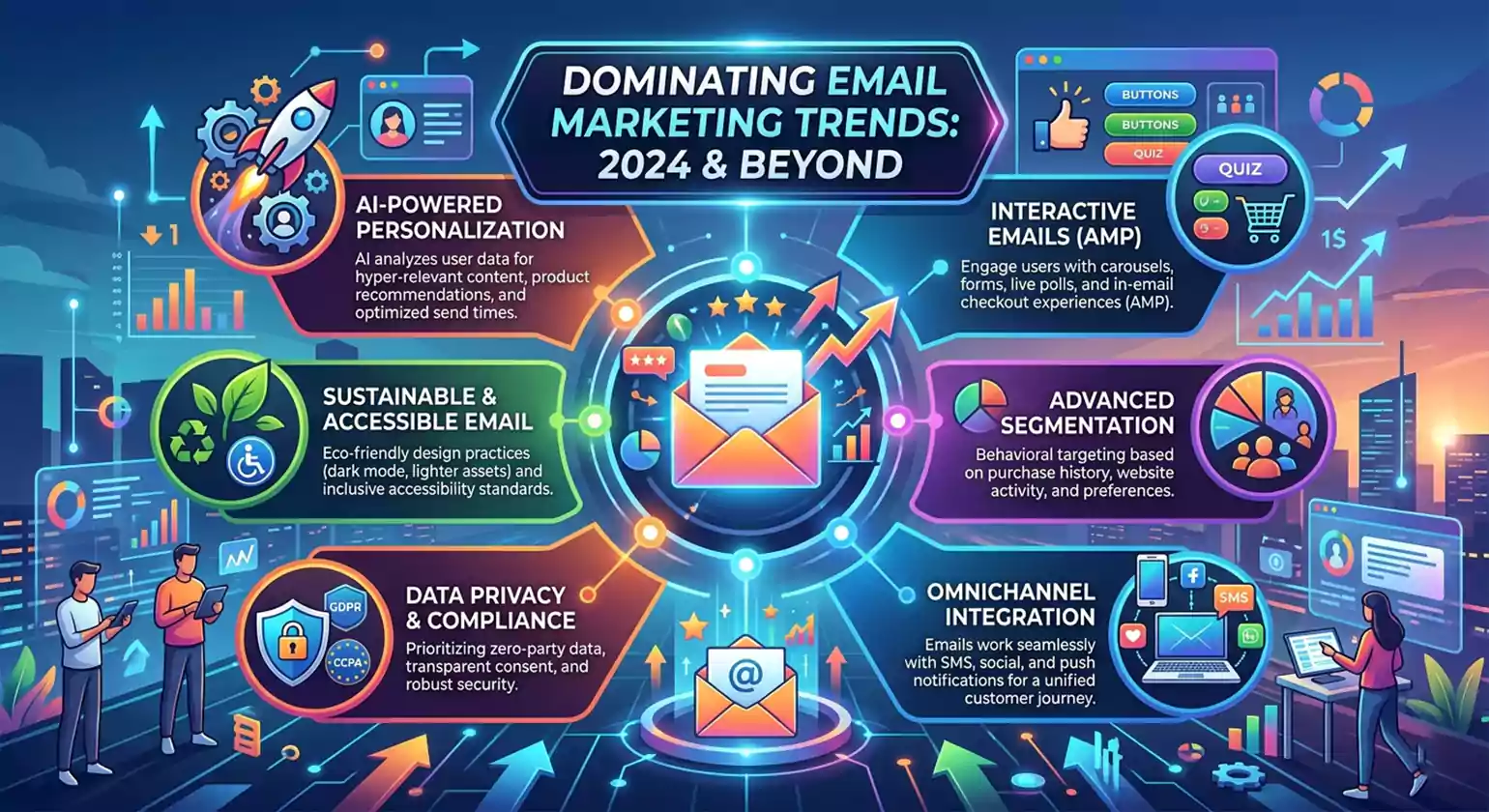
The biggest email marketing trends in 2026 are hard to miss. AI that personalizes each message, privacy-first tactics, predictive email tools, clickable emails, and smarter automation are all taking over. They all do one thing: send people emails that actually feel like they were made for them.
1. AI & Generative AI in Email Marketing
AI is changing how marketers create, design, and send emails—and it’s a bigger shift than most realize. Marketers use AI to write subject lines, design email layouts, and even predict how a campaign will perform before it’s sent.
- AI-generated subject lines can push open rates up by 20–25%.
- Personalizing your content can lift click-through rates by as much as 30%.
- AI tools can cut campaign creation time by 40–60%, freeing you up to focus on strategy.
- And the results speak for themselves. When your emails feel personal and your subject lines are sharp, people notice. They open. They click. They convert.
Actionable Tip: Stop guessing which subject line will perform better. Use AI tools to test multiple versions at once and let the data pick the winner for you. It is one of the easiest wins in email marketing right now.
2. Hyper-Personalization with Real-Time Data
Let’s be real, generic emails are dead. Nobody wants a mass email that feels like it’s not for them. In 2026, smart brands do more than just throw in your first name. They look at what you browsed, where you are, and what you bought before. Then they shape every email around that..
And the numbers do not lie:
- Personalized emails drive up to 6 times more transactions than generic ones. That is not a small bump. That is a massive difference.
- Dynamic content changes on the fly based on exactly what the user just did. No delays. No guessing.
- This is not about making emails look personal. It is about making them actually be personal. There is a big difference between the two.
Real-World Example:
Picture this. A customer spots a product they love, adds it to their cart, and then gets distracted and leaves. Within minutes their inbox has an email showing that exact product. Not a generic discount. Not a bland newsletter. The exact thing they were just looking at.
3. AI-Driven Email Automation & Workflows
Email Marketing Trends automation is not what it used to be. AI has made it smarter, faster, and far more effective. Instead of sending emails on a fixed schedule, brands now respond to what users actually do in real time. And the results are seriously impressive. Automated emails generate 320% more revenue than bulk emails. Let that sink in. Trigger-based workflows improve engagement by 2–3 times compared to standard campaigns.
The most popular workflows right now are:
- Welcome email sequences – Your first chance to make a great impression.
- Cart abandonment emails – A simple reminder for shoppers who got distracted and didn’t finish their purchase.
- Re-engagement campaigns – Bringing back readers who have slowly stopped interacting.
Pro Tip: Ditch the fixed send schedule. Use behavior-based triggers instead. When someone takes an action, respond to it. That is how you stay relevant and keep people engaged.
4. Privacy-First & Cookieless Email Marketing
With the rise in the number of privacy regulations, marketers are opting for a consent-based Fundamentals marketing strategy.
- Over 70% of users prefer brands with high data privacy
- Third-party cookies are disappearing fast
Key Strategies:
- Permission-based email lists
- Focus on transparency and trust
- Value exchange
5. Predictive Analytics & Customer Intent Modeling
What is your customer going to do next? That’s the question every marketer wants answered.. And now, predictive analytics makes it possible. Instead of guessing, you can use real data to figure out what your audience is likely to do before they do it.
The results speak for themselves: Businesses using predictive models see 20% more conversions. That is not a small win. That is a real edge over competitors who are still guessing.
And it goes beyond just conversions. AI can now tell you the best time to send an email and the best product to recommend to each reader. You do not have to figure that out yourself anymore. The data does it for you.
Real-World Example: A customer bought from you three months ago. Predictive analytics spots the pattern and flags them as likely to buy again soon. Before they even start looking, you send them a special offer on something they actually want. They feel understood. You get the sale. Everyone wins.
6. Interactive & AMP Emails
Nobody wants to open a dull, lifeless Email Marketing Trends anymore. People want something they can actually click or tap on. That’s where interactive emails shine. They turn reading into doing—something fun, memorable, and way less boring.
And the numbers back it up:
Interactive emails boost engagement by 2–3 times compared to standard emails. That is a massive jump for something as simple as adding an interactive element.
Users can now fill out forms, take quizzes, and even shop directly inside the email itself. No clicking away. No extra steps. Everything happens right there in the inbox.
The most popular formats right now are:
- Polls and Surveys – Ask your audience something. People love sharing their opinion and it gives you valuable data at the same time.
- Spin to Win Offers – A little bit of fun goes a long way. Give readers a chance to win something and watch your click rates climb.
- Product Carousels – Let readers browse your products without ever leaving the email. It is like bringing your store straight to their inbox.
7. Mobile-First + Dark Mode Optimization
- Over 70% of emails are read on a mobile device.
- Bad mobile experiences can lead to 50% less engagement.
- Dark mode is growing extremely fast.
Best Practices:
- Responsive design
- Subject line length: 40 characters or less
- Image optimization for dark mode
8. Zero-Party Data & First-Party Data Strategy
Zero-party data is information people choose to share with you. No tracking. No guessing. They hand it over willingly because they trust you and want a better experience.
The numbers prove it:
Brands that use their own data often make twice the money compared to those still chasing third-party data. That’s a big gap you can’t ignore.
Zero-party data helps you build real trust with people. It also makes personalization feel natural, not creepy.
The best ways to collect it are simple:
- Preference Centers – Let your audience tell you exactly what they want to hear about. Then deliver just that.
- Surveys and Quizzes – People enjoy sharing their opinions when there is something in it for them.
- Email Sign-Up with Interests – Give new subscribers a chance to choose their interests from day one. It creates a relationship based on relevance and respect from the very start.
9. Real-Time & Dynamic Email Content
Static emails are becoming a thing of the past. Today’s emails are alive. They change and update the moment someone opens them. What your reader sees is not what was written days ago. It is fresh, relevant, and pulled in real time.
Here is what that actually looks like in practice:
Email content updates automatically the second it is opened. No manual changes needed on your end.
Readers see real-time prices, live stock availability, and ticking countdown timers right inside their inbox.
10. ROI-Driven Email Marketing & Revenue Attribution
Marketers are done playing guessing games. They want to see real numbers and real results. Every campaign needs to prove its worth. And Email Marketing Trends? It delivers like no other channel out there.
The proof is in the numbers: Email marketing returns an average of $36–$42 for every single dollar spent. That is one of the highest returns of any marketing channel available today. Advanced attribution models now track exactly which emails drove revenue. No more wondering what worked and what did not.
The key metrics every marketer should be watching are:
Conversion Rate – How many readers actually took the action you wanted? That’s the number that truly shows what worked.
Revenue Per Subscriber – How much is each person on your list actually worth to your business? Know this number and protect it.
Pro Tip: Do not just chase open rates. Use attribution tools to find out which campaigns are actually driving revenue. Opens feel good. Revenue pays the bills.
Which Metrics Define Success in Email Marketing Trends?
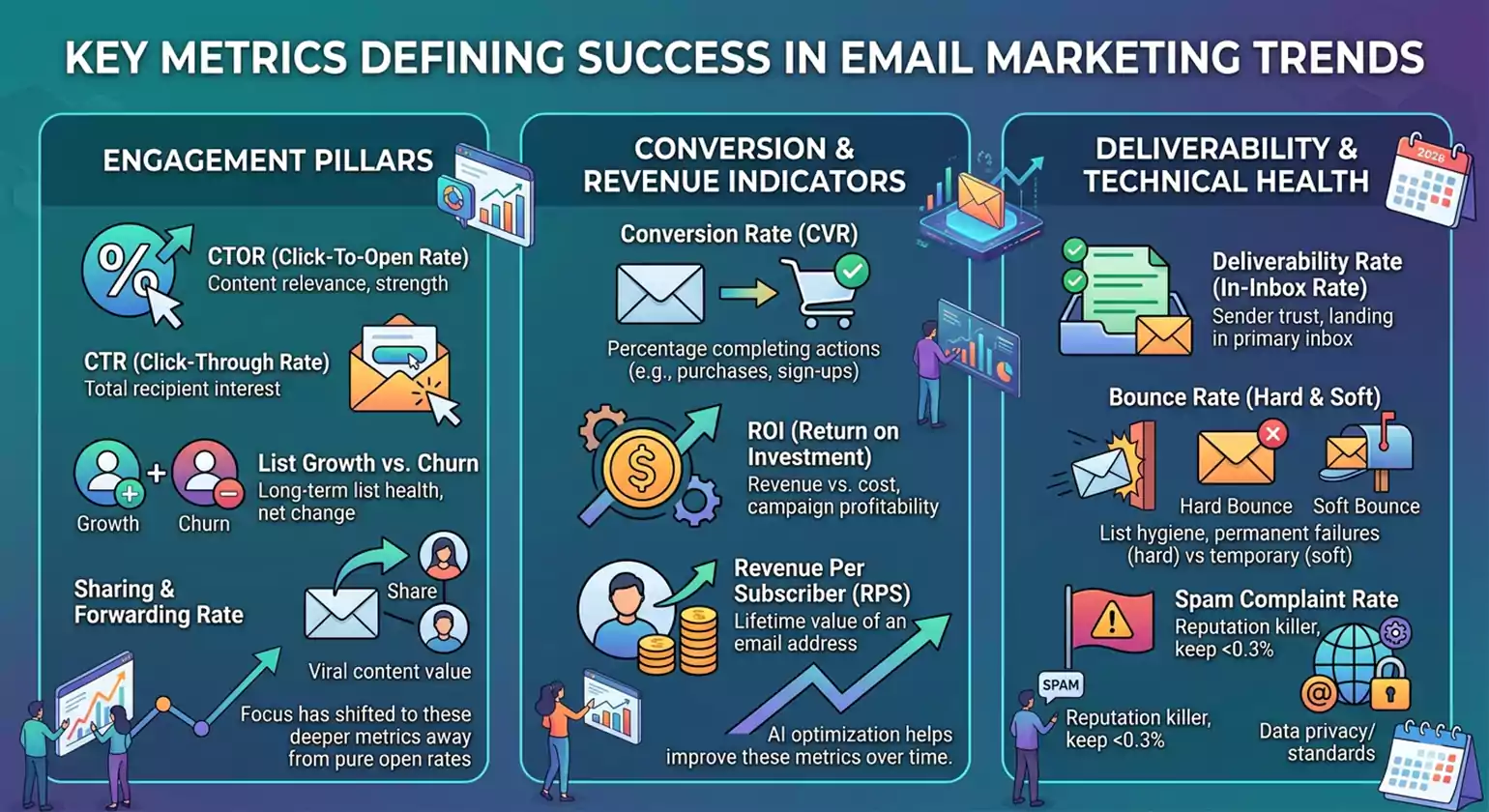
Measuring email campaign success really comes down to a few key numbers. Open rate, click‑through rate, conversion rate, bounce rate, and unsubscribe rate each tell a different piece of the story. Put together, they show how well your emails are doing and how engaged your audience really is.
But here’s the catch—no single number tells you everything. Marketers who stare at just one metric are missing the full picture. You have to look at all of them together to see what’s actually working and what needs fixing.
1. Open Rate vs Click-Through Rate Trends
Both open rate and click-through rate still matter. But their roles are shifting in ways that every marketer needs to understand.
Open rates are becoming less reliable. Updates like Apple Mail Privacy Protection have changed the game. Emails are now being marked as opened even when nobody actually read them. That does not mean open rates are useless. They still give you a rough sense of how well your subject line is landing. Just do not treat them as gospel anymore.
Click-through rate is a different story. It is still one of the most honest signals you have. When someone clicks a link in your email they made a deliberate choice to engage. No privacy update can fake that. That is why CTR remains one of the most trusted indicators of real campaign performance.
2. Key Differences:
- Open Rate – The percentage of people who opened your email. Simple but increasingly tricky to trust.
- CTR – The percentage of people who actually clicked a link inside your email. This one shows real intent.
3. Latest Trends (2026):
- Average open rates sit between 18–25% depending on your industry and audience.
- Average CTR lands between 2–5%. But high-performing campaigns? They are hitting 8% and beyond.
- Personalized subject lines alone can push open rates up by more than 20%. That is a big return for a small change.
Actionable Tips:
- Write curiosity-driven subject lines – Give people a reason to open. Tease. Intrigue. Make them feel like they will miss something if they do not click.
- Add clear calls to action – Do not make your readers guess what to do next. Tell them directly and make it easy to act.
- Segment your audience – Stop sending the same email to everyone. The more relevant your email feels, the more clicks you will get.
4. Engagement Metrics That Matter in 2026
Opens and clicks are just the beginning. The marketers who are really winning right now are digging deeper. They are looking at metrics that reveal how their audience truly feels about their emails over time. These numbers do not just measure a single campaign. They tell you whether your entire email program is healthy or quietly falling apart
- Bounce Rate – This tells you how many emails never made it to the inbox. Keep it below 2%. Anything higher is a red flag that needs attention fast.
- Unsubscribe Rate – People opting out is normal. But if it creeps above 0.5% you need to take a hard look at what you are sending and who you are sending it to.
- Spam Complaint Rate – This one needs to stay below 0.1%. Even a small spike here can seriously damage your sender reputation and hurt your deliverability.
- Email Sharing and Forwarding Rate – When people share your email they are telling you something important. Your content is genuinely useful and worth passing on.
- Time Spent Reading – Are people actually reading your emails or just glancing and moving on? This metric tells you whether your content is hitting the mark or missing it completely.
The way marketers measure success is changing fast. Here is what is happening right now:
- Single metrics are being replaced by engagement scoring models that look at the full picture of how subscribers interact with your emails over time.
- Internet Service Providers are paying close attention to engagement signals when deciding where your emails land. Low engagement means more emails going to spam.
- Brands that actively focus on engagement are seeing 20% higher deliverability rates. That is a serious advantage in a crowded inbox.
Conclusion
Email marketing trends are shaping how brands connect, engage, and convert. Staying updated helps you stay competitive and drive better results. Start applying these trends today to improve your campaigns, boost ROI, and build stronger relationships with your audience.
FAQs
What are the most important email marketing trends today?
AI that personalizes every message. Automation that runs on its own. Emails you can click and interact with. Plus, designs that actually work on a phone. Privacy matters more now too.
Why are email marketing trends important for businesses?
If you don’t keep up, your emails get ignored. Trends help more people open, click, and buy. That means better results without spending more money.
How is AI shaping email marketing trends?
AI figures out who to send what and when. It writes better subject lines. It learns from past emails. Less guesswork, better results.
How can businesses adapt to new email marketing trends?
Get tools that automate and personalize. Check your data often. Make emails look good on mobile. Test small changes. Don’t just set it and forget it.
How often do email marketing trends change?
Big shifts come once a year or so. Small updates pop up all the time—new AI, new rules, new habits. Look at your strategy every few months.