Table of Contents
keyTakeaways
Ecommerce Technical SEO optimizes your store’s backend (speed, structure, crawlability) to help search engines index products efficiently.
It matters because faster, error-free sites improve rankings, user experience, and conversions.
Fix issues by improving site speed, mobile usability, internal linking, schema markup, and crawl errors.
Use strategies like Core Web Vitals optimization, clean URLs, faceted navigation control, and XML sitemaps for faster ranking gains.
Leverage tools such as Google Search Console, Screaming Frog, and PageSpeed Insights to monitor performance, fix issues, and boost traffic and sales.
What is Ecommerce Technical SEO?
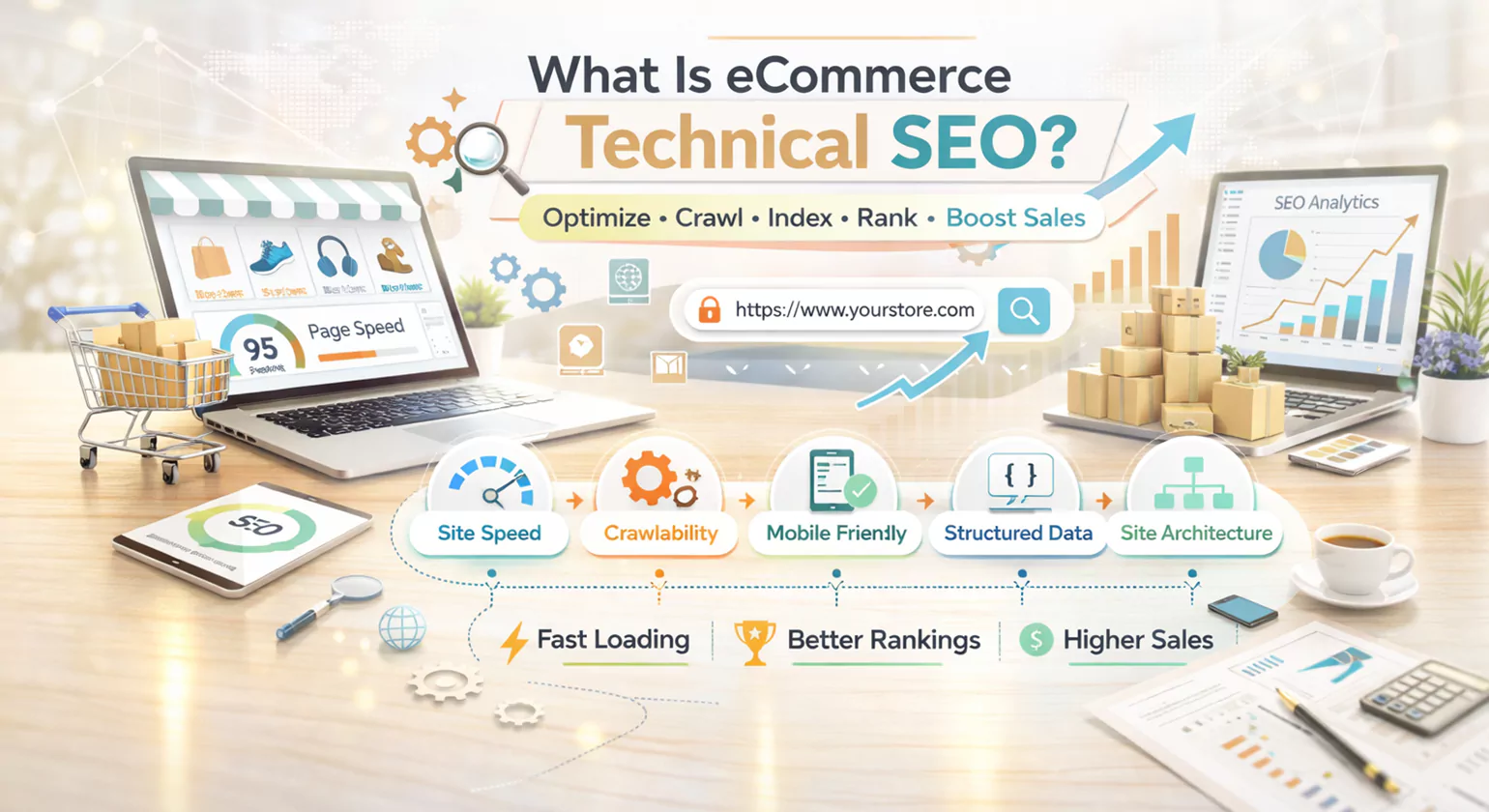
Ecommerce Technical SEO focuses on making sure search engines can easily crawl, index, and rank your website without any friction. In simple terms, it’s about improving your store’s organic search visibility through faster loading speeds, a well-structured site, and seamless search engine accessibility. Many businesses also rely on SEO services for ecommerce to implement these optimizations effectively and at scale.
In practice, this means that your website should be fast, mobile-friendly, have a good site structure, and display content in a way that search engines can easily understand and parse, often using structured data. The last point is particularly important because having slow website pages can harm both search engine rankings and conversions. For example, HubSpot states that pages that load in 2 seconds or less convert much better than pages that load longer than that.
Why Technical SEO is Crucial for eCommerce Websites
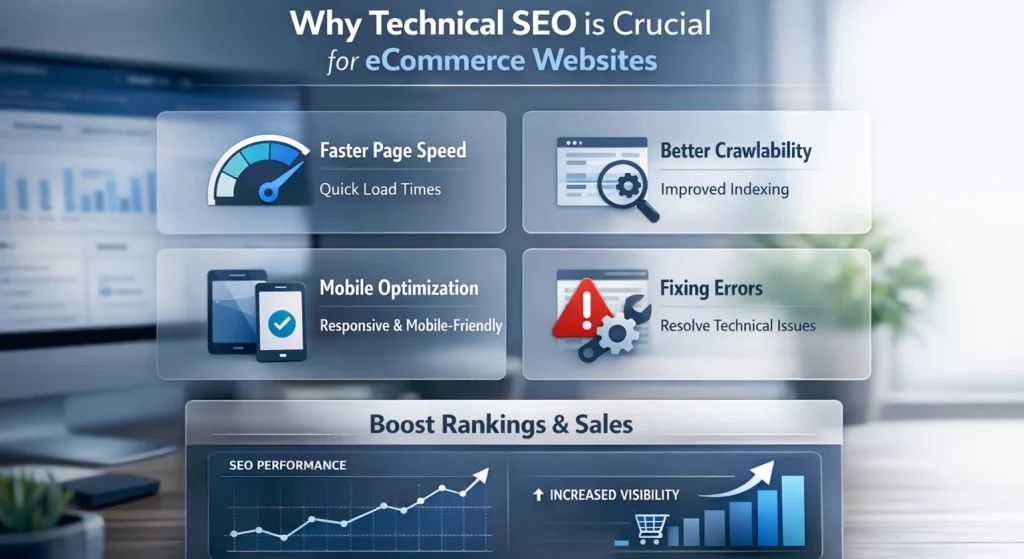
When it comes to Ecommerce Technical for online stores, the goal is to make sure that your store is easily crawled by search engines, is fast, and is user-friendly. When you optimize your store, you are not only allowing search engines to crawl your store efficiently, but you are also making sure that the end user has a good experience, which translates into better conversions.
From Rankings to Revenue
When we talk about rankings, we are talking about revenue, as the end goal is to get more people visiting your store, which translates into more sales.
While 75% of people do not scroll past the first page, according to HubSpot, when we optimize our store, we are not only improving our rankings, we are improving our revenue at the same time.
Crawlability and Indexability
Lorem ipsum dolor sit amet, consectetur adipiscing elit. Ut elit tellus, luctus nec ullamcorper mattis, pulvinar dapibus leo.
UX and Conversion Outcomes
When it comes to the end user, we know that the faster the website, the better the outcome, as Google has stated that when the load time increases by 1 second, the bounce rate increases by 32% when the load time is 3 seconds.
How to Fix Your Store with eCommerce Technical SEO Best Practices
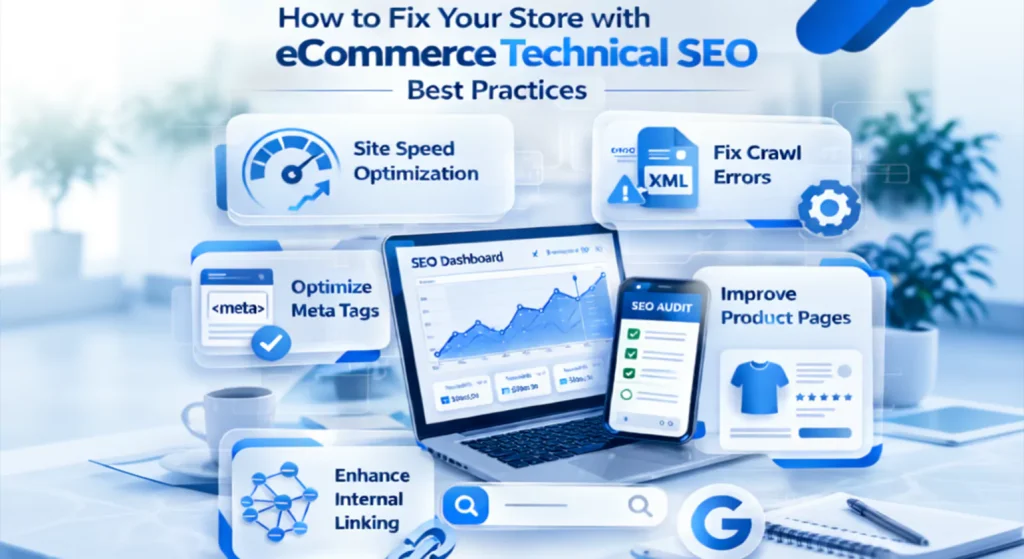
Enhance your online store with effective Ecommerce Technical SEO techniques to boost rankings and sales. Focus on improving site speed, crawlability, and mobile friendliness to deliver a seamless user experience. HubSpot reports that pages loading within two seconds are more likely to convert visitors, making performance optimization essential.
Start with an ecommerce seo audit using tools like Google Search Console to identify issues. Optimize Core Web Vitals, fix broken links, and implement structured data to improve indexing. Additionally, strengthen mobile SEO and regularly resolve crawl errors to maintain performance and ensure consistent, long-term growth.
1. Crawlability and Indexing
For search engines to display you on their ranking pages, they must be able to crawl your site and index it. When crawling is hindered by things such as blocked pages, orphaned URLs, or incorrect no index tags, it negatively impacts visibility. Take, for example, an ecommerce website audit that resolved crawling problems, which resulted in a 35% increase in indexed pages in a matter of weeks.
Action steps: Utilize tools such as Google Search Console and Screaming Frog SEO Spider to detect crawling problems, fix blocked pages, and prioritize crawling for the most important pages on your website.
2. Robots.txt and XML Sitemap Optimization
The robots.txt file manages what search engines are or are not allowed on your website, while XMLSitemaps direct search engines towards the pages on your website that are most important for crawling and indexing. When these are incorrectly set up, it can prevent important pages on your website from being crawled or index correctly. According to Google, it is important to keep sitemaps clean and up to date for better crawling and indexing.
Action steps: Allow important pages on your website in the robots.txt file, remove any unnecessary pages, and submit segmented XML sitemaps, such as those for products or category pages, in the search console.
3. Site Architecture & URL Structure
A clean, logical structure is helpful to both search engines and humans. Flat sites mean that most content is just a few clicks away. SEO-friendly URLs increase relevance and CTRs.
Action: Maintain logical hierarchies (Home > Category > Product), keep URLs concise, and add relevant keywords without over-optimizing.
4. Internal Linking & Crawl Depth Optimization
Internal linking shares page authority with other pages on your website. Pages that are too deep within your website may not be crawled by search engines. Research has shown that pages within three clicks of your homepage tend to get crawled more frequently.
Action: Add internal links within your website’s content, add breadcrumb navigation, and reduce crawl depth.
5. Duplicate Content & Canonicalization
Filters, variants, and session-based URLs can cause duplicate content problems that confuse search engines. Canonical URLs solve this problem by specifying the preferred URL. Duplicate content is a common problem on ecommerce sites that lose traffic as a result.
Action: Use canonical URLs, avoid using URL parameters when possible, and eliminate duplicate product pages.
6. Product Page Technical SEO
Product pages are the key drivers of revenue for businesses using b2c ecommerce platforms. When content is lacking, pages are slow, or structured data is lacking, it negatively impacts performance. Optimizing product pages can increase click-through rates by as much as 30%.
Action: Make sure content is unique, every image is optimized, and structured data for price and availability is added, all while keeping pages loading quickly.
7. Page Speed and Core Web Vitals
Speed is important, and this is something we know affects search engine rankings as well as conversion rates, so it’s an important element of eCommerce technical SEO. Google informs us that “half of users will leave if a page doesn’t load within 3 seconds.” Core Web Vitals measure the actual user experience.
What to Do: Compress images, use lazy loading, reduce JavaScript, and improve key metrics such as LCP, CLS, and INP with Page Speed Insights.
8. Mobile-First Indexing and Responsive Design
Google primarily uses the mobile version of the site for ranking. This means that if the mobile user experience is poor, it can negatively impact the ranking, leading to a loss in sales.
Action: Improve the mobile user experience, increase loading speed, and ensure all content is accessible on small screens.
9. Structured Data and Schema Markup
Structured data and schema markup are a fundamental part of eCommerce technical SEO. This is because it can help search engines understand the content on your pages more accurately, as well as provide enhanced search results such as stars, prices, and many other features that can increase the click-through rate for your website.
What to do: Add product, review, FAQ, and breadcrumb schema markup in JSON-LD format, and then test everything with the Google “Rich Results Tool”.
10. HTTPS, Security & Technical Trust Signals
Security is no longer optional. It’s a legitimate ranking factor and trust signal. Insecure sites will lose conversions. HTTPS protects user data and increases trust.
Action: Obtain SSL certificates, fix mixed content, and secure payment systems.
11. Pagination, Filters & Faceted Navigation
Faceted navigation can result in thousands of URL variants, wasting crawl resources and causing duplicate content issues. This can significantly impact rankings if mismanaged.
Action: Use rel=canonical, noindex filtered pages, and parameter handling in Google Search Console.
12. Redirect Management & Broken Links
Managing redirects and fixing broken links is an essential part of eCommerce technical SEO. Broken links harm user experience and leak valuable link equity, while proper redirects help preserve rankings during content updates.
Action: Fix 404 errors, use 301 redirects for permanent changes, and update internal links to avoid redirect chains.
13. Global SEO & Localization
When targeting new markets, it is essential to get your targeting right. Using hreflang tags incorrectly can cause your pages to be misplaced in search engine rankings.
What to do: Get hreflang tags right, create localized content, and use country-coded domains or subdirectories.
14. Ecommerce SEO for JavaScript Heavy Sites
JavaScript-heavy sites can prevent search engines from crawling your content correctly, leading to indexing and ranking problems.
What to do: Use server-side rendering or dynamic rendering, ensuring that your most important content is loaded in the initial HTML.
15. Log File Analysis & Deep Crawl Audits
Analyzing your log files will give your insight into how search engines crawl your website, highlighting wasted crawl budgets or ignored content.
What to do: Analyze your server log files to understand crawl rates, prioritize your key pages, and eliminate inefficient crawling patterns.
What Technical SEO Ecommerce Strategies Boost Rankings Fast?
Quickly improving rankings is all about optimizing how your website is constructed, automating processes, and using AI. For ecommerce sites, Technical SEO is all about optimizing crawlability, speed, and scalability to work efficiently with large product offerings.
Edge SEO & CDN Optimization
Edge SEO makes use of CDNs to roll out updates instantly without affecting your website’s backend. Faster page loads can quickly improve rankings. Cloudflare states that by reducing page load times, conversions can be increased by as much as 7 to 10 percent.
AI SEO Optimization
AI tools analyze search intent and adjust content in real-time. Using tools like SurferSEO can quickly improve rankings by matching search intent with user queries
Headless Commerce & SEO
Headless commerce is all about speeding up your website, but it’s also essential to ensure that your SEO strategy is solid. Google suggests using dynamic rendering to ensure that your website’s content is crawled correctly.
Automation - For Large-Scale Online Stores
Automation is all about optimizing meta tags, internal linking, and indexing on a large scale. Shopify sites using automation techniques saw 30 percent faster indexing within a few weeks.
Best eCommerce Technical SEO Tools to Increase Traffic and Sales
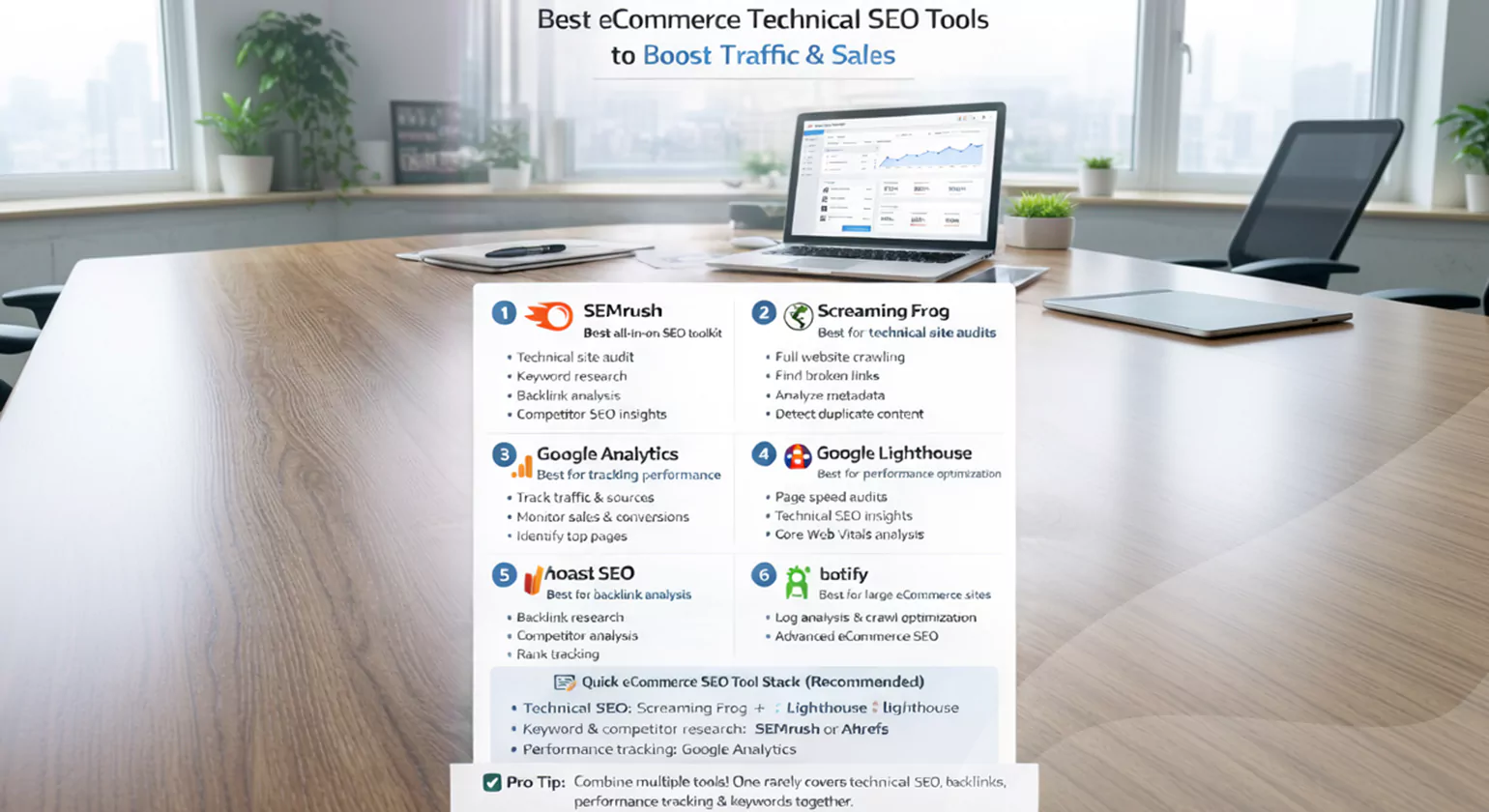
A good technical SEO tool set can significantly benefit an eCommerce business by improving the site’s performance, speed, and crawlability, which can positively impact search engine rankings.
1. Site Auditing Tools
- – Screaming Frog: highlights crawl issues, broken links, and duplicated content
- – Ahrefs: detects technical SEO problems and backlink deficiencies
- – SEMrush: performs comprehensive site audits with fixes
2. Page Speed Tools
- – Google PageSpeed Insights: measures the performance of the website and its Core Web Vitals
- – GTmetrix: analyzes the speed of the website and performance issues
3. Log Analysis Tools
- – JetOctopus: monitors bot traffic and crawl rate
- – Screaming Frog Log Analyzer: optimizes crawl budget and indexing
4. Schema Testing Tools
- – Google Rich Results Test: tests the structured data on the website
- – Schema Markup Validator: detects schema errors and warnings
Conclusion
eCommerce technical SEO is significant because it can impact the speed at which the website loads, the ease with which search engines crawl and index the website, and the smoothness with which the end-user experience is achieved. By adjusting the technical parameters of the website like speed, site architecture, and indexing, ecommerce sites can achieve higher search engine rankings, increased visibility, and consistent sales growth.
FAQs
1. What is eCommerce technical SEO and why is it important?
eCommerce technical SEO improves site structure, speed, and crawlability, helping search engines index pages correctly, boost rankings, enhance user experience, and increase conversions and sales.
2. How do I optimize my eCommerce website for better technical SEO performance?
Optimize by improving site speed, fixing crawl errors, using clean URLs, adding structured data, ensuring mobile-friendliness, and strengthening internal linking for better indexing and rankings.
3. What are the most common technical SEO issues in eCommerce sites?
Common issues include duplicate content, slow loading speed, broken links, poor site structure, crawl errors, missing schema markup, and improper handling of filters or pagination.
4. How can I fix duplicate content problems in an eCommerce store?
Fix duplicate content using canonical tags, unique product descriptions, proper URL parameters, noindex for filters, and consistent internal linking to signal the preferred page version.
5. How does page speed affect eCommerce SEO and conversions?
Faster page speed improves rankings, reduces bounce rates, enhances user experience, and increases conversions, while slow sites lose traffic, rankings, and potential sales.