Table of Contents
Key Takeaways
- Mobile Marketing Trends focus on reaching users through smartphones with personalized, fast, and engaging experiences.
- AI-driven personalization helps deliver targeted content and ads based on user behavior.
- Short-form videos (Reels, Shorts) boost engagement and conversions.
- Mobile commerce (M-commerce) is growing with easy in-app purchases and digital wallets.
- Voice search and chatbots improve user interaction and support.
- Privacy-first marketing is essential due to data protection rules.
- 5G technology enhances speed, enabling better video, AR, and real-time experiences.
- Staying updated with Mobile Marketing Trends helps businesses improve visibility, engagement, and ROI.
Why Should You Follow Mobile Marketing Trends? & Why It Matters in 2026
Being updated on the latest Mobile Marketing Trends is a necessity in 2026. This is because trends and consumer behaviors change fast, and it is essential for a business to stay updated and visible in a world dominated by mobile devices. Understanding these shifts is also part of mastering the Fundamentals of Marketing, where adapting to consumer behavior is key to long-term success.
According to Statista, over 70% of internet traffic worldwide is generated from mobile devices. This is a growing trend. Another reason for staying updated is that, according to HubSpot, conversion rates can increase up to 64% if a campaign is optimized for mobile devices. For example, a brand can use artificial intelligence for creating ads and push notifications. E-commerce apps use in-app messaging and mobile UX to create a better user experience.
If a business does not stay updated on the latest trends, it will end up losing customers to competitors. Voice search optimization, short video marketing, and m-commerce are some of the latest trends in the market.
Actionable takeaway: A business should first audit their current position and optimize their website for mobile devices. They should use mobile-first marketing strategies and stay updated on the latest trends.
Key Mobile Marketing Statistics You Should Know
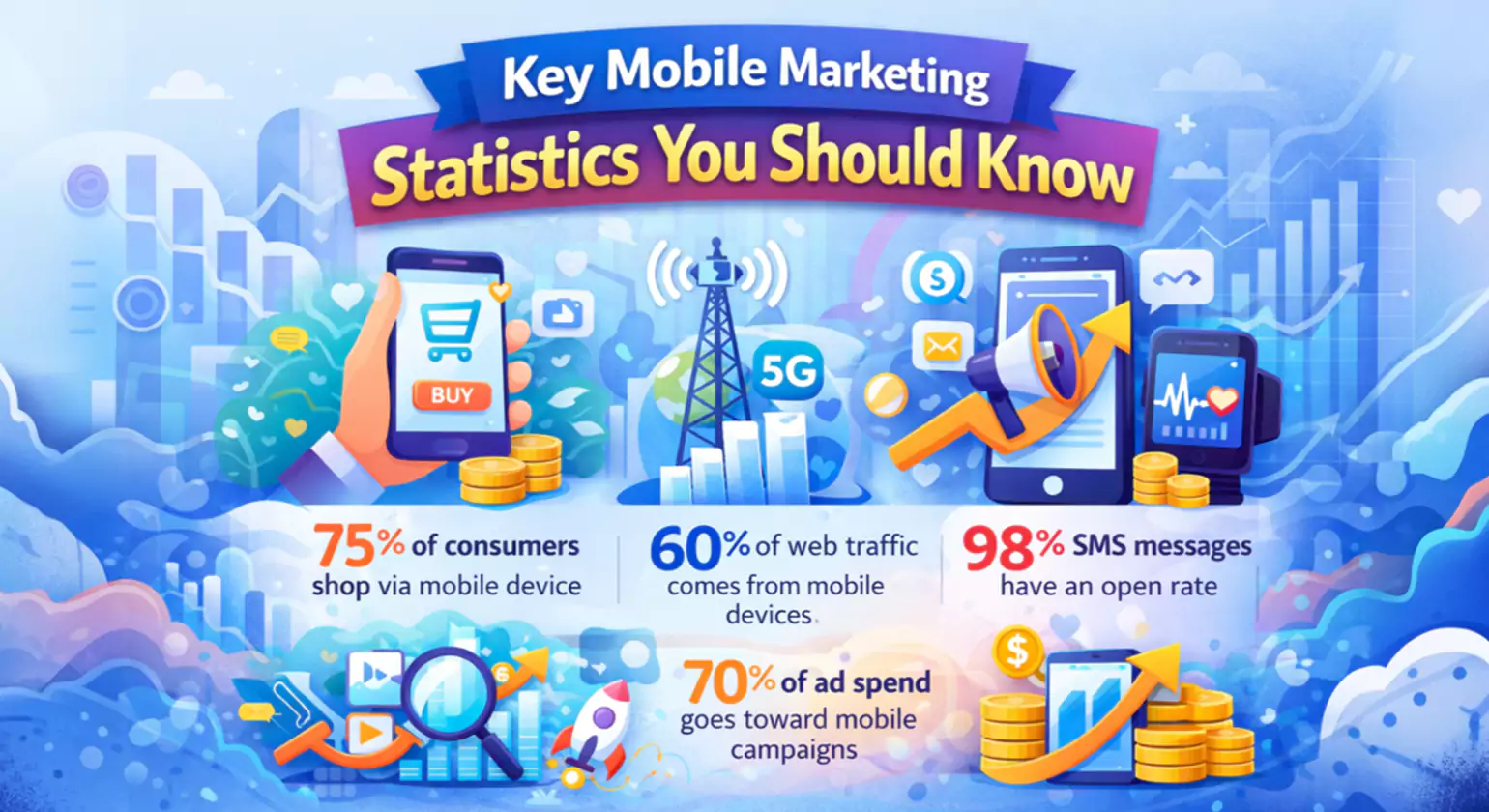
Mobile is the most used digital channel in 2026, and as such, it affects every other channel, making Mobile Marketing Trends very important for improving user engagement and overall marketing performance.
Global Mobile Usage Trends
Mobile is responsible for more than 70% of global web traffic, and people spend 4.5 hours on mobile devices daily, according to Statista. This is due to the rising mobile user trends, usage, and dependence on real-time digital interactions.
Mobile vs. Desktop Traffic Insights
SimilarWeb shows that mobile is always ahead of desktop in terms of traffic share, especially for social media and eCommerce. However, desktop is more successful for high-value conversions, more time spent on websites, and more research for specific products.
User Behavior & Engagement Data
Mobile-optimized websites can boost conversions by up to 64%, according to HubSpot. This is due to the benefits of faster loading times, mobile optimization, and personalization, such as push notifications, which improve user retention and experience.
Actionable takeaway: Focus on mobile optimization. Improve your website’s loading speed, user experience, and test personalization. Leverage mobile marketing statistics and insights to improve user experience and drive growth.
Top 20 Mobile Marketing Trends Shaping 2026
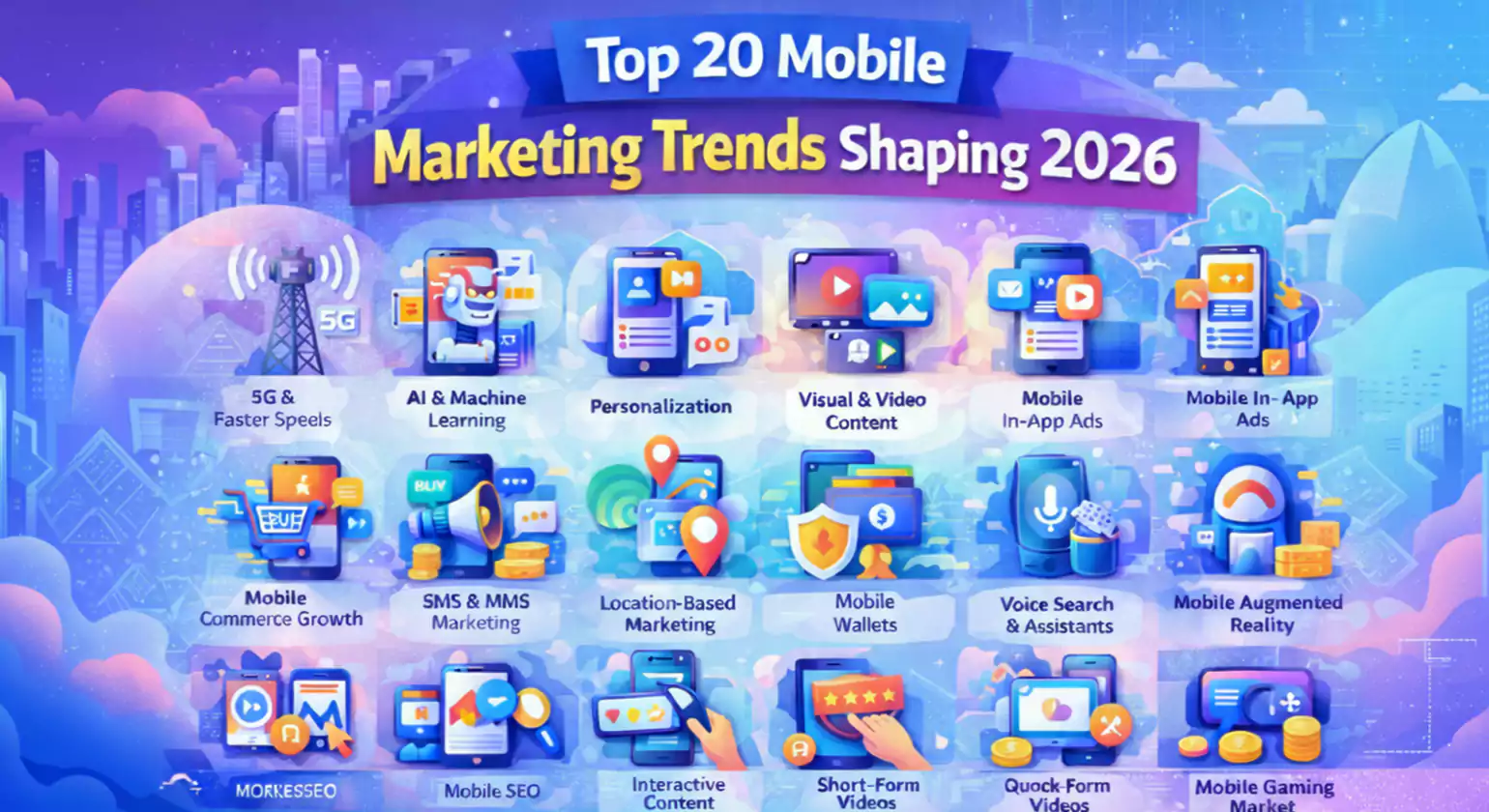
Mobile Marketing Trends for 2026 are fueled by the power of AI, increasing connectivity speeds, immersive experiences, and privacy-centric approaches for better engagement and conversion. It requires adapting to changing consumer behavior for mobile-first ecosystems.
According to HubSpot, 72% of users expect personalized experiences, while Statista predicts mobile commerce will reach over $4 trillion by 2026. This demonstrates the necessity for mobile-first strategies.
To succeed in changing mobile market trends, you need personalization, user experience, and data-driven decisions. Begin with 2-3 trends and scale based on ROI for success.
1. AI-Powered Personalization
One of the most impactful of the mobile market trends is AI-powered personalization. This allows brands to personalize their marketing in real-time. AI-powered personalization analyzes the behavior, choices, and interactions of the audience and offers them relevant information or products. Companies such as Amazon and Netflix were able to increase audience engagement by over 35% by leveraging AI-powered recommendations. To leverage AI-powered personalization, you can use machine learning tools for audience segmentation and dynamic content delivery. AI-powered personalization can significantly impact conversions and customer loyalty.
2. Voice Search Optimization
Voice search optimization has revolutionized the way people use their mobile phones. With voice search optimization, voice queries are becoming extremely significant. People are no longer typing queries; rather, they are asking questions. According to Google, 27% of mobile users use voice search worldwide. This indicates that voice search optimization is gaining traction. Brands need to optimize their content for long-tail keywords and question-based queries to remain competitive in the search engine results.
Mobile Commerce (M-Commerce) Growth
3. Mobile Commerce (M-Commerce) Growth
Mobile commerce is still a dominant factor in Mobile Marketing Trends, as consumers increasingly prefer shopping through smartphones for their convenience and speed. Statista predicts that more than 70% of eCommerce sales will be through mobile devices by 2026. Major eCommerce sites like Shopify and Amazon have optimized their mobile sites for better user convenience. Businesses can improve their sites by ensuring fast page load times, ease of navigation, and ease of checkouts. Adding multiple payment options will help in better conversions and improving overall customer satisfaction.
4. Short-Form Video Content
Short-form video content is another important factor in mobile market trends, as it grabs consumers’ attention in no time and helps in high engagement. Social media sites like TikTok and Instagram have proven that videos less than 60 seconds work wonders for brands. According to HubSpot, short-form videos attract twice as much engagement as any other content. Businesses can concentrate on creating more videos and improving engagement, as it will help in improving brand recall and engagement.
5. 5G Technology
5G Technology plays a vital role in shaping Mobile Marketing Trends because it provides fast speeds, lower latency, and greater connectivity. This enables marketers to create richer experiences that can be consumed seamlessly. With speeds that are 100 times faster than 4G, users are expecting more from a business. Marketers should take advantage of 5G Technology to create high-quality content that can be consumed instantly. This can be done by optimizing platforms to ensure that they are fast and efficient.
6. Progressive Web Apps
Progressive Web Apps are a significant factor in mobile market trends because they combine the features of mobile apps and websites. This enables marketers to reach a wider audience. Progressive Web Apps are fast, can be consumed offline, and do not require users to download them. Pinterest saw a 60% increase in engagement after adopting a Progressive Web App. Marketers can use Progressive Web Apps to enhance the consumer experience while minimizing costs.
7. Augmented Reality (AR) Experiences
Augmented Reality (AR) Experiences enhance the Mobile Marketing Trends by providing immersive and interactive experiences for consumers. It provides an interactive experience between online and offline shopping. Consumers can see the products virtually before purchasing the products. Brands like IKEA have effectively used AR to increase the confidence of consumers. It is beneficial for brands to increase the time spent by consumers on the brand’s website.
8. In-App Advertising Expansion
In-app advertising is expanding rapidly due to the increase in the time spent by consumers on mobile applications. It is beneficial for brands to advertise on mobile applications because consumers are spending more time on mobile applications than on the internet. In-app advertising is beneficial for brands because they can reach the targeted audience. eMarketer states that mobile applications are generating over 70% of the revenue from mobile ads. It is beneficial for brands to give priority to the user experience of the ads. It is beneficial for brands to increase the engagement rates of the consumers.
9. Location-Based Marketing
Location-based marketing is a highly effective Mobile Marketing Trend that leverages GPS technology for personalized marketing. Businesses can use geofencing as a marketing strategy for improving conversions. Research has revealed that using this marketing strategy can improve engagement by as much as 20%. Businesses can improve their marketing strategy by leveraging personalization techniques in combination with this marketing strategy.
10. Mobile-First Indexing
engines prefer ranking and indexing the mobile version of a website. This is a highly important aspect of Mobile Content Marketing within Mobile Marketing Trends, as more than 60% of global searches originate from mobile gadgets. Businesses can avoid losing visibility by optimizing their website for mobile gadgets. Optimizing content specifically for mobile users improves both SEO performance and overall user engagement.
11. Conversational Marketing (Chatbots)
Conversational marketing, enabled by chatbots, offers the opportunity for real-time interaction between brands and customers on mobile devices. It offers benefits in terms of customer support, engagement, and lead generation. Businesses utilizing chatbots claim up to 30% faster response times and improved customer satisfaction rates. Businesses should look at utilizing AI-powered chatbots to offer a better customer experience through conversations.
12. Social Commerce on Mobile
Social commerce is another emerging trend where users can shop directly from social media platforms. Apps like Instagram and Facebook enable in-app purchases, creating a seamless shopping experience. Businesses can benefit by leveraging engaging content, shopping tags, and smooth checkout options. To improve results, they should focus on mobile-friendly visuals and strong calls to action that enhance overall sales performance.
13. Influencer Marketing
However, influencer marketing remains a strong strategy because it enables businesses to market their products through authentic and influential voices. The power of mobile platforms can be leveraged to reach a wider audience through influencer marketing. According to the Influencer Marketing Hub, businesses can make a return of $5.78 for every single dollar spent. It is essential for businesses to associate themselves with influencers within their niche and values. Authentic marketing attracts more trust and engagement compared to conversion rates from other forms of marketing.
14. Interactive Content Formats
Interactive content formats are increasingly becoming popular trends in mobile marketing. These content formats allow users to participate more in the content, hence improving engagement levels. It is important for businesses to use interactive content formats, as they have shown that interactive content is twice as engaging as non-interactive content. It is important for businesses to include gamification in their content to make it more interactive and engaging for users.
15. Mobile Wallet Marketing
Mobile wallet marketing is becoming an integral part of Mobile Marketing Trends as digital payments are on the increase. Apple Pay and Google Pay are examples of mobile wallets that can be used to carry out smooth transactions. This provides a platform to personalize offers that can be sent to customers. This improves the customer experience and provides a sense of loyalty to customers. Mobile wallet marketing features can be added to marketing campaigns to ensure a smooth checkout process.
16. App Store Optimization (ASO)
App Store Optimization plays a vital role in making apps more visible to users. This can be done by optimizing keywords, images, and ratings. It is a significant part of trends in mobile marketing that can benefit businesses that operate apps. It can increase the rankings of apps. Businesses can optimize keywords in descriptions, images, and ratings. It can also be done based on insights to increase app usage.
17. Push Notification Personalization
Personalization of push notifications is a highly effective strategy for re-engaging users by sending timely and relevant notifications. Personalization of push notifications is a major factor in Mobile Marketing Trends, as it helps improve click-through and retention rates. Research has proven that personalization of push notifications increases CTR by as much as 50%. It is recommended that organizations personalize their notifications based on users’ behavior and interests. This helps maintain users’ interest while avoiding annoying users through excessive and irrelevant notifications.
18. Privacy-First Marketing
In recent times, privacy-first marketing has become a necessity, and users want to have control over their data and privacy. This has led organizations to focus on privacy-first marketing, and the regulations have also become stricter for data privacy. It is recommended that organizations focus on privacy-first marketing and use first-party data, as it is not only beneficial for organizations in terms of avoiding legal issues but also helps in building trust.
19. Omnichannel Mobile Experiences
Omnichannel mobile experiences provide users with an interconnected journey through various touchpoints such as applications, websites, and social media sites. This is an important aspect of Mobile Marketing Trends as users seek seamless experiences. According to Salesforce, companies with effective omnichannel experiences retain up to 89% of their customers. Companies need to incorporate various touchpoints and messages for their customers. This will help them provide a seamless customer experience, which will increase customer satisfaction and retention rates.
20. AI-Driven Predictive Analytics
AI-driven predictive analytics is beneficial for businesses in predicting users’ behavior and creating proactive marketing strategies. It is an advanced feature of mobile market trends
, which helps in improving accuracy and effectiveness of marketing campaigns. By using historical data, organizations can predict their customers’ needs and preferences, which helps in better decision-making and increasing ROI. It is recommended that organizations use predictive analytics tools for creating proactive marketing strategies, ensuring they reach their customers at the right time.
Conclusion
Mobile marketing trends in 2026 have emphasized the need to personalize marketing efforts, focus on mobile-first marketing, and leverage technologies like AI, AR, and 5G. Businesses that are able to adapt to these trends are likely to increase user engagement and conversions. This can be achieved through a focus on user-centric marketing strategies that are always evolving to ensure that businesses reach their maximum potential in digital marketing.
FAQs
1. What are the most recent trends in mobile marketing in 2026?
Key trends include AI-driven personalization, short-form video dominance, voice search optimization, mobile commerce growth, AR experiences, and privacy-first marketing. Brands are focusing on real-time engagement, app-less experiences like PWAs, and hyper-targeted campaigns to improve user experience and conversions.
2. What are the most effective mobile marketing strategies today?
Top strategies include personalized messaging, omnichannel campaigns, mobile-first website optimization, in-app advertising, and data-driven targeting. Leveraging AI, push notifications, and social commerce helps brands engage users instantly, boost retention, and drive higher conversions.
3. What is the future of mobile marketing?
The future of mobile marketing is AI-powered, immersive, and privacy-focused. Technologies like AR, 5G, and predictive analytics will enable real-time, personalized experiences. Brands will prioritize user trust, automation, and seamless cross-device interactions to stay competitive.
4. What are the top mobile marketing trends to follow?
Top trends include AI personalization, voice and visual search, short-form video, mobile wallets, influencer marketing, and location-based targeting. Businesses should also adopt PWAs, conversational marketing, and privacy-first strategies to stay ahead.
5. How is AI transforming mobile marketing in 2026?
AI is transforming mobile marketing by enabling hyper-personalization, predictive analytics, chatbots, and automated campaigns. It helps brands deliver real-time recommendations, optimize ads, and improve customer experiences, leading to higher engagement and better ROI.