Table of Contents
Key Takeaways
- Direct Mail Response Marketing uses physical mail (postcards, letters) to drive quick customer actions like calls or purchases.
- Increase response rates with personalization, strong offers, clear CTAs, targeted lists, and attractive design.
- Measure performance using response rate, conversion rate, ROI, and tools like QR codes or unique numbers.
- Benefits include high engagement, better audience targeting, and less competition than digital ads.
- Drawbacks like higher costs and tracking limits can be improved with smart targeting, A/B testing, and digital integration.
What is Direct Mail Response Marketing?
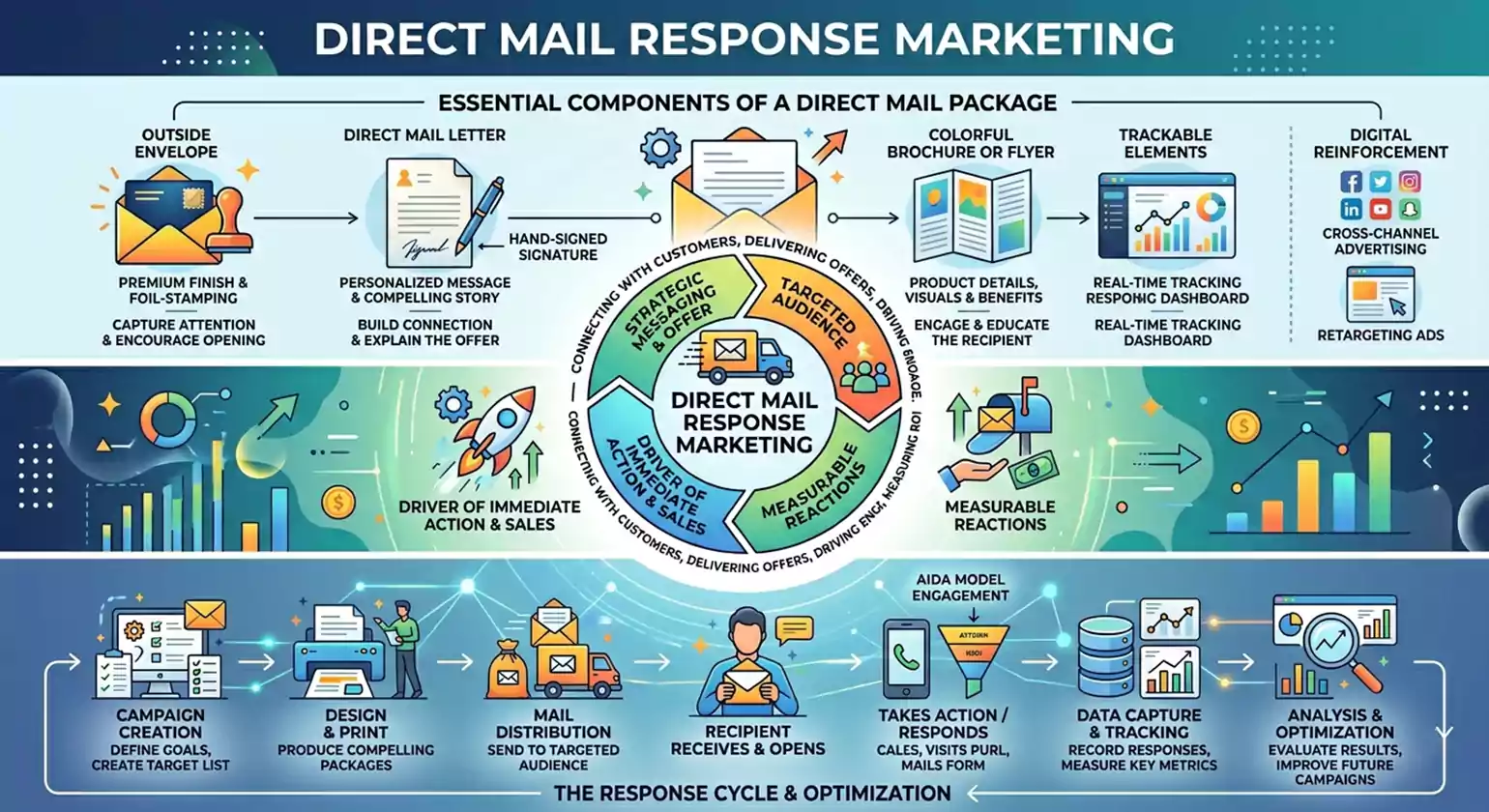
Direct Mail Response Marketing is a strategy-oriented approach to marketing aimed at producing specific outcomes, such as phone calls, clicks, or sales, through direct mail marketing campaigns. This approach is more outcome-oriented compared to other forms of marketing campaigns aimed at generating brand awareness. This makes it a real-life application of the Fundamentals of Marketing.
According to the Data & Marketing Association, direct mail marketing campaigns can achieve response rates of 9%, compared to email marketing strategy. In fact, a retail brand saw a 30% increase in store visits within two weeks after sending personalized direct mail postcards with discount codes.
How it differs from traditional direct mail
Direct mail traditionally focuses on awareness, whereas Direct Mail Response Marketing is designed for results. It uses personalization, scarcity, and measurement tools such as QR codes or URL customization. Instead of “just informing,” it drives people to act now, and marketers can track results in real-time.
Why response-driven direct mail campaigns are important in 2026
In 2026, with the rise of privacy concerns and decreased email engagement, response-driven direct mail campaigns become even more important. Physical mail stands out from the noise of digital communication, offering higher levels of trust, and with the improved ROI of data-driven direct mail and omnichannel integration, it’s a key element in a marketer’s arsenal.
How Direct Mail Response Marketing Works
Direct Mail Response Marketing works by targeting the right audience, delivering personalized mail, and tracking measurable responses like calls, visits, or conversions.
- End-to-End Process: Identify the audience segment → Create personalized creatives → Send at the right time → Track via QR codes, URLs, call tracking.
- Key Components of a High Response Campaign: A strong offer, call-to-action, personalization, and targeting are essential to increase the overall response rate.
- Examples of Response-Driven Mail Formats: Postcards, self-mailers, and dimensional mailers are some of the mail formats that are known to increase the overall response rate of the mail campaigns.
How to Increase Direct Mail Marketing Response Rate: 10 Proven Strategies
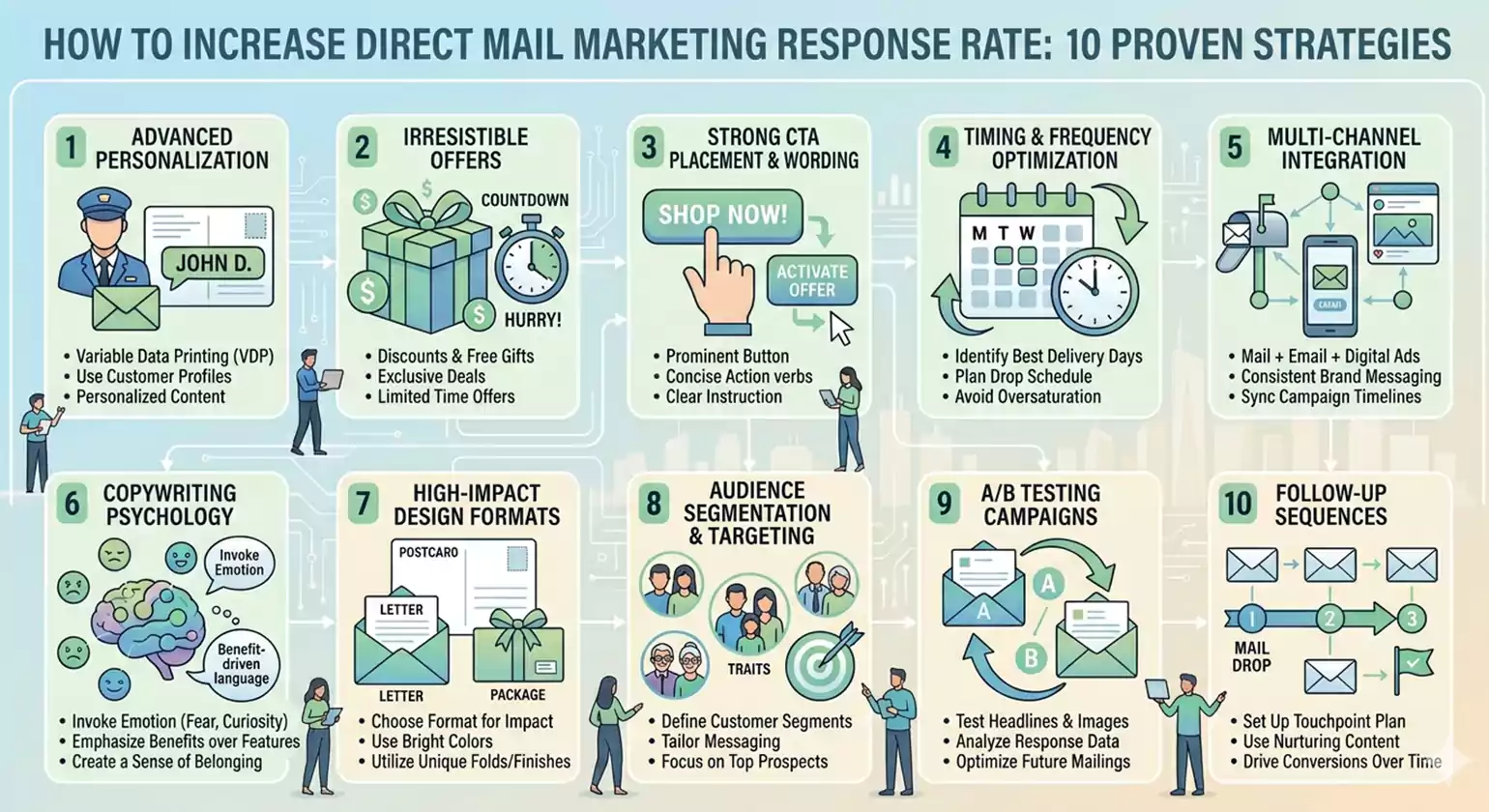
The results of Direct Mail Response Marketing campaigns can be increased by using personalization techniques, attractive offers, powerful calls-to-action, and follow-ups. These techniques, when used in conjunction with segmentation and testing, can improve results and maximize ROI.
1. Advanced Personalization
Personalized mailers help increase engagement since they make the reader feel understood. Personalized messages help build strong connections, as explained in Direct Mail Response Marketing. HubSpot claims that personalized CTAs increase conversions by as much as 202%. Personalization through names, purchase history, and location-based offers increases response rates.
Actionable Takeaway: Personalization is a great way to start with simple personalization, such as names and purchase history, and scale up with CRM data.
2. Irresistible Offers (Discounts, Urgency, Exclusivity)
Compelling offers help generate immediate results. The Data & Marketing Association found that targeted mailers generate a 9% response rate. Direct MailMarketing uses urgency and discounts to generate conversions.
Actionable Takeaway: Use urgency and discounts. Add deadlines, scarcity (“only 100 spots”), and the benefits of acting. Test different offers to see which has the best conversion rate.
3. Strong CTA Placement and Wording
Effective calls-to-action help users act. Research using eye-tracking has revealed that calls-to-action placed above the fold may result in 30%+ increased engagement. Instead of using passive calls-to-action, action-oriented words such as “Claim Your Offer Now” should be used.
Actionable takeaway: One call-to-action should be used; it should be bold, prominent, and strategically duplicated.
4. Timing & Frequency Optimization
Sending mail at the right time may also help in increased visibility. Research has revealed that sending mail during the middle of the week may result in better performance. In Direct Mail Response Marketing, repeated exposure has been known to build up response rates over time.
Actionable takeaway: Sending mail in cycles (e.g., every 2-3 weeks) may help in increased response rates.
5. Multi-Channel Integration (Mail + Email + Ads)
Using multiple channels can maximize the impact of the campaign. In Direct Response Marketing, integration between channels can build more powerful touchpoints. In fact, according to USPS, integration between mail and digital channels can increase response rates by 28%.
Actionable Takeaway: Integrate your mail campaign with email and ads. Using QR codes and/or URLs can help link the offline and online customer journeys.
6. Copywriting Psychology (Fear, Curiosity, Benefit-Driven)
Using psychological triggers can improve copy effectiveness. Highlighting benefits and sparking curiosity often outperforms generic messaging. For example, “Don’t miss your exclusive reward” triggers both fear of missing out and curiosity.
Actionable Takeaway: Benefits over features. Using psychological triggers is a delicate balancing act; however, the headline can be a powerful response driver.
7. High Impact Design Formats (Postcards vs. Letters vs. Packages)
Different formats can generate different levels of response. Postcards are quick and easy to read. Letters can be more personal. Packages can generate high response rates because people are curious.
Actionable Takeaways: Choose a format depending on the campaign objectives. Choose a postcard for awareness campaigns and a letter for more detailed offers. Test different formats for the best ROI.
8. Audience Segmentation & Targeting
Targeted campaigns can perform much better than unsegmented campaigns. In fact, a marketing study found that response rates can improve by 50% or more through segmentation. In other words, targeting existing customers can perform much better than targeting anyone.
Actionable Takeaways: Segment the audience by demographics, behavior, and past purchase history. Prioritize high-value audiences for the best ROI.
9. A/B Testing Campaigns
Testing can help you find out what works best for you. Brands that use A/B testing see a significant improvement in performance over time.
Actionable takeaway: Make sure you are testing a single variable at a time. This way, you can track results and scale what works best for you.
10. Follow-Up Sequences
Using follow-ups can help you achieve higher results, as research proves that multiple touches can increase results by as much as 40%. This can be done by sending a reminder postcard after the first mail.
Actionable takeaway: Make sure you always have a follow-up plan in place, especially with a combination of mail and email reminders.
Benefits of Direct Mail Response Marketing
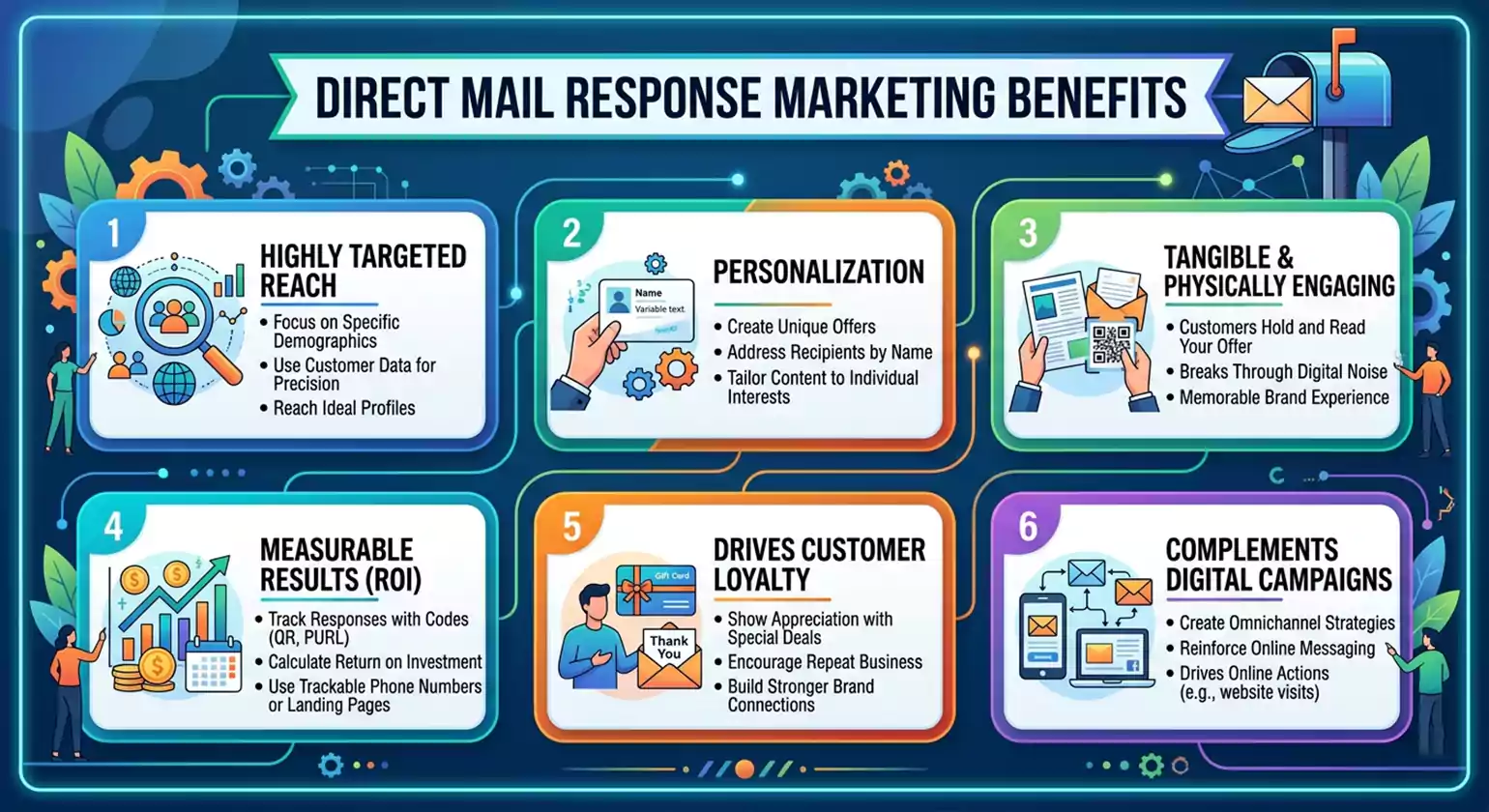
Direct Mail Response Marketing provides higher engagement, increased recall, and conversion, offering a great opportunity in a crowded digital ad landscape.
1. Higher Response Rates than Digital Ads
Studies by Data & Marketing Association have shown that direct mail has a 4.9% average response rate, compared to an average of only 1% for email marketing.
2. Less Competition, Higher Attention Span
Digital ads face a crowded inbox, but mailboxes don’t. Direct mail is not as popular as digital ads, so your message will get higher attention.
3. Advantages of Personalization and Targeting
Direct mail is highly targeted, and with the help of modern technologies, marketers can send highly targeted mailers based on demographic, behavioral, and purchase history data.
4. ROI and Measurability
Direct mail is fully measurable, and marketers can track the ROI of direct mail campaigns using QR codes, coupon codes, and landing pages. Personalized direct mail campaigns increase ROI by over 200%, as shown by HubSpot.
How to Measure Direct Mail Response Rates

Measuring Direct Mail Response Marketing rate involves measuring responses divided by the total mail sent, then analyzing the conversion rate and ROI.
What is a Response Rate?
Response rate marketing measures the percentage of people who have acted after receiving your direct mail marketing campaigns. If you have sent 5,000 postcards and have received 250 responses, then your response rate is 5%. According to the Data & Marketing Association, direct mail marketing campaigns have a response rate that averages between 4-9%, which is higher than many other forms of marketing.
Key Metrics (Conversion Rate, ROI, CPA)
You should also measure the conversion rate, ROI, and CPA for your direct mail marketing campaigns. If you have a response rate marketing campaign that has a response rate of 5%, you may have a conversion rate of just 2%. According to HubSpot, campaigns with a clear call-to-action have the ability to boost conversion rates by 20%+.
Tracking Methods
QR Codes
QR codes help in instant tracking if a user scans the QR code and lands on a campaign-specific page. Tracking user scans, time spent, etc., is also possible using this method. For instance, QR codes are used in restaurant campaigns to track dine-in offers.
Personalized URLs (PURLs)
PURLs help in creating a unique landing page for each user. This enhances the level of personalization in a campaign. Research has proven that using a personalized campaign increases response rates up to 30%. This tracking method also helps in collecting user data for follow-up campaigns.
Coupon Codes
Coupon codes help track direct purchases related to a Direct Mail Response Marketing piece. Many retail brands use unique coupon codes for their campaigns. This tracking method provides a clear link between revenue generation and campaigns, making it easy to calculate ROI for a mail campaign.
Call Tracking Numbers
With unique phone numbers, you can track calls from a particular mail piece. This technique can be used by businesses, for example, real estate agencies, to gauge the quality of leads and the number of leads generated from a campaign. It also enables businesses to personalize messages according to the campaign that results in the most calls.
Top Drawbacks of Direct Mail Marketing (And How to Overcome Them)

The drawbacks of Direct Mail Response Marketing, such as low response, targeting, and tracking, can be addressed.
Low Open & Engagement Rate
The major problem is people are not responding or engaging. This is because people are not interested in the mail sent. According to HubSpot, using personalized marketing can increase response rates by 20%.
Spam Filters & Deliverability
Unlike digital marketing, physical mail is not affected by spam filters. However, using incorrect contact information can lead to a waste of budget. It is therefore important to maintain clean lists.
Limited Audience Targeting Accuracy
The traditional method of targeting is based on broad demographic characteristics. This is not accurate. Using data can improve accuracy. This can help marketers target their audience more precisely.
Difficulties in Tracking and Measuring ROI
Tracking offline campaigns can be difficult without proper tools. Tools like QR codes, PURLs, or coupon codes can be employed. According to the DMA, using these can improve visibility of ROI for campaigns by more than 30%.
Longer Campaign Execution Time
Offline campaigns take more time, especially when it comes to printing, designing, and delivery. It is advisable to plan and combine campaigns with email or ads for better efficiency.
Conclusion
Direct Mail Response Marketing is still a powerful strategy when combined with data, personalization, and tracking. While it has some limitations, integrating it with other marketing channels improves its reach and measurability. Start leveraging direct mail today to boost engagement and drive better results.
FAQs
1. What is a good response rate for direct mail marketing in 2026?
A good response rate in 2026 is 5%–9% for targeted campaigns and 2%–4% for cold lists. Highly personalized campaigns can exceed 10%, especially with strong offers and precise audience segmentation.
2. How do you improve direct mail response rates effectively?
Improve response rates using personalization, compelling offers, clear CTAs, and clean data. Combine mail with digital follow-ups, test formats, and optimize timing to increase engagement and conversions.
3. What is the average response rate for direct mail?
The average response rate is 4.4% for prospect lists and 9% for house lists, according to industry benchmarks like the Data & Marketing Association (DMA).
4. What are the best practices for managing customer preferences in direct mail marketing?
Respect preferences by offering opt-outs, frequency control, and relevant content. Use CRM data to track behavior and ensure compliance, improving trust and long-term engagement.
5. How to use direct mail marketing effectively?
Use direct mail effectively by targeting the right audience, crafting strong offers, and integrating digital channels. Track results with QR codes or URLs and continuously test to improve ROI.