Table of Contents
Quick Blog Overview
- Myth-Busting PHP Indexing: We explore why your PHP website is an SEO powerhouse and why the “dynamic URL” myth is a relic of the past.
- The “Speed” Secret: A no-nonsense guide to reducing server response times (TTFB) so you can achieve those coveted green Core Web Vitals scores.
- Automating Metadata: Learn how to leverage your code to do the hard work for you by automatically creating clean URLs and meta tags on your website.
- Smart Crawl Management: Proven techniques for using sitemaps and robots.txt to ensure Googlebot crawls only your most valuable pages.
- The Implementation Checklist: A non-fiction guide with PHP code examples to help you analyze and optimize your backend without the pain.
Feeling invisible online despite posting great content? You’re not alone. Many business owners spend countless hours on their website, but Google doesn’t even know their pages exist. The issue isn’t your content—it’s your code. In the cutthroat US market, where every click matters, knowing SEO for PHP websites can be the difference between a thriving online store and an empty page. In this guide, we’ll expose the secret backend adjustments that search engines respond to and trust, so your PHP website finally gets the attention it deserves.
Quick Answer: How does PHP impact rankings?
Optimization of your Seo for php website entails optimizing server-side scripts to provide search engines with high-speed crawlable HTML. This affects your search engine rankings by controlling the way your metadata is optimized, ensuring that your URL structure is clean, and lowering server response times. When your PHP is optimized, search engine algorithm php filters can index your pages without any difficulties.
How PHP Impacts SEO Performance (What Business Owners Must Know)
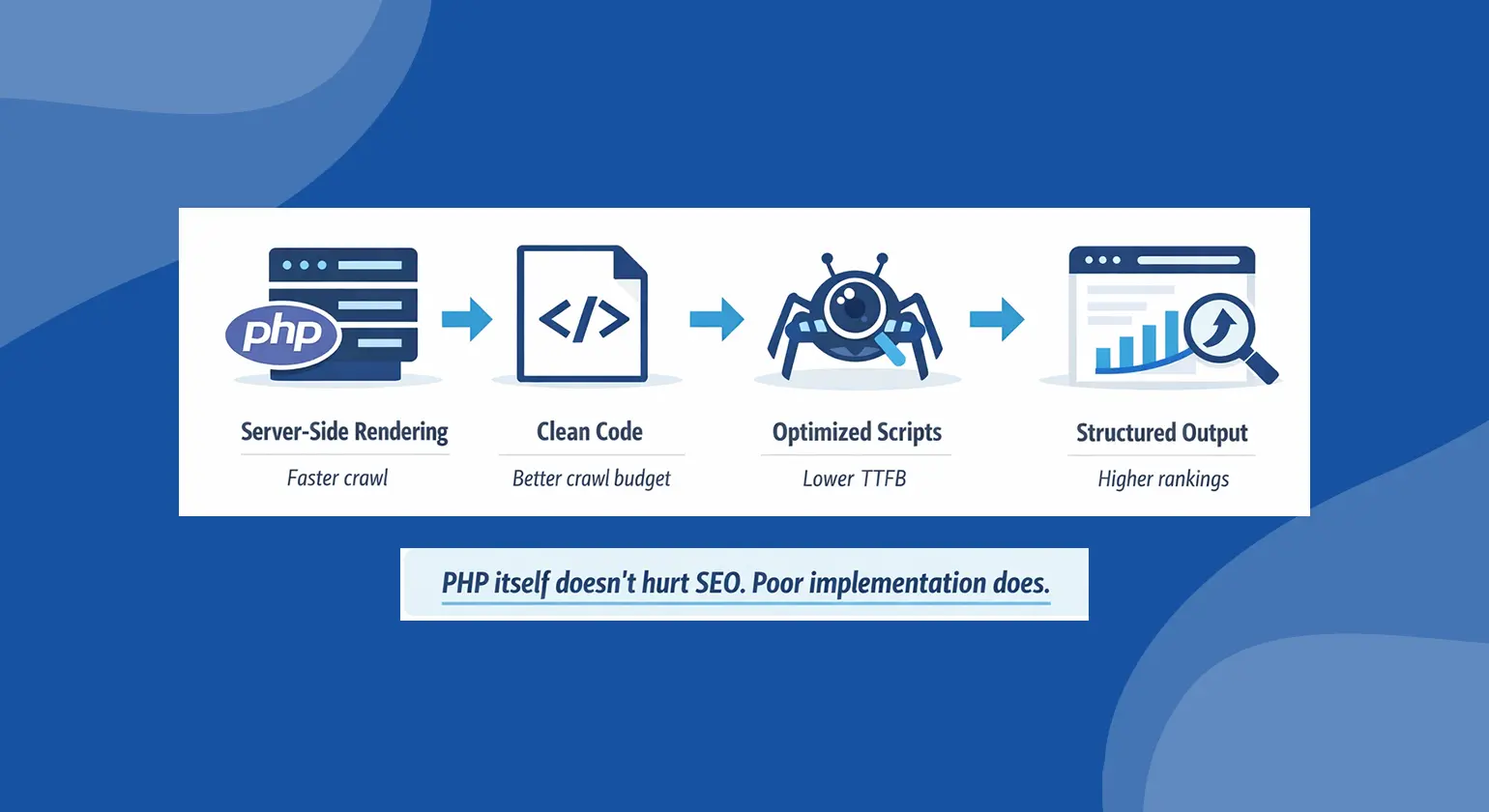
PHP is the backbone of the web, powering everything from small blogs to massive e-commerce engines. As a server-side language, it processes data before it reaches the visitor’s screen. This is a massive win for php and Seo because it allows us to serve “pre-rendered” content that Googlebot can scan instantly.
How search engines crawl and index PHP pages
Search engines use “spiders” to crawl your site. When a spider hits a PHP page, the server executes the code and hands over a plain HTML file. This means the seo in php website process is naturally efficient because the crawler doesn’t have to wait for complex JavaScript to load.
php and seo: common myths vs reality
A common myth is that search engines struggle with dynamic pages. Years ago, query strings (like ?id=10) were hard to index. Today, the search engine algorithm php is highly advanced. Google can crawl dynamic pages perfectly fine, provided you aren’t creating “spider traps”—infinite loops of links that waste crawl resources.
Does search engine algorithm php treat dynamic pages differently?
Technically, no. Google treats a PHP-generated page the same as a static HTML file once it receives the code. However, if your dynamic logic is slow, it affects your Seo php score. The algorithm prioritizes stability and speed, so if your server takes too long to “build” the page, your rankings may drop.
Why some PHP websites struggle to rank
Many sites fail because of “Technical Debt”—messy code that creates slow load times or duplicate content. If your database is unoptimized, your seo for php website results will suffer. By cleaning up your backend, you create a foundation that search engines love to reward.
Is PHP bad for SEO?
Absolutely not. In fact, most of the internet uses it. The language is a tool; the search engine optimization php results depend on how you use that tool. When managed correctly, PHP offers more flexibility for SEO than almost any other language.
Technical SEO Foundations for a PHP Website
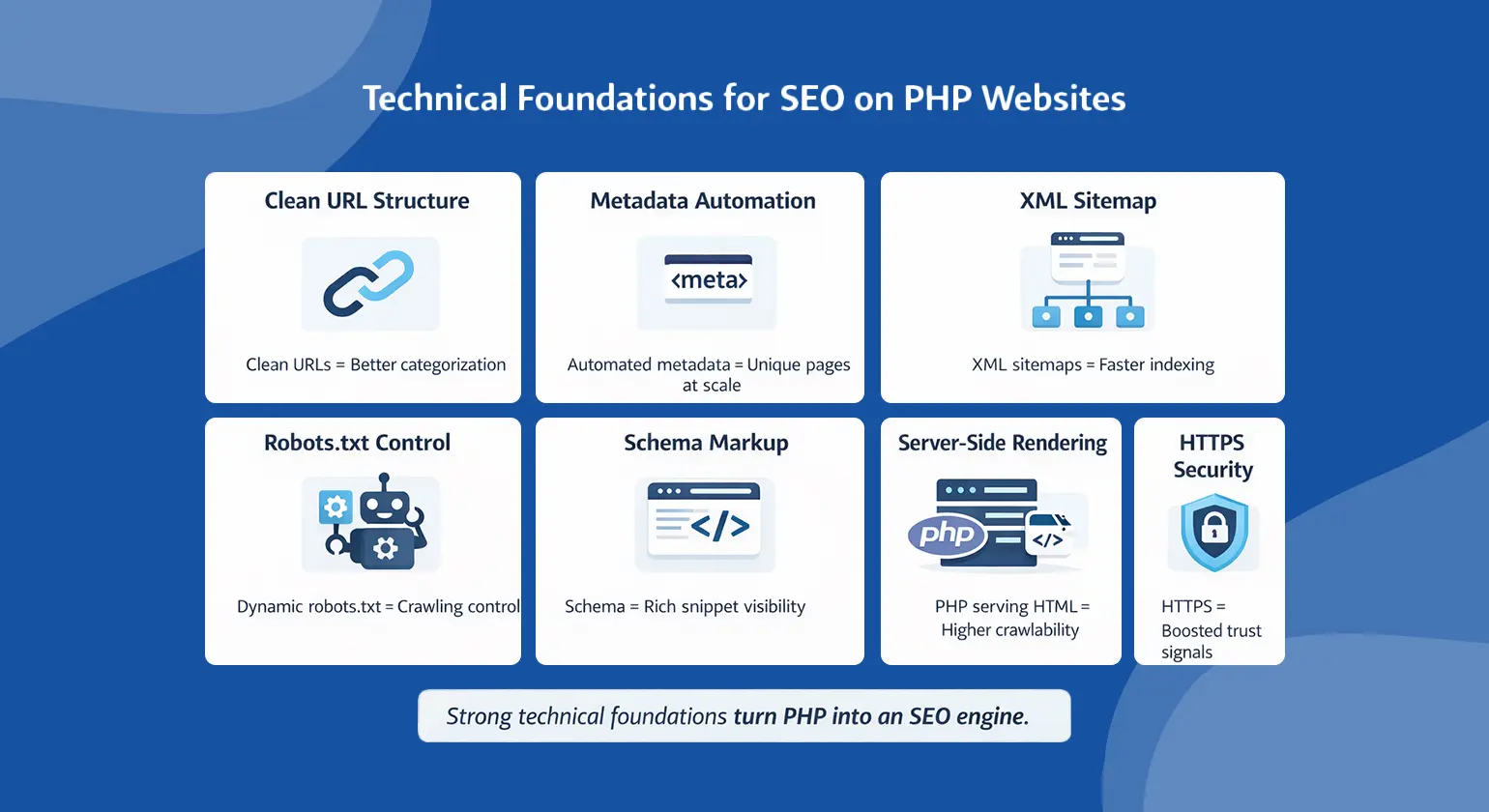
To win at seo php, you need to turn complex data into a simple, readable structure. This starts with how your URLs look and how your metadata is handled.
Dynamic URL handling and clean URL structure
Users and search engines prefer “pretty” URLs. Instead of a messy string of numbers, your PHP should be configured (often via .htaccess) to show /seo-for-php-website/. This is much easier for the search engine algorithm php to categorize. If your current site structure feels clunky, our ui ux design services can help align your interface with modern standards.
Metadata automation using PHP (titles, descriptions, canonicals)
One of the best things about php seo is automation. You don’t have to manually write meta tags for 1,000 products. You can write a script that pulls the product name directly into your title tags. This ensures every page is unique, which is a core pillar of search engine optimization php.
Server-side rendering and crawlability
Because PHP is rendered on the server, it is “SEO-ready” out of the box. This ensures high crawlability. If you find yourself overwhelmed by these technicalities, a virtual administrative assistant can handle the operational side of site maintenance while you focus on growth.
XML sitemap generation with PHP
Your site needs a roadmap. You can use PHP to dynamically generate an XML sitemap that updates every time you add a new page. This tells Google exactly where to go. For busy founders, this level of php seo automation is a lifesaver.
Robots.txt and indexation control
You can use PHP to dynamically manage your robots.txt file. This allows you to hide certain parts of your site from search engines during development, ensuring only your best content is indexed.
Schema markup implementation
Use JSON-LD schema to give search engines more context about your business. By injecting schema directly into your PHP templates, you increase your chances of winning “rich snippets” in search results.
HTTPS and security essentials
Security is a major ranking factor. Ensure your SSL certificate is properly configured. A secure seo for php website builds trust with both Google and your customers.
Performance Optimization: Core Web Vitals & Crawl Budget for PHP SEO
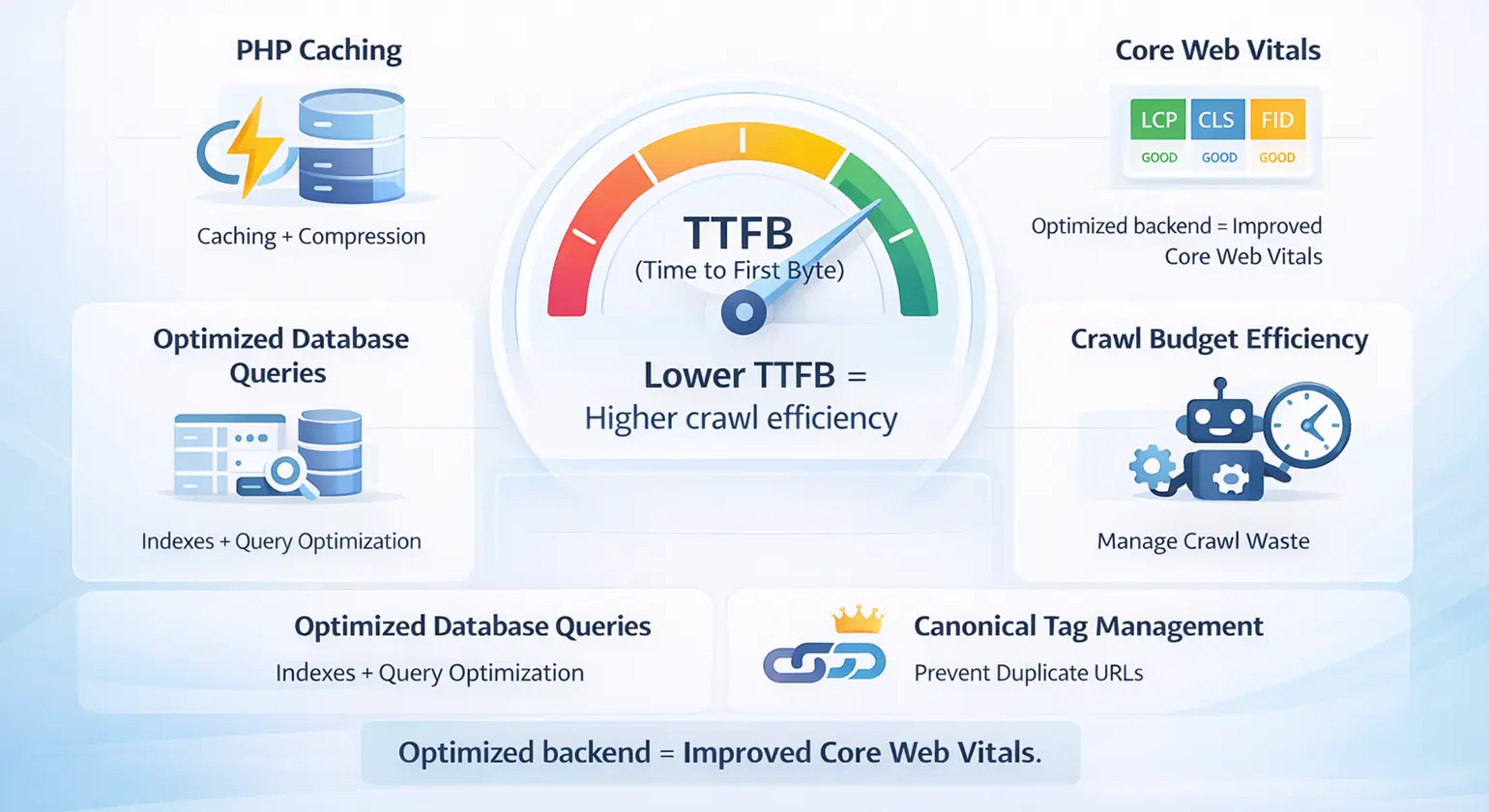
Google’s “Core Web Vitals” are the benchmarks for a healthy site. For a seo for php website, the most important metric is often Time to First Byte (TTFB).
Reducing server response time (TTFB)
This is the time it takes for your server to start sending data. If your PHP code has to do too much work before sending the page, your TTFB will be high. Reducing this is critical for your seo for php website strategy.
PHP caching strategies
Caching is like keeping a “snapshot” of your page ready so the server doesn’t have to rebuild it every time someone clicks. This significantly boosts your seo for php website speed.
Optimizing database queries
Every time a page loads, PHP talks to your database. If those queries are slow, your page is slow. Optimizing these calls is a huge part of seo in php website management. If this sounds too technical, our website development services can audit your code for you.
Managing duplicate parameters and crawl waste
If you have multiple URLs for the same content (like sorting filters), you waste your “crawl budget.” Use canonical tags in your PHP header to tell Google which version is the “master” copy.
Improving internal linking structure
PHP can be used to create dynamic “related post” sections, which improves internal linking. This helps search engines discover your content faster and improves your seo for php website rankings.
Fixing common performance bottlenecks
Other times, the problem is not with the PHP version itself but with how it interacts with your server. Tools such as Google Lighthouse can help you identify where the problem is.
SEO for PHP Website: Step-by-Step Implementation Checklist
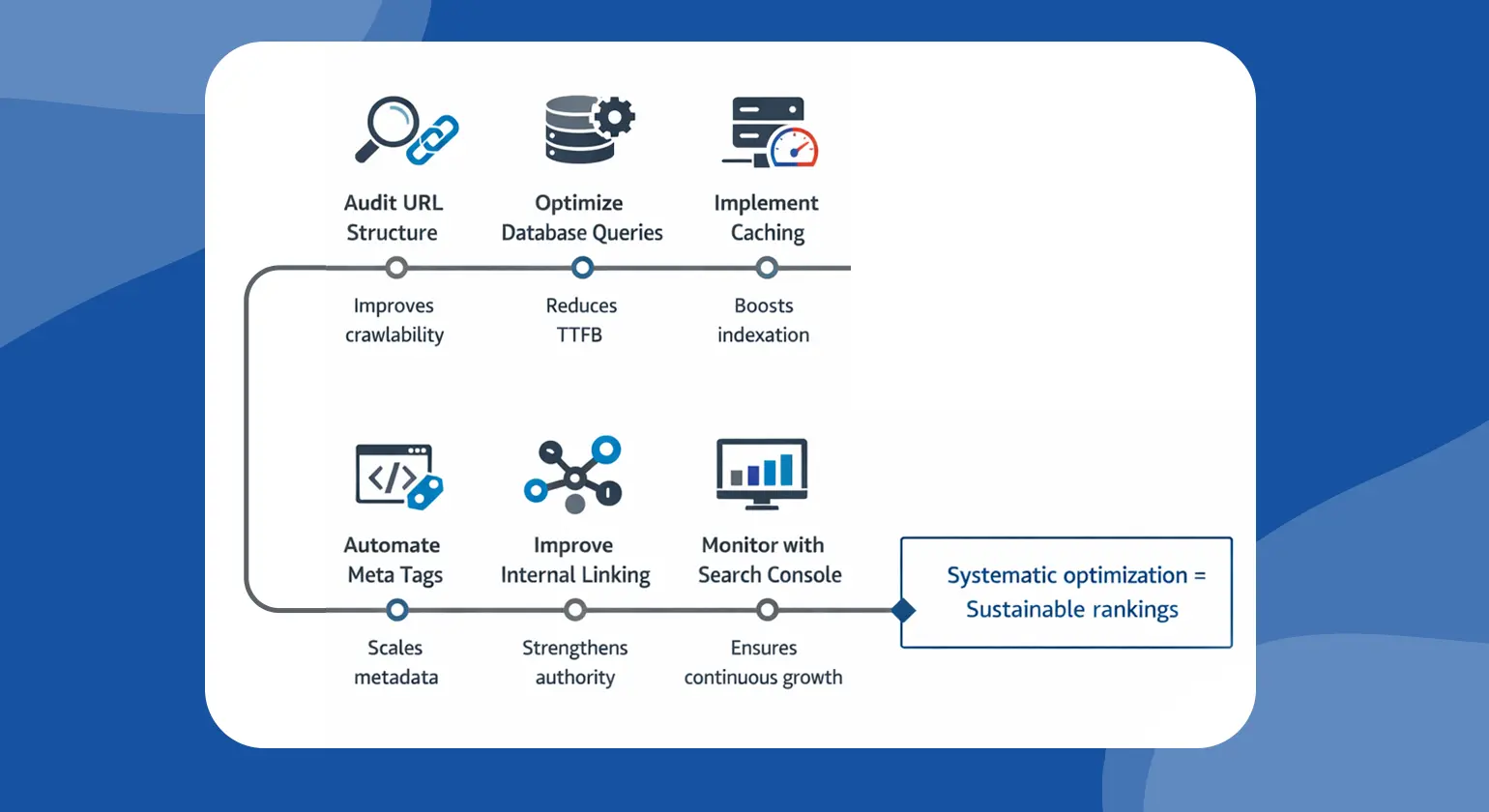
Scaling a seo for php website requires a systematic approach. Here is the framework we use to help our clients dominate the SERPs:
On-page search engine optimization php checklist
- Clean Slugs: Ensure all URLs are readable.
- Header Tags: Use PHP to ensure H1 tags are dynamically populated.
- Alt Text: Automate image alt tags using file names if necessary.
Technical SEO audit framework for PHP sites
You should check for 404 errors, broken redirects, and slow-loading scripts. Regular audits will ensure that your seo for php website is in good health as you grow.
Code-level fixes with sample PHP snippets
PHP
// Example: Dynamic Meta Title
<title><?php echo $product_name; ?> – Buy Online in the US</title>
This ensures your seo for php website stays consistent. If you need help filling these tags with copy, our content creation services can provide high-quality, optimized text.
Common php seo mistakes to avoid
The biggest mistake is ignoring the Core Web Vitals report. Many developers focus on features and forget about speed. Another mistake is hard-coding titles instead of using the power of PHP automation.
How to test and monitor improvements
Use Google Search Central to track your progress. Monitor your “Core Web Vitals” and “Indexation” reports weekly to ensure your seo for php website is trending upward.
Advanced Technical SEO Fixes and Outsourcing
When we talk about seo for php website success, we eventually have to address the “When to outsource” question. Most business owners shouldn’t be digging into PHP files. It’s a specialized skill.
Hiring a digital marketing virtual assistant allows you to focus on sales while we handle the technical implementation. Whether you need a virtual executive assistant to manage your schedule or a team to overhaul your seo for php website, Ossisto has you covered.
Key Takeaways
seo for php website performance is one of the best investments you can make for your future success. It is not only about pleasing Google; it is about providing your customers with a fast, stable, and secure experience. When your backend is optimized, your marketing campaigns work much better. Take the first step towards improved rankings and run a Lighthouse audit today to see how your website performs. Your path to the top of the SERPs begins with a single line of clean and optimized code.
Explore further >>> Best Link Management Tools for Smarter Marketing in 2026
>>>> A Complete Guide on Dynamic Content Marketing
FAQs
1. Can PHP websites be SEO friendly and how?
Yes, PHP websites can be extremely SEO friendly. Since PHP is a server-side language, search engines get the fully structured HTML page right away. To make PHP SEO friendly:
- Use clean URLs that are descriptive.
- Optimize server speed and database efficiency.
- Automate meta title and description generation.
- Create XML sitemaps and manage crawl paths.
When implemented correctly, PHP becomes a powerful foundation for higher rankings and improved visibility.
2. How to optimize PHP code for better SEO performance?
To optimize PHP for SEO:
- Reduce server response time by minimizing loops and repetitive queries.
- Use caching to display pages quickly.
- Optimize database queries using indexing and efficient retrieval.
- Compress HTML output to reduce page load time.
Faster execution lowers Time to First Byte (TTFB), improves crawl efficiency, and boosts rankings in search engines.
3. What are the best SEO practices for PHP-based websites?
Key SEO practices for PHP websites include:
- Clean URLs for better indexing and user experience.
- Using automated metadata (title tags and descriptions) for individual pages at scale.
- XML sitemap generation to guide search engines.
- Schema markup for rich snippet visibility.
- Using HTTPS security for trust and ranking building.
- Optimizing internal linking and Core Web Vitals for speed and engagement.
Following these steps ensures search engines can efficiently crawl, index, and rank your PHP pages.
4. How to make PHP dynamic URLs SEO friendly?
To make PHP dynamic URLs SEO friendly, follow these steps:
- Use URL rewriting with .htaccess or routing to reduce parameter-heavy URLs.
- Use clean slugs instead of messy strings like ?id=25, which should be keyword-rich.
- Use canonical tags to specify the preferred page version and prevent duplicate content.
- Make sure the URLs are readable, descriptive, and consistent throughout the website.
By doing this, you can increase click-through rates, indexing, and search engine visibility.
5. How to improve page speed and SEO for PHP websites?
To optimize page speed and SEO, you should:
- Use server-side caching for faster page loading.
- Optimize database queries for faster loading.
- Compress CSS, JS, and HTML files.
- Optimize PHP script execution and minimize code repetition.
Reducing TTFB and faster page loading result in better Core Web Vitals, improved user experience, and an indication to search engines that your PHP website is deserving of better rankings.